Civil Rights
Movements, leaders, victories and the continuing fight for equality.

Explore the people, places, events, achievements, struggles and stories that shaped our journey.
Movements, leaders, victories and the continuing fight for equality.
Innovation, patents, science, technology and world-changing contributions.
Pioneers, champions, Negro Leagues, records, activism and excellence.
Meet the people whose lives, choices and achievements shaped the journey.
Black towns, communities, institutions and places where history happened.
Moments that changed communities, movements, institutions and the nation.
Mansa Musa was the ruler of the Mali Empire in West Africa. Details recorded here should be sourced; unknown information is left blank.
MORE →Reflects the personal views, recollections, and perspective of the author, Mike Davis.
This is a personal recollection on the Move fire on May 13, 1985
In statistics, Mallows's ,[1][2] named for Colin Lingwood Mallows, is used to assess the fit of a regression model that has been estimated using ordinary least squares. It is applied in the context of model selection, where a number of predictor variables are available for predicting some outcome, and the goal is to find the best model involving a subset of these predictors. A small value of means that the model is relatively precise.
Mallows's is 'essentially equivalent'[3] to the Akaike information criterion in the case of linear regression. This equivalence is only asymptotic; Akaike[4] notes that requires some subjective judgment in the choice of the variance estimate associated with each response in the linear model (typically denoted as ).
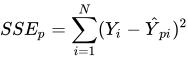
Mallows's addresses the issue of overfitting, in which model selection statistics such as the residual sum of squares always get smaller as more variables are added to a model. Thus, if we aim to select the model giving the smallest residual sum of squares, the model including all variables would always be selected. Instead, the statistic calculated on a sample of data estimates the sum squared prediction error (SSPE) as its population target
where is the fitted value from the regression model for the ith case, E(Yi | Xi) is the expected value for the ith case, and is the error variance (assumed constant across the cases). The mean squared prediction error (MSPE) will not automatically get smaller as more variables are added. The optimum model under this criterion is a compromise influenced by the sample size, the effect sizes of the different predictors, and the degree of collinearity between them.
If p regressors are selected from a set of k regressors, with k > p, the statistic for that particular set of regressors is defined as:
where
Given a linear model such as:
where:
An alternate version of can also be defined as:[5]
where
Note that this version of the does not give equivalent values to the earlier version, but the model with the smallest from this definition will also be the same model with the smallest from the earlier definition.
The criterion suffers from two main limitations[6]
The statistic is often used as a stopping rule for various forms of stepwise regression. Mallows proposed the statistic as a criterion for selecting among many alternative subset regressions. Under a model not suffering from appreciable lack of fit (bias), has expectation nearly equal to p; otherwise the expectation is roughly P plus a positive bias term. Nevertheless, even though it has expectation greater than or equal to p, there is nothing to prevent Cp < p or even in extreme cases. It is suggested that one should choose a subset that has approaching p,[7] from above, for a list of subsets ordered by increasing p. In practice, the positive bias can be adjusted for by selecting a model from the ordered list of subsets, such that .
Since the sample-based statistic is an estimate of the MSPE, using for model selection does not completely guard against overfitting. For instance, it is possible that the selected model will be one in which the sample was a particularly severe underestimate of the MSPE.
Model selection statistics such as are generally not used blindly, but rather information about the field of application, the intended use of the model, and any known biases in the data are taken into account in the process of model selection.
{{cite journal}}: CS1 maint: periodical has ISBN (link)
Source: Wikipedia. Article content is retrieved live through the MediaWiki API.
In statistics, Mallows's C p {\textstyle {\boldsymbol {C_{p}}}} , named for Colin Lingwood Mallows, is used to assess the fit of a regression model that has been estimated using ordinary least squares. It is applied in the context of model selection, where a number of predictor variables are available for predicting some outcome, and the goal is to find the best model involving a subset of these predictors. A small value of C p {\textstyle C_{p}} means that the model is relatively precise. Mallows's C p {\displaystyle C_{p}} is 'essentially equivalent' to the Akaike information criterion in the case of linear regression. This equivalence is only asymptotic; Akaike notes that C p {\displaystyle C_{p}} requires some subjective judgment in the choice of the variance estimate associated with each response in the linear model (typically denoted as σ ^ 2 {\displaystyle {\hat {\sigma }}^{2}} ).
Colin Lingwood Mallows (10 September 1930 – 4 November 2023) was an English statistician who worked in the United States from 1960. He was known for Mallows's Cp, a regression model diagnostic procedure, widely used in regression analysis and the Fowlkes–Mallows index, a popular clustering validation criterion.

Biodiesel is a renewable biofuel, a form of diesel fuel, derived from biological sources like vegetable oils, animal fats, or recycled greases, and consisting of long-chain fatty acid esters. It is typically made from fats. The roots of biodiesel as a fuel source can be traced back to when J. Patrick and E. Duffy first conducted transesterification of vegetable oil in 1853, predating Rudolf Diesel's development of the diesel engine. Diesel's engine, initially designed for mineral oil, successfully ran on peanut oil at the 1900 Paris Exposition. This landmark event highlighted the potential of vegetable oils as an alternative fuel source. The interest in using vegetable oils as fuels resurfaced periodically, particularly during resource-constrained periods such as World War II. However, challenges such as high viscosity and resultant engine deposits were significant hurdles. The modern form of biodiesel emerged in the 1930s, when a method was found for transforming vegetable oils for fuel use, laying the groundwork for contemporary biodiesel production. The physical and chemical properties of biodiesel vary depending on its source and production method. The trade association National Biodiesel Board defines "biodiesel" as a mono-alkyl ester. It has been experimented with in railway locomotives and power generators. Generally characterized by a higher boiling point and flash point than petrodiesel, biodiesel is slightly miscible with water and has distinct lubricating properties. Its calorific value is approximately 9% lower than that of standard diesel, impacting fuel efficiency. Biodiesel production has evolved significantly, with early methods including the direct use of vegetable oils, to more advanced processes like transesterification, which reduces viscosity and improves combustion properties. Notably, biodiesel production generates glycerol as a by-product, which has its own commercial applications. Biodiesel's primary application is in transport. There have been efforts to make it a drop-in biofuel, meaning compatible with existing diesel engines and distribution infrastructure. However, it is usually blended with petrodiesel, typically to less than 10%, since most engines cannot run on pure biodiesel without modification. The blend percentage of biodiesel is indicated by a "B" factor. B100 represents pure biodiesel, while blends like B20 contain 20% of biodiesel, with the remainder being traditional petrodiesel. These blends offer a compromise between the environmental benefits of biodiesel and performance characteristics of standard diesel fuel. Biodiesel blends can be used as heating oil. The environmental impact of biodiesel is complex and varies based on factors like feedstock type, land use changes, and production methods. While it can potentially reduce greenhouse gas emissions compared to fossil fuels, concerns about biodiesel include land use changes, deforestation, and the food vs. fuel debate. The debate centers on the impact of biodiesel production on food prices and availability, as well as its overall carbon footprint. Despite these challenges, biodiesel remains a key component in the global strategy to reduce reliance on fossil fuels and mitigate the impacts of climate change.

The 2025 Ballon d'Or (lit. '2025 Golden Ball') was the 69th annual ceremony of the Ballon d'Or, presented by France Football, recognising the best footballers in the world in the 2024–25 season. For the fourth time in the history of the award, it was awarded based on the results of the season instead of the calendar year. This was the period from 1 August 2024 to 13 July 2025 (final of the 2025 FIFA Club World Cup) for the men's award, and to 2 August 2025 (final of the 2025 Copa América Femenina) for the women's award. The ceremony took place on 22 September 2025, with the nominees having been announced on 7 August 2025.
Before the 1921 destruction of Tulsa’s Greenwood District, Black residents had created a remarkable center of business and community life. The district included stores, professional offices, entertainment venues and homes owned by Black citizens. Understanding Greenwood means learning what was built—not only what was burned.
MORE →Shirley Chisholm, elected in 1968.