Civil Rights
Movements, leaders, victories and the continuing fight for equality.

Explore the people, places, events, achievements, struggles and stories that shaped our journey.
Movements, leaders, victories and the continuing fight for equality.
Innovation, patents, science, technology and world-changing contributions.
Pioneers, champions, Negro Leagues, records, activism and excellence.
Meet the people whose lives, choices and achievements shaped the journey.
Black towns, communities, institutions and places where history happened.
Moments that changed communities, movements, institutions and the nation.
Katherine Johnson’s mathematical calculations helped guide some of America’s most important early space missions while she confronted the racial and gender barriers faced by Black women in twentieth-century America.
MORE →Reflects the personal views, recollections, and perspective of the author, Mike Davis.
This is a personal recollection on the Move fire on May 13, 1985
| Part of a series on |
| Finance |
|---|
 |
Mathematical finance, also known as quantitative finance and financial mathematics, is a field of applied mathematics, concerned with mathematical modeling in the financial field.
In general, there exist two separate branches of finance that require advanced quantitative techniques: derivatives pricing on the one hand, and risk and portfolio management on the other.[1] Mathematical finance overlaps heavily with the fields of computational finance and financial engineering. The latter focuses on applications and modeling, often with the help of stochastic asset models, while the former focuses, in addition to analysis, on building tools of implementation for the models. Also related is quantitative investing, which relies on statistical and numerical models (and lately machine learning) as opposed to traditional fundamental analysis when managing portfolios.
French mathematician Louis Bachelier's doctoral thesis, defended in 1900, is considered the first scholarly work on mathematical finance. But mathematical finance emerged as a discipline in the 1970s, following the work of Fischer Black, Myron Scholes and Robert Merton on option pricing theory. Mathematical investing originated from the research of mathematician Edward Thorp who used statistical methods to first invent card counting in blackjack and then applied its principles to modern systematic investing.[2]
The subject has a close relationship with the discipline of financial economics, which is concerned with much of the underlying theory that is involved in financial mathematics. While trained economists use complex economic models that are built on observed empirical relationships, in contrast, mathematical finance analysis will derive and extend the mathematical or numerical models without necessarily establishing a link to financial theory, taking observed market prices as input. See: Valuation of options; Financial modeling; Asset pricing. The fundamental theorem of arbitrage-free pricing is one of the key theorems in mathematical finance, while the Black–Scholes equation and formula are amongst the key results.[3]
Today many universities offer degree and research programs in mathematical finance.
There are two separate branches of finance that require advanced quantitative techniques: derivatives pricing, and risk and portfolio management. One of the main differences is that they use different probabilities such as the risk-neutral probability (or arbitrage-pricing probability), denoted by "Q", and the actual (or actuarial) probability, denoted by "P".
| Goal | "extrapolate the present" |
| Environment | risk-neutral probability |
| Processes | continuous-time martingales |
| Dimension | low |
| Tools | Itō calculus, PDEs |
| Challenges | calibration |
| Business | sell-side |
The goal of derivatives pricing is to determine the fair price of a given security in terms of more liquid securities whose price is determined by the law of supply and demand. The meaning of "fair" depends, of course, on whether one considers buying or selling the security. Examples of securities being priced are plain vanilla and exotic options, convertible bonds, etc.
Once a fair price has been determined, the sell-side trader can make a market on the security. Therefore, derivatives pricing is a complex "extrapolation" exercise to define the current market value of a security, which is then used by the sell-side community. Quantitative derivatives pricing was initiated by Louis Bachelier in The Theory of Speculation ("Théorie de la spéculation", published 1900), with the introduction of the most basic and most influential of processes, Brownian motion, and its applications to the pricing of options.[4][5] Brownian motion is derived using the Langevin equation and the discrete random walk.[6] Bachelier modeled the time series of changes in the logarithm of stock prices as a random walk in which the short-term changes had a finite variance. This causes longer-term changes to follow a Gaussian distribution.[7]
The theory remained dormant until Fischer Black and Myron Scholes, along with fundamental contributions by Robert C. Merton, applied the second most influential process, the geometric Brownian motion, to option pricing. For this M. Scholes and R. Merton were awarded the 1997 Nobel Memorial Prize in Economic Sciences. Black was ineligible for the prize because he died in 1995.[8]
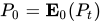
The next important step was the fundamental theorem of asset pricing by Harrison and Pliska (1981), according to which the suitably normalized current price P0 of security is arbitrage-free, and thus truly fair only if there exists a stochastic process Pt with constant expected value which describes its future evolution:[9]
| 1 |
A process satisfying (1) is called a "martingale". A martingale does not reward risk. Thus the probability of the normalized security price process is called "risk-neutral" and is typically denoted by the blackboard font letter "".
The relationship (1) must hold for all times t: therefore the processes used for derivatives pricing are naturally set in continuous time.
Quantitative analysts (quants) in the "Q-world" focus on the pricing of derivative products. Their role requires a detailed understanding of the mathematical models used for specific financial instruments.
Securities are priced individually, and thus the problems in the Q world are low-dimensional in nature. Calibration is one of the main challenges of the Q world: once a continuous-time parametric process has been calibrated to a set of traded securities through a relationship such as (1), a similar relationship is used to define the price of new derivatives.
The main quantitative tools necessary to handle continuous-time Q-processes are Itô's stochastic calculus, simulation and partial differential equations (PDEs).[10]
| Goal | "model the future" |
| Environment | real-world probability |
| Processes | discrete-time series |
| Dimension | large |
| Tools | multivariate statistics |
| Challenges | estimation |
| Business | buy-side |
Risk and portfolio management aims to model the statistically derived probability distribution of the market prices of all the securities at a given future investment horizon. This "real" probability distribution of the market prices is typically denoted by the blackboard font letter "", as opposed to the "risk-neutral" probability "" used in derivatives pricing. Based on the P distribution, the buy-side community takes decisions on which securities to purchase in order to improve the prospective profit-and-loss profile of their positions considered as a portfolio. Increasingly, elements of this process are automated; see Outline of finance § Quantitative investing for a listing of relevant articles.
For their pioneering work, Markowitz and Sharpe, along with Merton Miller, shared the 1990 Nobel Memorial Prize in Economic Sciences, for the first time ever awarded for a work in finance.
The portfolio-selection work of Markowitz and Sharpe introduced mathematics to investment management. With time, the mathematics has become more sophisticated. Thanks to Robert Merton and Paul Samuelson, one-period models were replaced by continuous time, Brownian-motion models, and the quadratic utility function implicit in mean–variance optimization was replaced by more general increasing, concave utility functions.[11] Furthermore, in recent years the focus shifted toward estimation risk, i.e., the dangers of incorrectly assuming that advanced time series analysis alone can provide completely accurate estimates of the market parameters.[12] See Financial risk management § Investment management.
Much effort has gone into the study of financial markets and how prices vary with time. Charles Dow, one of the founders of Dow Jones & Company and The Wall Street Journal, enunciated a set of ideas on the subject which are now called Dow Theory. This is the basis of the so-called technical analysis method of attempting to predict future changes. One of the tenets of "technical analysis" is that market trends give an indication of the future, at least in the short term. A 2007 review of 95 modern studies found 56 positive, 20 negative, and 19 mixed results for technical trading strategies, while noting recurring methodological problems that limited conclusive findings.[13]
Over the years, increasingly sophisticated mathematical models and derivative pricing strategies have been developed, but their credibility was damaged by the 2008 financial crisis.
Contemporary practice of mathematical finance has been subjected to criticism from figures within the field notably by Paul Wilmott, and by Nassim Nicholas Taleb, in his book The Black Swan.[14] Taleb claims that the prices of financial assets cannot be characterized by the simple models currently in use, rendering much of current practice at best irrelevant, and, at worst, dangerously misleading. Wilmott and Emanuel Derman published the Financial Modelers' Manifesto in January 2009[15] which addresses some of the most serious concerns. Bodies such as the Institute for New Economic Thinking are now attempting to develop new theories and methods.[16]
In general, modeling the changes by distributions with finite variance is, increasingly, said to be inappropriate.[17] In the 1960s it was discovered by Benoit Mandelbrot that changes in prices do not follow a Gaussian distribution, but are rather modeled better by Lévy alpha-stable distributions.[18] The scale of change, or volatility, depends on the length of the time interval to a power a bit more than 1/2. Large changes up or down are more likely than what one would calculate using a Gaussian distribution with an estimated standard deviation. But the problem is that it does not solve the problem as it makes parametrization much harder and risk control less reliable.[14]
Perhaps more fundamental: though mathematical finance models may generate a profit in the short-run, this type of modeling is often in conflict with a central tenet of modern macroeconomics, the Lucas critique - or rational expectations - which states that observed relationships may not be structural in nature and thus may not be possible to exploit for public policy or for profit unless we have identified relationships using causal analysis and econometrics.[19] Mathematical finance models do not, therefore, incorporate complex elements of human psychology that are critical to modeling modern macroeconomic movements such as the self-fulfilling panic that motivates bank runs.
{{cite book}}: CS1 maint: multiple names: authors list (link)
{{cite book}}: CS1 maint: multiple names: authors list (link)
| International | |
|---|---|
| National | |
| Other | |
Source: Wikipedia. Article content is retrieved live through the MediaWiki API.
Mathematical finance, also known as quantitative finance and financial mathematics, is a field of applied mathematics, concerned with mathematical modeling in the financial field. In general, there exist two separate branches of finance that require advanced quantitative techniques: derivatives pricing on the one hand, and risk and portfolio management on the other. Mathematical finance overlaps heavily with the fields of computational finance and financial engineering. The latter focuses on applications and modeling, often with the help of stochastic asset models, while the former focuses, in addition to analysis, on building tools of implementation for the models. Also related is quantitative investing, which relies on statistical and numerical models (and lately machine learning) as opposed to traditional fundamental analysis when managing portfolios. French mathematician Louis Bachelier's doctoral thesis, defended in 1900, is considered the first scholarly work on mathematical finance. But mathematical finance emerged as a discipline in the 1970s, following the work of Fischer Black, Myron Scholes and Robert Merton on option pricing theory. Mathematical investing originated from the research of mathematician Edward Thorp who used statistical methods to first invent card counting in blackjack and then applied its principles to modern systematic investing. The subject has a close relationship with the discipline of financial economics, which is concerned with much of the underlying theory that is involved in financial mathematics. While trained economists use complex economic models that are built on observed empirical relationships, in contrast, mathematical finance analysis will derive and extend the mathematical or numerical models without necessarily establishing a link to financial theory, taking observed market prices as input. See: Valuation of options; Financial modeling; Asset pricing. The fundamental theorem of arbitrage-free pricing is one of the key theorems in mathematical finance, while the Black–Scholes equation and formula are amongst the key results. Today many universities offer degree and research programs in mathematical finance.

Mathematical induction is a method for proving that a statement P ( n ) {\displaystyle P(n)} is true for every natural number n {\displaystyle n} , that is, that the infinitely many cases P ( 0 ) , P ( 1 ) , P ( 2 ) , P ( 3 ) , … {\displaystyle P(0),P(1),P(2),P(3),\dots } all hold. This is done by first proving a simple case, then also showing that if we assume the claim is true for a given case, then the next case is also true. Informal metaphors help to explain this technique, such as falling dominoes or climbing a ladder: Mathematical induction proves that we can climb as high as we like on a ladder, by proving that we can climb onto the bottom rung (the basis) and that from each rung we can climb up to the next one (the step). A proof by induction consists of two cases. The first, the base case, proves the statement for n = 0 {\displaystyle n=0} without assuming any knowledge of other cases. The second case, the induction step, proves that if the statement holds for any given case n = k {\displaystyle n=k} , then it must also hold for the next case n = k + 1 {\displaystyle n=k+1} . These two steps establish that the statement holds for every natural number n {\displaystyle n} . The base case does not necessarily begin with n = 0 {\displaystyle n=0} , but often with n = 1 {\displaystyle n=1} , and possibly with any fixed natural number n = N {\displaystyle n=N} , establishing the truth of the statement for all natural numbers n ≥ N {\displaystyle n\geq N} . The method can be extended to prove statements about more general well-founded structures, such as trees; this generalization, known as structural induction, is used in mathematical logic and computer science. Mathematical induction in this extended sense is closely related to recursion. Mathematical induction is an inference rule used in formal proofs, and is the foundation of most correctness proofs for computer programs. Despite its name, mathematical induction differs fundamentally from inductive reasoning as used in philosophy, in which the examination of many cases results in a probable conclusion. The mathematical method examines infinitely many cases to prove a general statement, but it does so by a finite chain of deductive reasoning involving the variable n {\displaystyle n} , which can take infinitely many values. The result is a rigorous proof of the statement, not an assertion of its probability.

Mathematical analysis is the branch of mathematics that studies functions, spaces, and operators through methods of approximation and convergence. It grew out of calculus, especially the use of derivatives and integrals to study variable quantities, and in the 19th century its foundations were reformulated with greater rigor. Basic objects of study in mathematical analysis include the real numbers, functions, sequences, series, and limits. Analysis is closely connected with applications in the sciences, providing methods for formulating and analyzing mathematical models, constructing approximations, and estimating their errors. Typical analytical questions concern how functions, sequences, and operators behave under limiting processes and perturbations: convergence and continuity, regularity and stability, quantitative bounds, and the accuracy of approximations. Modern analysis studies these questions in many settings, including Euclidean spaces, metric spaces, topological spaces, measure spaces, and function spaces. Its major areas include complex analysis, functional analysis, measure theory, harmonic analysis, and the theory of ordinary and partial differential equations.

Mathematical optimization (alternatively spelled optimisation) or mathematical programming is the selection of a best element, with regard to some criteria, from some set of available alternatives. It is generally divided into two subfields: discrete optimization and continuous optimization. Optimization problems arise in all quantitative disciplines from computer science and engineering to operations research and economics, and the development of solution methods has been of interest in mathematics for centuries. In the more general approach, an optimization problem consists of maximizing or minimizing a real function by systematically choosing input values from within an allowed set and computing the value of the function. The generalization of optimization theory and techniques to other formulations constitutes a large area of applied mathematics.
Before the 1921 destruction of Tulsa’s Greenwood District, Black residents had created a remarkable center of business and community life. The district included stores, professional offices, entertainment venues and homes owned by Black citizens. Understanding Greenwood means learning what was built—not only what was burned.
MORE →The Greenwood District.