Explore the people, places, events, achievements, struggles and stories that shaped our journey.
✊🏾
Civil Rights
Movements, leaders, victories and the continuing fight for equality.
⚙️
Black Inventors
Innovation, patents, science, technology and world-changing contributions.
🏆
Sports
Pioneers, champions, Negro Leagues, records, activism and excellence.
♟️
People
Meet the people whose lives, choices and achievements shaped the journey.
📍
Places
Black towns, communities, institutions and places where history happened.
📜
Events
Moments that changed communities, movements, institutions and the nation.
Enter a person, place, event, or topic.
MY'STORY
The MOVE Fire
This is a personal recollection on the Move fire on May 13, 1985 Philadelphia police fired thousands of rounds at the MOVE house, city officials approved dropping an explosive device on the roof, the resulting fire was allowed to burn, 11 people—including five children—died, and 61 homes were destroyed. Philadelphia City Council later called it a “brutal attack carried out by the City of Philadelphia on its own citizens” and acknowledged that no individual faced criminal consequences for the bombing. One timeline correction worth preserving for the BHP record: the major previous MOVE-police confrontation was August 8, 1978, about seven years before the bombing, not a year or two earlier. Officer James Ramp was killed, other police and firefighters were wounded, nine MOVE members were later convicted, and television cameras recorded police beating Delbert Africa during his arrest. The 1985 MOVE Commission later specifically criticized city planners for failing to adequately use lessons from that 1978 confrontation. And that actually strengthens the point you’re making: 1985 did not happen without precedent or institutional memory. There had already been a deadly confrontation with MOVE, years of conflict, negotiations and police involvement before Osage Avenue.
In August 1908, a white mob attacked Springfield, Illinois’s Black community, destroying homes and businesses and lynching two Black men. National outrage over the violence helped spur the movement that created the NAACP the following year.
Reflects the personal views, recollections, and perspective of the author, Mike Davis.
The MOVE Fire
This is a personal recollection on the Move fire on May 13, 1985
Philadelphia police fired thousands of rounds at the MOVE house, city officials approved dropping an explosive device on the roof, the resulting fire was allowed to burn, 11 people—including five children—died, and 61 homes were destroyed. Philadelphia City Council later called it a “brutal attack carried out by the City of Philadelphia on its own citizens” and acknowledged that no individual faced criminal consequences for the bombing.
One timeline correction worth preserving for the BHP record: the major previous MOVE-police confrontation was August 8, 1978, about seven years before the bombing, not a year or two earlier. Officer James Ramp was killed, other police and firefighters were wounded, nine MOVE members were later convicted, and television cameras recorded police beating Delbert Africa during his arrest. The 1985 MOVE Commission later specifically criticized city planners for failing to adequately use lessons from that 1978 confrontation.
And that actually strengthens the point you’re making: 1985 did not happen without precedent or institutional memory. There had already been a deadly confrontation with MOVE, years of conflict, negotiations and police involvement before Osage Avenue.
BHP gathered finds from its connected research sources.
Showing the 4
strongest Black History matches.
Diagram summarizing relationships between matrix classes and common matrix factorizations
In the mathematical discipline of linear algebra, a matrix decomposition or matrix factorization is a factorization of a matrix into a product of matrices. There are many different matrix decompositions; each finds use among a particular class of problems.
For example, when solving a system of linear equations, the matrix A can be decomposed via the LU decomposition. The LU decomposition factorizes a matrix into a lower triangular matrixL and an upper triangular matrixU. The systems and require fewer additions and multiplications to solve, compared with the original system , though one might require significantly more digits in inexact arithmetic such as floating point.
Similarly, the QR decomposition expresses A as QR with Q an orthogonal matrix and R an upper triangular matrix. The system Q(Rx) = b is solved by Rx = QTb = c, and the system Rx = c is solved by 'back substitution'. The number of additions and multiplications required is about twice that of using the LU solver, but no more digits are required in inexact arithmetic because the QR decomposition is numerically stable.
Decompositions related to solving systems of linear equations
Existence: An LUP decomposition exists for any square matrix A. When P is an identity matrix, the LUP decomposition reduces to the LU decomposition.
Comments: The LUP and LU decompositions are useful in solving an n-by-n system of linear equations . These decompositions summarize the process of Gaussian elimination in matrix form. Matrix P represents any row interchanges carried out in the process of Gaussian elimination. If Gaussian elimination produces the row echelon form without requiring any row interchanges, then P = I, so an LU decomposition exists.
Decomposition: , where is upper triangular with real positive diagonal entries
Comment: if the matrix is Hermitian and positive semi-definite, then it has a decomposition of the form if the diagonal entries of are allowed to be zero
Uniqueness: for positive definite matrices Cholesky decomposition is unique. However, it is not unique in the positive semi-definite case.
Comment: if is real and symmetric, has all real elements
Comment: An alternative is the LDL decomposition, which can avoid extracting square roots.
Uniqueness: In general it is not unique, but if is of full rank, then there exists a single that has all positive diagonal elements. If is square, also is unique.
Comment: The QR decomposition provides an effective way to solve the system of equations . The fact that is orthogonal means that , so that is equivalent to , which is very easy to solve since is triangular.
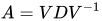
Existence: An n-by-n matrix A always has n (complex) eigenvalues, which can be ordered (in more than one way) to form an n-by-n diagonal matrix D and a corresponding matrix of nonzero columns V that satisfies the eigenvalue equation. is invertible if and only if the n eigenvectors are linearly independent (that is, each eigenvalue has geometric multiplicity equal to its algebraic multiplicity). A sufficient (but not necessary) condition for this to happen is that all the eigenvalues are different (in this case geometric and algebraic multiplicity are equal to 1)
Comment: One can always normalize the eigenvectors to have length one (see the definition of the eigenvalue equation)
Comment: Every normal matrixA (that is, matrix for which , where is a conjugate transpose) can be eigendecomposed. For a normal matrixA (and only for a normal matrix), the eigenvectors can also be made orthonormal () and the eigendecomposition reads as . In particular all unitary, Hermitian, or skew-Hermitian (in the real-valued case, all orthogonal, symmetric, or skew-symmetric, respectively) matrices are normal and therefore possess this property.
Comment: For any real symmetric matrixA, the eigendecomposition always exists and can be written as , where both D and V are real-valued.
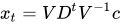
Comment: The eigendecomposition is useful for understanding the solution of a system of linear ordinary differential equations or linear difference equations. For example, the difference equation starting from the initial condition is solved by , which is equivalent to , where V and D are the matrices formed from the eigenvectors and eigenvalues of A. Since D is diagonal, raising it to power , just involves raising each element on the diagonal to the power t. This is much easier to do and understand than raising A to power t, since A is usually not diagonal.
Comment: the Jordan normal form generalizes the eigendecomposition to cases where there are repeated eigenvalues and cannot be diagonalized, the Jordan–Chevalley decomposition does this without choosing a basis.
Decomposition: This is a version of Schur decomposition where and only contain real numbers. One can always write where V is a real orthogonal matrix, is the transpose of V, and S is a block upper triangular matrix called the real Schur form. The blocks on the diagonal of S are of size 1×1 (in which case they represent real eigenvalues) or 2×2 (in which case they are derived from complex conjugate eigenvalue pairs).
Comment: in the complex QZ decomposition, the ratios of the diagonal elements of S to the corresponding diagonal elements of T, , are the generalized eigenvalues that solve the generalized eigenvalue problem (where is an unknown scalar and v is an unknown nonzero vector).
Decomposition (real version): and where A, B, Q, Z, S, and T are matrices containing real numbers only. In this case Q and Z are orthogonal matrices, the T superscript represents transposition, and S and T are block upper triangular matrices. The blocks on the diagonal of S and T are of size 1×1 or 2×2.
Comment: The diagonal elements of D are the nonnegative square roots of the eigenvalues of .
Comment: V may be complex even if A is real.
Comment: This is not a special case of the eigendecomposition (see above), which uses instead of . Moreover, if A is not real, it is not Hermitian and the form using also does not apply.
Comment: The diagonal elements of D are called the singular values of A.
Comment: Like the eigendecomposition above, the singular value decomposition involves finding basis directions along which matrix multiplication is equivalent to scalar multiplication, but it has greater generality since the matrix under consideration need not be square.
Uniqueness: the singular values of are always uniquely determined. and need not to be unique in general.
Refers to variants of existing matrix decompositions, such as the SVD, that are invariant with respect to diagonal scaling.
Applicable to: m-by-n matrix A.
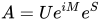
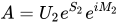
Unit-Scale-Invariant Singular-Value Decomposition: , where S is a unique nonnegative diagonal matrix of scale-invariant singular values, U and V are unitary matrices, is the conjugate transpose of V, and positive diagonal matrices D and E.
Comment: Is analogous to the SVD except that the diagonal elements of S are invariant with respect to left and/or right multiplication of A by arbitrary nonsingular diagonal matrices, as opposed to the standard SVD for which the singular values are invariant with respect to left and/or right multiplication of A by arbitrary unitary matrices.
Comment: Is an alternative to the standard SVD when invariance is required with respect to diagonal rather than unitary transformations of A.
Uniqueness: The scale-invariant singular values of (given by the diagonal elements of S) are always uniquely determined. Diagonal matrices D and E, and unitary U and V, are not necessarily unique in general.
Comment: U and V matrices are not the same as those from the SVD.
Analogous scale-invariant decompositions can be derived from other matrix decompositions; for example, to obtain scale-invariant eigenvalues.[3][4]
Uniqueness: is always unique and equal to (which is always hermitian and positive semidefinite). If is invertible, then is unique.
Comment: Since any Hermitian matrix admits a spectral decomposition with a unitary matrix, can be written as . Since is positive semidefinite, all elements in are non-negative. Since the product of two unitary matrices is unitary, taking one can write which is the singular value decomposition. Hence, the existence of the polar decomposition is equivalent to the existence of the singular value decomposition.
This section needs expansion with: examples and additional citations. You can help by adding missing information. (December 2014)
There exist analogues of the SVD, QR, LU and Cholesky factorizations for quasimatrices and cmatrices or continuous matrices.[13] A "quasimatrix" is, like a matrix, a rectangular scheme whose elements are indexed, but one discrete index is replaced by a continuous index. Likewise, a "cmatrix", is continuous in both indices. As an example of a cmatrix, one can think of the kernel of an integral operator.
^If a non-square matrix is used, however, then the matrix U will also have the same rectangular shape as the original matrix A. And so, calling the matrix U upper triangular would be incorrect as the correct term would be that U is the 'row echelon form' of A. Other than this, there are no differences in LU factorization for square and non-square matrices.
^Lay, David C. (2016). Linear algebra and its applications. Steven R. Lay, Judith McDonald (Fifth Global ed.). Harlow. p. 142. ISBN978-1-292-09223-2. OCLC920463015.{{cite book}}: CS1 maint: location missing publisher (link)
^Piziak, R.; Odell, P. L. (1 June 1999). "Full Rank Factorization of Matrices". Mathematics Magazine. 72 (3): 193. doi:10.2307/2690882. JSTOR2690882.
^Uhlmann, J.K. (2018), "A Generalized Matrix Inverse that is Consistent with Respect to Diagonal Transformations", SIAM Journal on Matrix Analysis and Applications, 239 (2): 781–800, doi:10.1137/17M113890X
^ abcBhatia, Rajendra (2013-11-15). "The bipolar decomposition". Linear Algebra and Its Applications. 439 (10): 3031–3037. doi:10.1016/j.laa.2013.09.006.
^Idel, Martin; Soto Gaona, Sebastián; Wolf, Michael M. (2017-07-15). "Perturbation bounds for Williamson's symplectic normal form". Linear Algebra and Its Applications. 525: 45–58. arXiv:1609.01338. doi:10.1016/j.laa.2017.03.013. S2CID119578994.
Choudhury, Dipa; Horn, Roger A. (April 1987). "A Complex Orthogonal-Symmetric Analog of the Polar Decomposition". SIAM Journal on Algebraic and Discrete Methods. 8 (2): 219–225. doi:10.1137/0608019.
Fredholm, I. (1903), "Sur une classe d'´equations fonctionnelles", Acta Mathematica (in French), 27: 365–390, doi:10.1007/bf02421317
Hilbert, D. (1904), "Grundzüge einer allgemeinen Theorie der linearen Integralgleichungen", Nachr. Königl. Ges. Gött (in German), 1904: 49–91
Before the 1921 destruction of Tulsa’s Greenwood District, Black residents had created a remarkable center of business and community life. The district included stores, professional offices, entertainment venues and homes owned by Black citizens. Understanding Greenwood means learning what was built—not only what was burned.
Which Supreme Court case ruled state-sponsored public-school segregation unconstitutional?
Brown v. Board of Education in 1954.
HAVE YOU CHECKED OUT...?
Who Was Shirley Chisholm?
Long before a Black president entered the White House, Shirley Chisholm was breaking national political barriers. She became the first Black woman in Congress and later sought a major party’s presidential nomination. Her campaign placed race, gender and political representation before a national audience.


![[icon]](viewer.php?source=wikipedia&q=File%3AWiki%20letter%20w%20cropped.svg&result=0#selected-result)