Civil Rights
Movements, leaders, victories and the continuing fight for equality.

Explore the people, places, events, achievements, struggles and stories that shaped our journey.
Movements, leaders, victories and the continuing fight for equality.
Innovation, patents, science, technology and world-changing contributions.
Pioneers, champions, Negro Leagues, records, activism and excellence.
Meet the people whose lives, choices and achievements shaped the journey.
Black towns, communities, institutions and places where history happened.
Moments that changed communities, movements, institutions and the nation.
Wilmington, North Carolina once had a thriving Black middle class and an elected interracial government. In 1898 white supremacists used violence to overthrow that government, kill Black residents and drive many others from the city.
MORE →Reflects the personal views, recollections, and perspective of the author, Mike Davis.
This is a personal recollection on the Move fire on May 13, 1985
| Matrix gamma | |||
|---|---|---|---|
| Notation | |||
| Parameters |
shape parameter (real) | ||
| Support | positive-definite real matrix | ||
|
| |||
In statistics, a matrix gamma distribution is a generalization of the gamma distribution to positive-definite matrices.[1] It is effectively a different parametrization of the Wishart distribution, and is used similarly, e.g. as the conjugate prior of the precision matrix of a multivariate normal distribution and matrix normal distribution. The compound distribution resulting from compounding a matrix normal with a matrix gamma prior over the precision matrix is a generalized matrix t-distribution.[1]
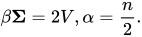
A matrix gamma distributions is identical to a Wishart distribution with
Notice that the parameters and are not identified; the density depends on these two parameters through the product .
 | This article about matrices is a stub. You can help Wikipedia by adding missing information. |
Source: Wikipedia. Article content is retrieved live through the MediaWiki API.
In statistics, a matrix gamma distribution is a generalization of the gamma distribution to positive-definite matrices. It is effectively a different parametrization of the Wishart distribution, and is used similarly, e.g. as the conjugate prior of the precision matrix of a multivariate normal distribution and matrix normal distribution. The compound distribution resulting from compounding a matrix normal with a matrix gamma prior over the precision matrix is a generalized matrix t-distribution. A matrix gamma distributions is identical to a Wishart distribution with β Σ = 2 V , α = n 2 . {\displaystyle \beta {\boldsymbol {\Sigma }}=2V,\alpha ={\frac {n}{2}}.} Notice that the parameters β {\displaystyle \beta } and Σ {\displaystyle {\boldsymbol {\Sigma }}} are not identified; the density depends on these two parameters through the product β Σ {\displaystyle \beta {\boldsymbol {\Sigma }}} .
In statistics, the inverse matrix gamma distribution is a generalization of the inverse gamma distribution to positive-definite matrices. It is a more general version of the inverse Wishart distribution, and is used similarly, e.g. as the conjugate prior of the covariance matrix of a multivariate normal distribution or matrix normal distribution. The compound distribution resulting from compounding a matrix normal with an inverse matrix gamma prior over the covariance matrix is a generalized matrix t-distribution. This reduces to the inverse Wishart distribution with ν {\displaystyle \nu } degrees of freedom when β = 2 , α = ν 2 {\displaystyle \beta =2,\alpha ={\frac {\nu }{2}}} .
In statistics, the matrix variate beta distribution is a generalization of the beta distribution. It is also called the MANOVA ensemble and the Jacobi ensemble. If U {\displaystyle U} is a p × p {\displaystyle p\times p} positive definite matrix with a matrix variate beta distribution, and a , b > ( p − 1 ) / 2 {\displaystyle a,b>(p-1)/2} are real parameters, we write U ∼ B p ( a , b ) {\displaystyle U\sim B_{p}\left(a,b\right)} (sometimes B p I ( a , b ) {\displaystyle B_{p}^{I}\left(a,b\right)} ). The probability density function for U {\displaystyle U} is: { β p ( a , b ) } − 1 det ( U ) a − ( p + 1 ) / 2 det ( I p − U ) b − ( p + 1 ) / 2 . {\displaystyle \left\{\beta _{p}\left(a,b\right)\right\}^{-1}\det \left(U\right)^{a-(p+1)/2}\det \left(I_{p}-U\right)^{b-(p+1)/2}.} Here β p ( a , b ) {\displaystyle \beta _{p}\left(a,b\right)} is the multivariate beta function: β p ( a , b ) = Γ p ( a ) Γ p ( b ) Γ p ( a + b ) {\displaystyle \beta _{p}\left(a,b\right)={\frac {\Gamma _{p}\left(a\right)\Gamma _{p}\left(b\right)}{\Gamma _{p}\left(a+b\right)}}} where Γ p ( a ) {\displaystyle \Gamma _{p}\left(a\right)} is the multivariate gamma function given by Γ p ( a ) = π p ( p − 1 ) / 4 ∏ i = 1 p Γ ( a − ( i − 1 ) / 2 ) . {\displaystyle \Gamma _{p}\left(a\right)=\pi ^{p(p-1)/4}\prod _{i=1}^{p}\Gamma \left(a-(i-1)/2\right).}
In statistics, the Wishart distribution is a generalization of the gamma distribution to multiple dimensions. It is named in honor of John Wishart, who first formulated the distribution in 1928. Other names include Wishart ensemble (in random matrix theory, probability distributions over matrices are usually called "ensembles"), or Wishart–Laguerre ensemble (since its eigenvalue distribution involves Laguerre polynomials), or LOE, LUE, LSE (in analogy with GOE, GUE, GSE). It is a family of probability distributions defined over symmetric, positive-definite random matrices (i.e. matrix-valued random variables). These distributions are of great importance in the estimation of covariance matrices in multivariate statistics. In Bayesian statistics, the Wishart distribution is the conjugate prior of the inverse covariance-matrix of a multivariate-normal random vector.
Before the 1921 destruction of Tulsa’s Greenwood District, Black residents had created a remarkable center of business and community life. The district included stores, professional offices, entertainment venues and homes owned by Black citizens. Understanding Greenwood means learning what was built—not only what was burned.
MORE →Madam C.J. Walker