Civil Rights
Movements, leaders, victories and the continuing fight for equality.

Explore the people, places, events, achievements, struggles and stories that shaped our journey.
Movements, leaders, victories and the continuing fight for equality.
Innovation, patents, science, technology and world-changing contributions.
Pioneers, champions, Negro Leagues, records, activism and excellence.
Meet the people whose lives, choices and achievements shaped the journey.
Black towns, communities, institutions and places where history happened.
Moments that changed communities, movements, institutions and the nation.
Wilmington, North Carolina once had a thriving Black middle class and an elected interracial government. In 1898 white supremacists used violence to overthrow that government, kill Black residents and drive many others from the city.
MORE →Reflects the personal views, recollections, and perspective of the author, Mike Davis.
This is a personal recollection on the Move fire on May 13, 1985
In the mathematical theory of compact Lie groups a special role is played by torus subgroups, in particular by the maximal torus subgroups.
A torus in a compact Lie group G is a compact, connected, abelian Lie subgroup of G (and therefore isomorphic to[1] the standard torus Tn). A maximal torus is one which is maximal among such subgroups. That is, T is a maximal torus if for any torus T′ containing T we have T = T′. Every torus is contained in a maximal torus simply by dimensional considerations. A noncompact Lie group need not have any nontrivial tori (e.g. Rn).
The dimension of a maximal torus in G is called the rank of G. The rank is well-defined since all maximal tori turn out to be conjugate. For semisimple groups the rank is equal to the number of nodes in the associated Dynkin diagram.
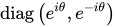
The unitary group U(n) has as a maximal torus the subgroup of all diagonal matrices. That is,
T is clearly isomorphic to the product of n circles, so the unitary group U(n) has rank n. A maximal torus in the special unitary group SU(n) ⊂ U(n) is just the intersection of T and SU(n) which is a torus of dimension n − 1.
A maximal torus in the special orthogonal group SO(2n) is given by the set of all simultaneous rotations in any fixed choice of n pairwise orthogonal planes (i.e., two dimensional vector spaces). Concretely, one maximal torus consists of all block-diagonal matrices with diagonal blocks, where each diagonal block is a rotation matrix. This is also a maximal torus in the group SO(2n+1) where the action fixes the remaining direction. Thus both SO(2n) and SO(2n+1) have rank n. For example, in the rotation group SO(3) the maximal tori are given by rotations about a fixed axis.
The symplectic group Sp(n) has rank n. A maximal torus is given by the set of all diagonal matrices whose entries all lie in a fixed complex subalgebra of H.
Let G be a compact, connected Lie group and let be the Lie algebra of G. The first main result is the torus theorem, which may be formulated as follows:[2]
This theorem has the following consequences:
If T is a maximal torus in a compact Lie group G, one can define a root system as follows. The roots are the weights for the adjoint action of T on the complexified Lie algebra of G. To be more explicit, let denote the Lie algebra of T, let denote the Lie algebra of , and let denote the complexification of . Then we say that an element is a root for G relative to T if and there exists a nonzero such that
for all . Here is a fixed inner product on that is invariant under the adjoint action of connected compact Lie groups.
The root system, as a subset of the Lie algebra of T, has all the usual properties of a root system, except that the roots may not span .[6] The root system is a key tool in understanding the classification and representation theory of G.
Given a torus T (not necessarily maximal), the Weyl group of G with respect to T can be defined as the normalizer of T modulo the centralizer of T. That is,
Fix a maximal torus in G; then the corresponding Weyl group is called the Weyl group of G (it depends up to isomorphism on the choice of T).
The first two major results about the Weyl group are as follows.
We now list some consequences of these main results.
The representation theory of G is essentially determined by T and W.
As an example, consider the case with being the diagonal subgroup of . Then belongs to if and only if maps each standard basis element to a multiple of some other standard basis element , that is, if and only if permutes the standard basis elements, up to multiplication by some constants. The Weyl group in this case is then the permutation group on elements.
Suppose f is a continuous function on G. Then the integral over G of f with respect to the normalized Haar measure dg may be computed as follows:
where is the normalized volume measure on the quotient manifold and is the normalized Haar measure on T.[10] Here Δ is given by the Weyl denominator formula and is the order of the Weyl group. An important special case of this result occurs when f is a class function, that is, a function invariant under conjugation. In that case, we have
Consider as an example the case , with being the diagonal subgroup. Then the Weyl integral formula for class functions takes the following explicit form:[11]
Here , the normalized Haar measure on is , and denotes the diagonal matrix with diagonal entries and .
Source: Wikipedia. Article content is retrieved live through the MediaWiki API.
In the mathematical theory of compact Lie groups a special role is played by torus subgroups, in particular by the maximal torus subgroups. A torus in a compact Lie group G is a compact, connected, abelian Lie subgroup of G (and therefore isomorphic to the standard torus Tn). A maximal torus is one which is maximal among such subgroups. That is, T is a maximal torus if for any torus T′ containing T we have T = T′. Every torus is contained in a maximal torus simply by dimensional considerations. A noncompact Lie group need not have any nontrivial tori (e.g. Rn). The dimension of a maximal torus in G is called the rank of G. The rank is well-defined since all maximal tori turn out to be conjugate. For semisimple groups the rank is equal to the number of nodes in the associated Dynkin diagram.

In the theory of algebraic groups, a Borel subgroup of an algebraic group G is a maximal Zariski closed and connected solvable algebraic subgroup. For example, in the general linear group GLn (n x n invertible matrices), the subgroup of invertible upper triangular matrices is a Borel subgroup. For groups realized over algebraically closed fields, there is a single conjugacy class of Borel subgroups. Borel subgroups are one of the two key ingredients in understanding the structure of simple (more generally, reductive) algebraic groups, in Jacques Tits' theory of groups with a (B, N) pair. Here the group B is a Borel subgroup and N is the normalizer of a maximal torus contained in B. The notion was introduced by Armand Borel, who played a leading role in the development of the theory of algebraic groups.
In mathematics, a Hermitian symmetric space is a Hermitian manifold which at every point has an inversion symmetry preserving the Hermitian structure. First studied by Élie Cartan, they form a natural generalization of the notion of Riemannian symmetric space from real manifolds to complex manifolds. Every Hermitian symmetric space is a homogeneous space for its isometry group and has a unique decomposition as a product of irreducible spaces and a Euclidean space. The irreducible spaces arise in pairs as a non-compact space that, as Borel showed, can be embedded as an open subspace of its compact dual space. Harish Chandra showed that each non-compact space can be realized as a bounded symmetric domain in a complex vector space. The simplest case involves the groups SU(2), SU(1,1) and their common complexification SL(2,C). In this case the non-compact space is the unit disk, a homogeneous space for SU(1,1). It is a bounded domain in the complex plane C. The one-point compactification of C, the Riemann sphere, is the dual space, a homogeneous space for SU(2) and SL(2,C). Irreducible compact Hermitian symmetric spaces are exactly the homogeneous spaces of simple compact Lie groups by maximal closed connected subgroups which contain a maximal torus and have center isomorphic to the circle group. There is a complete classification of irreducible spaces, with four classical series, studied by Cartan, and two exceptional cases; the classification can be deduced from Borel–de Siebenthal theory, which classifies closed connected subgroups containing a maximal torus. Hermitian symmetric spaces appear in the theory of Jordan triple systems, several complex variables, complex geometry, automorphic forms and group representations, in particular permitting the construction of the holomorphic discrete series representations of semisimple Lie groups.
In mathematics, Borel–de Siebenthal theory describes the closed connected subgroups of a compact Lie group that have maximal rank, i.e. contain a maximal torus. It is named after the Swiss mathematicians Armand Borel and Jean de Siebenthal who developed the theory in 1949. Each such subgroup is the identity component of the centralizer of its center. They can be described recursively in terms of the associated root system of the group. The subgroups for which the corresponding homogeneous space has an invariant complex structure correspond to parabolic subgroups in the complexification of the compact Lie group, a reductive algebraic group.
Before the 1921 destruction of Tulsa’s Greenwood District, Black residents had created a remarkable center of business and community life. The district included stores, professional offices, entertainment venues and homes owned by Black citizens. Understanding Greenwood means learning what was built—not only what was burned.
MORE →Brown v. Board of Education in 1954.









![{\displaystyle \displaystyle {\int _{G}f(g)\,dg=|W|^{-1}\int _{T}|\Delta (t)|^{2}\int _{G/T}f\left(yty^{-1}\right)\,d[y]\,dt,}}](https://wikimedia.org/api/rest_v1/media/math/render/svg/b00ad401d0ba06e0b839ccd2b27267c35161b566)
![{\displaystyle d[y]}](https://wikimedia.org/api/rest_v1/media/math/render/svg/81558ffccd1a3dc8835b1f19f2d21322b1a79daa)