Civil Rights
Movements, leaders, victories and the continuing fight for equality.

Explore the people, places, events, achievements, struggles and stories that shaped our journey.
Movements, leaders, victories and the continuing fight for equality.
Innovation, patents, science, technology and world-changing contributions.
Pioneers, champions, Negro Leagues, records, activism and excellence.
Meet the people whose lives, choices and achievements shaped the journey.
Black towns, communities, institutions and places where history happened.
Moments that changed communities, movements, institutions and the nation.
In 1968 Shirley Chisholm became the first Black woman elected to the United States Congress. In 1972 she launched a campaign for the Democratic presidential nomination, breaking another political barrier.
MORE →Reflects the personal views, recollections, and perspective of the author, Mike Davis.
This is a personal recollection on the Move fire on May 13, 1985
 | This article needs more citations. (February 2018) |
Modular exponentiation is exponentiation performed over a modulus. It is useful in computer science, especially in the field of public-key cryptography, where it is used in both Diffie–Hellman key exchange and RSA public/private keys.
Modular exponentiation is the remainder c when an integer b (the base) is raised to the power e (the exponent), and divided by a positive integer m (the modulus); that is, c = be mod m. From the definition of division, it follows that 0 ≤ c < m.
For example, given b = 5, e = 3 and m = 13, dividing 53 = 125 by 13 leaves a remainder of c = 8.
When b and m are relatively prime, one can also allow the exponent e to be negative by finding the multiplicative inverse d of b modulo m (for instance by using extended Euclidean algorithm). More precisely:
Modular exponentiation is efficient to compute, even for very large integers. On the other hand, computing the modular discrete logarithm – that is, finding the exponent e when given b, c, and m – is believed to be difficult. This one-way function behavior makes modular exponentiation a candidate for use in cryptographic algorithms.
The most direct method of calculating a modular exponent is to calculate be directly, then to take this number modulo m. Consider trying to compute c, given b = 4, e = 13, and m = 497:
One could use a calculator to compute 413; this comes out to 67,108,864. Taking this value modulo 497, the answer c is determined to be 445.
Note that b is only one digit in length and that e is only two digits in length, but the value be is eight digits in length.
In strong cryptography, b is often at least 1024 bits.[1] Consider b = 5 × 1076 and e = 17, both of which are perfectly reasonable values. In this example, b is 77 digits in length and e is two digits in length, but the value be is 1,304 decimal digits in length. Such calculations are possible on modern computers, but the sheer magnitude of such numbers causes the speed of calculations to drop considerably. As b and e increase even further to provide better security, the value be becomes unwieldy.
The time required to perform the exponentiation depends on the operating environment and the processor. The method described above requires Θ(e) multiplications to complete.
Keeping the numbers smaller requires additional modular reduction operations, but the reduced size makes each operation faster, saving time (as well as memory) overall.
This algorithm makes use of the identity
The modified algorithm is:
Note that at the end of every iteration through the loop, the equation c ≡ be′ (mod m) holds true. The algorithm ends when the loop has been executed e times. At that point c contains the result of be mod m.
In summary, this algorithm increases e′ by one until it is equal to e. At every step multiplying the result from the previous iteration, c, by b and performing a modulo operation on the resulting product, thereby keeping the resulting c a small integer.
The example b = 4, e = 13, and m = 497 is presented again. The algorithm performs the iteration thirteen times:
The final answer for c is therefore 445, as in the direct method.
Like the first method, this requires O(e) multiplications to complete. However, since the numbers used in these calculations are much smaller than the numbers used in the first algorithm's calculations, the computation time decreases by a factor of at least O(e) in this method.
In pseudocode, this method can be performed the following way:
function modular_pow(base, exponent, modulus) is
    if modulus = 1 then
        return 0
    c := 1
    for e_prime = 0 to exponent-1 do
        c := (c * base) mod modulus
    return c
A third method drastically reduces the number of operations to perform modular exponentiation, while keeping the same memory footprint as in the previous method. It is a combination of the previous method and a more general principle called exponentiation by squaring (also known as binary exponentiation).
First, it is required that the exponent e be converted to binary notation. That is, e can be written as:
In such notation, the length of e is n bits. ai can take the value 0 or 1 for any i such that 0 ≤ i < n. By definition, an − 1 = 1.
The value be can then be written as:
The solution c is therefore:
The following is an example in pseudocode based on Applied Cryptography by Bruce Schneier.[2] The inputs base, exponent, and modulus correspond to b, e, and m in the equations given above.
function modular_pow(base, exponent, modulus) is
    if modulus = 1 then
        return 0
    Assert :: (modulus - 1) * (modulus - 1) does not overflow base
    result := 1
    base := base mod modulus
    while exponent > 0 do
        if (exponent mod 2 == 1) then
            result := (result * base) mod modulus
        exponent := exponent >> 1
        base := (base * base) mod modulus
    return result
Note that upon entering the loop for the first time, the code variable base is equivalent to b. However, the repeated squaring in the third line of code ensures that at the completion of every loop, the variable base is equivalent to b2i mod m, where i is the number of times the loop has been iterated. (This makes i the next working bit of the binary exponent exponent, where the least-significant bit is exponent0).
The first line of code simply carries out the multiplication in . If a is zero, no code executes since this effectively multiplies the running total by one. If a instead is one, the variable base (containing the value b2i mod m of the original base) is simply multiplied in.
In this example, the base b is raised to the exponent e = 13. The exponent is 1101 in binary. There are four binary digits, so the loop executes four times, with values a0 = 1, a1 = 0, a2 = 1, and a3 = 1.
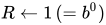
First, initialize the result to 1 and preserve the value of b in the variable x:
We are done: R is now .
Here is the above calculation, where we compute b = 4 to the power e = 13, performed modulo 497.
Initialize:
We are done: R is now , the same result obtained in the previous algorithms.
The running time of this algorithm is O(log exponent). When working with large values of exponent, this offers a substantial speed benefit over the previous two algorithms, whose time is O(exponent). For example, if the exponent was 220 = 1048576, this algorithm would have 20 steps instead of 1048576 steps.
function modPow(b, e, m)
  if m == 1 then
    return 0
  end
  local r = 1
  b = b % m
  while e > 0 do
    if e % 2 == 1 then
      r = (r*b) % m
    end
    b = (b*b) % m
    e = e >> 1     --use 'e = math.floor(e / 2)' on Lua 5.2 or older
  end
  return r
end
We can also use the bits of the exponent in left to right order. In practice, we would usually want the result modulo some modulus m. In that case, we would reduce each multiplication result (mod m) before proceeding. For simplicity, the modulus calculation is omitted here. This example shows how to compute using left to right binary exponentiation. The exponent is 1101 in binary; there are four bits, so there are four iterations.
Initialize the result to 1: .
In The Art of Computer Programming, Vol. 2, Seminumerical Algorithms, page 463, Donald Knuth notes that contrary to some assertions, this method does not always give the minimum possible number of multiplications. The smallest counterexample is for a power of 15, when the binary method needs six multiplications. Instead, form x3 in two multiplications, then x6 by squaring x3, then x12 by squaring x6, and finally x15 by multiplying x12 and x3, thereby achieving the desired result with only five multiplications. However, many pages follow describing how such sequences might be contrived in general.
The m-th term of any constant-recursive sequence (such as Fibonacci numbers or Perrin numbers) where each term is a linear function of k previous terms can be computed efficiently modulo n by computing Am mod n, where A is the corresponding k×k companion matrix. The above methods adapt easily to this application. This can be used for primality testing of large numbers n, for example.
A recursive algorithm for ModExp(A, b, c) = Ab mod c, where A is a square matrix.
function Matrix_ModExp(Matrix A, int b, int c) is
    if b == 0 then
        return I  // The identity matrix
    if (b mod 2 == 1) then
        return (A * Matrix_ModExp(A, b - 1, c)) mod c
    Matrix D := Matrix_ModExp(A, b / 2, c)
    return (D * D) mod c
Diffie–Hellman key exchange uses exponentiation in finite cyclic groups. The above methods for modular matrix exponentiation clearly extend to this context. The modular matrix multiplication C ≡ AB (mod n) is simply replaced everywhere by the group multiplication c = ab.
In quantum computing, modular exponentiation appears as the bottleneck of Shor's algorithm, where it must be computed by a circuit consisting of reversible gates, which can be further broken down into quantum gates appropriate for a specific physical device. Furthermore, in Shor's algorithm it is possible to know the base and the modulus of exponentiation at every call, which enables various circuit optimizations.[3]
Because modular exponentiation is an important operation in computer science, and there are efficient algorithms (see above) that are much faster than simply exponentiating and then taking the remainder, many programming languages and arbitrary-precision integer libraries have a dedicated function to perform modular exponentiation:
pow() (exponentiation) function [1] takes an optional third argument, the modulusBigInteger class has a ModPow() method to perform modular exponentiationjava.math.BigInteger class has a modPow() method to perform modular exponentiationpowermod function from Symbolic Math ToolboxMath::BigInt module has a bmodpow() method [2] to perform modular exponentiationexpmod.big.Int type contains an Exp() (exponentiation) method [3] whose third parameter, if non-nil, is the modulusbcpowmod() function [4] to perform modular exponentiationmpz_powm() function [5] to perform modular exponentiation@PowerMod() for FileMaker Pro (with 1024-bit RSA encryption example)openssl package has the OpenSSL::BN#mod_exp method [6] to perform modular exponentiation.
Source: Wikipedia. Article content is retrieved live through the MediaWiki API.
Modular exponentiation is exponentiation performed over a modulus. It is useful in computer science, especially in the field of public-key cryptography, where it is used in both Diffie–Hellman key exchange and RSA public/private keys. Modular exponentiation is the remainder c when an integer b (the base) is raised to the power e (the exponent), and divided by a positive integer m (the modulus); that is, c = be mod m. From the definition of division, it follows that 0 ≤ c < m. For example, given b = 5, e = 3 and m = 13, dividing 53 = 125 by 13 leaves a remainder of c = 8. When b and m are relatively prime, one can also allow the exponent e to be negative by finding the multiplicative inverse d of b modulo m (for instance by using extended Euclidean algorithm). More precisely: c = be mod m = d−e mod m, where e < 0 and b ⋅ d ≡ 1 (mod m). Modular exponentiation is efficient to compute, even for very large integers. On the other hand, computing the modular discrete logarithm – that is, finding the exponent e when given b, c, and m – is believed to be difficult. This one-way function behavior makes modular exponentiation a candidate for use in cryptographic algorithms.
In modular arithmetic computation, Montgomery modular multiplication, more commonly referred to as Montgomery multiplication, is a method for performing fast modular multiplication. It was introduced in 1985 by the American mathematician Peter L. Montgomery. Montgomery modular multiplication relies on a special representation of numbers called Montgomery form. The algorithm uses the Montgomery forms of a and b to efficiently compute the Montgomery form of ab mod N. The efficiency comes from avoiding expensive division operations. Classical modular multiplication reduces the double-width product ab using division by N and keeping only the remainder. This division requires quotient digit estimation and correction. The Montgomery form, in contrast, depends on a constant R > N which is coprime to N, and the only division necessary in Montgomery multiplication is division by R. The constant R can be chosen so that division by R is easy, significantly improving the speed of the algorithm. In binary computers, R is always a power of two, since division by powers of two can be implemented by bit shifting. The need to convert a and b into Montgomery form and their product out of Montgomery form means that computing a single product by Montgomery multiplication is slower than the conventional or Barrett reduction algorithms. However, when performing many multiplications in a row, as in modular exponentiation, intermediate results can be left in Montgomery form. Then the initial and final conversions become a negligible fraction of the overall computation. Many important cryptosystems such as RSA and Diffie–Hellman key exchange are based on arithmetic operations modulo a large odd number, and for these cryptosystems, computations using Montgomery multiplication with R a power of two are faster than the available alternatives.

Elliptic-curve cryptography (ECC) is an approach to public-key cryptography based on the algebraic structure of elliptic curves over finite fields. ECC allows smaller keys to provide equivalent security, compared to cryptosystems based on modular exponentiation in finite fields, such as the RSA cryptosystem and ElGamal cryptosystem. Elliptic curves are applicable for key agreement, digital signatures, pseudo-random generators and other tasks. Indirectly, they can be used for encryption by combining the key agreement with a symmetric encryption scheme. They are also used in several integer factorization algorithms that have applications in cryptography, such as Lenstra elliptic-curve factorization.
The Digital Signature Algorithm (DSA) is a public-key cryptosystem and Federal Information Processing Standard for digital signatures, based on the mathematical concept of modular exponentiation and the discrete logarithm problem. In a digital signature system, there is a keypair involved, consisting of a private and a public key. In this system a signing entity that declared their public key can generate a signature using their private key, and a verifier can assert the source if it verifies the signature correctly using the declared public key. DSA is a variant of the Schnorr and ElGamal signature schemes. The National Institute of Standards and Technology (NIST) proposed DSA for use in their Digital Signature Standard (DSS) in 1991, and adopted it as FIPS 186 in 1994. Five revisions to the initial specification have been released. The last standard, however, removed NIST's approval for DSA signature generation.
Before the 1921 destruction of Tulsa’s Greenwood District, Black residents had created a remarkable center of business and community life. The district included stores, professional offices, entertainment venues and homes owned by Black citizens. Understanding Greenwood means learning what was built—not only what was burned.
MORE →Shirley Chisholm, elected in 1968.