Civil Rights
Movements, leaders, victories and the continuing fight for equality.

Explore the people, places, events, achievements, struggles and stories that shaped our journey.
Movements, leaders, victories and the continuing fight for equality.
Innovation, patents, science, technology and world-changing contributions.
Pioneers, champions, Negro Leagues, records, activism and excellence.
Meet the people whose lives, choices and achievements shaped the journey.
Black towns, communities, institutions and places where history happened.
Moments that changed communities, movements, institutions and the nation.
Wilmington, North Carolina once had a thriving Black middle class and an elected interracial government. In 1898 white supremacists used violence to overthrow that government, kill Black residents and drive many others from the city.
MORE →Reflects the personal views, recollections, and perspective of the author, Mike Davis.
This is a personal recollection on the Move fire on May 13, 1985
 |
| Pallava script | |
|---|---|
 Pallava script chart using a modern font,[1] divided into 9 vowels, 35 consonants, 9 vowel diacritics, 3 special diacritics, and 3 punctuation marks. | |
| Script type | |
Period | 4th century CE to 7th century CE[2] |
| Direction | Left-to-right  |
| Languages | Old Tamil, Sanskrit, Telugu, Kannada, Konkani, Marathi, Old Khmer, Old Malay, Burmese, Thai, Sinhala, Lao, Mon, Balinese, etc. |
| Related scripts | |
Parent systems | |
Child systems | Tamil, Grantha, Mon-Burmese, Khmer, Cham, Kawi |
Sister systems | Vattezhuthu, Kolezhuthu |
| Brahmic scripts |
|---|
| The Brahmi script and its descendants |
The Pallava script, or Pallava Grantha, named after the Pallava dynasty of Southern India (Tamilakam), is attested since the 4th century CE. The Pallava script evolved from Tamil-Brahmi.[3] It was used to originally write Old Tamil and Sanskrit texts – the court languages of Pallavas, thus, it features glyphs to render the sounds of both languages. Both the Tamil script via the intermediate script/step called Chozha-Pallava-Script[4][5] and Grantha script have originated from the Pallava script.[6]
Pallava also spread to Southeast Asia and evolved into scripts such as Balinese,[7] Baybayin,[8] Javanese,[9] Kawi,[10] Khmer,[11] Lanna,[12] Lao,[13] Mon–Burmese,[14] New Tai Lue,[15] Sundanese,[16] and Thai.[17] This script is the sister of the Vatteluttu script which was also used to write Tamil and Malayalam in the past.[18]
Epigrapher Arlo Griffiths argues that the name of the script is misleading as not all of the relevant scripts referred to have a connection with the Pallava dynasty. He instead advocates that these scripts be called Late Southern Brāhmī scripts.[2]
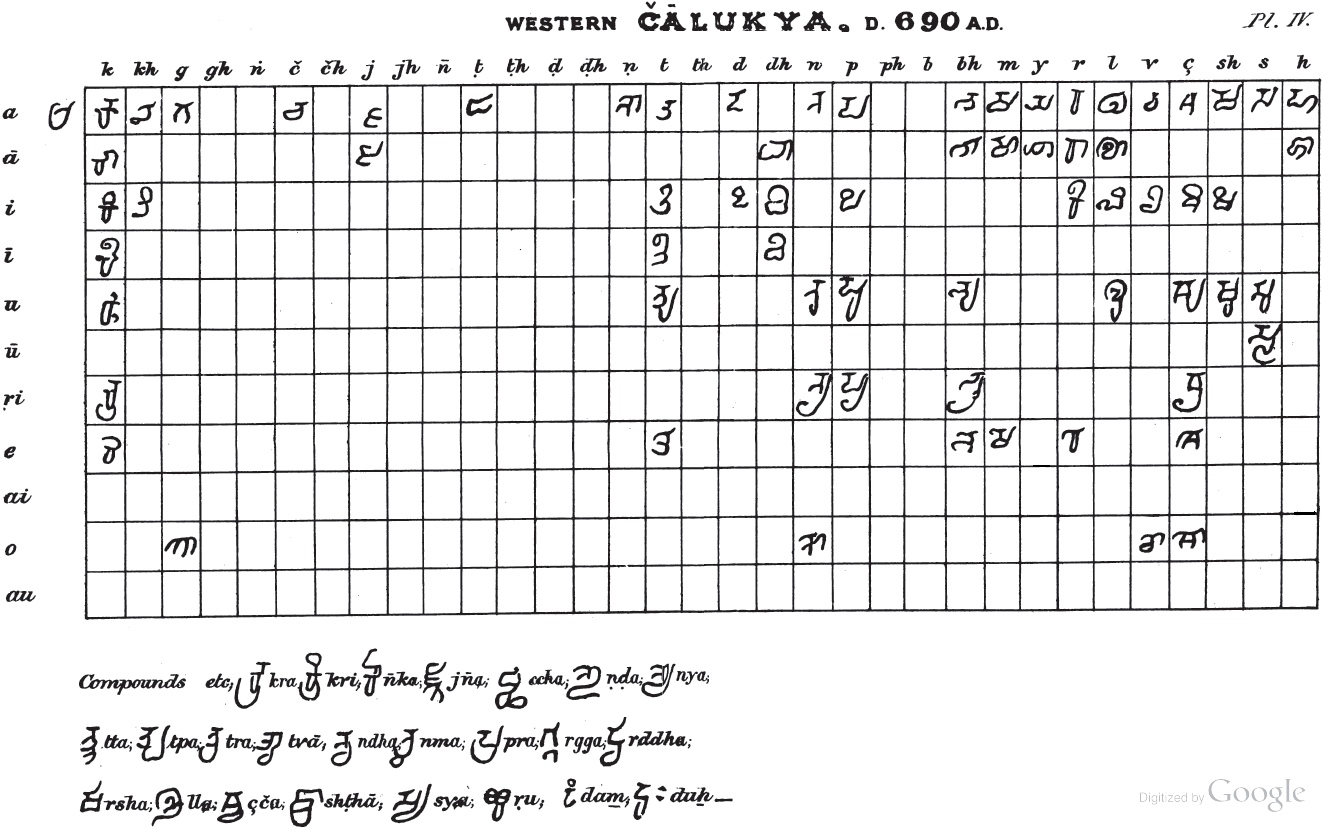
During the rule of the Pallavas, the script accompanied priests, monks, scholars, and traders into Southeast Asia. Pallavas developed the Pallava script based on Tamil-Brahmi. The main characteristics of the newer script are aesthetically matched and fuller consonant glyphs, similarly visible in the writing systems of Chalukya,[19] Kadamba, and Vengi at the time of Ikshvakus. Brahmi's design was slightly different from the scripts of Cholas, Pandyas, and Cheras. Pallava script was the first significant development of Brahmi in India, combining rounded and rectangular strokes and adding typographical effects, and was suitable for civic and religious inscriptions.
It served as parent script for several modern-day-scripts, such as Chozha-Pallava-Script, which ultimately gave rise to Tamil script and also Grantha script. Once the Pallava dynasty was integrated via the conquest by Aditya I in 897 CE,[20] which laid the foundation for the future Chola Empire – the Chozha-Pallava was subsequently developed under that dynasty and replaced both the Pallava and Grantha scripts to write Tamil texts, whereas Grantha remained to be in usage for rendering Manipravalam texts.[21] It also supplanted the Vatteluttu, when the Pandya Nadu in c. 850 CE was conquered by the Cholas as well.[22] The Chozha-Pallava script resembled the same glyph developments like its counterpart Grantha script, but it didn't feature any foreign sounds from Sanskrit, thus, simplifying the script and ultimately becoming the modern-day Tamil script.[4][5]
Kadamba-Pallava script[23] evolved into early forms of Kannada and Telugu scripts. Glyphs become more rounded and incorporate loops because of writing upon leaves and paper.[23]
The script is not yet a part of Unicode but proposals have been made to include it. In 2018, Anshuman Pandey made a proposal.[1]
The form shown here is based on examples from the 7th century CE. Letters labeled * have uncertain sound value, as they have little occurrence in Southeast Asia.

Each consonant has an inherent /a/, which will be sounded if no vowel sign is attached. If two consonants follow one another without intervening vowel, the second consonant is made into a subscript form, and attached below the first.
| ka | kha | ga | gha | ṅa |
|---|---|---|---|---|
 |
 |
 |
 |

|
| ca | cha | ja | jha* | ña |

|

|

|

|

|
| ṭa | ṭha* | ḍa | ḍha* | ṇa |

|

|

|

|

|
| ta | tha | da | dha | na |

|

|

|

|

|
| pa | pha | ba | bha | ma |

|

|

|

|

|
| ya | ra | la | va | |

|

|

|

|
|
| śa | ṣa | sa | ha | |

|

|

|

|
| a | ā | i | ī | u | e | o | ai* | au* |
|---|---|---|---|---|---|---|---|---|

|

|

|

|

|

|

|

|

|


A proposal to encode the script in Unicode was submitted in 2018.[1]
After about AD 1500, translations from Sanskrit did appear, and unassimilated words began to flood literary Malayalam; eventually a hybrid idiom (manipravalam) mixing Sanskrit and tamil words, and Sanskrit words with tamil inflections, was devised
 Media related to Pallava script at Wikimedia Commons
Source: Wikipedia. Article content is retrieved live through the MediaWiki API.
The Pallava script, or Pallava Grantha, named after the Pallava dynasty of Southern India (Tamilakam), is attested since the 4th century CE. The Pallava script evolved from Tamil-Brahmi. It was used to originally write Old Tamil and Sanskrit texts – the court languages of Pallavas, thus, it features glyphs to render the sounds of both languages. Both the Tamil script via the intermediate script/step called Chozha-Pallava-Script and Grantha script have originated from the Pallava script. Pallava also spread to Southeast Asia and evolved into scripts such as Balinese, Baybayin, Javanese, Kawi, Khmer, Lanna, Lao, Mon–Burmese, New Tai Lue, Sundanese, and Thai. This script is the sister of the Vatteluttu script which was also used to write Tamil and Malayalam in the past. Epigrapher Arlo Griffiths argues that the name of the script is misleading as not all of the relevant scripts referred to have a connection with the Pallava dynasty. He instead advocates that these scripts be called Late Southern Brāhmī scripts.

The Burmese-Mon script (Burmese: မြန်မာမွန်အက္ခရာ, ; Mon: အက္ခရ်မန်ဗၟာ, , also called the Mon script and Burmese script) is an abugida that derives from the Pallava Grantha script of southern India and later of Southeast Asia. It is the primary writing system for Burmese, Mon, Shan, Rakhine, Jingpho, and several Karen languages. The Mon-Burmese script is distinguished from Khmer-derived scripts (e.g., Khmer and Thai) by its basis on Pali orthography (they traditionally lack Sanskrit letters representing the sibilants ⟨ś⟩ and ⟨ṣ⟩ and the vocalic sonorants ⟨ṛ⟩ and ⟨ḷ⟩), the use of a virāma, and the round shape of letters.

Old Sundanese script (Sundanese: ᮃᮊ᮪ᮞᮛ ᮞᮥᮔ᮪ᮓ ᮘᮥᮠᮥᮔ᮪, romanized: Aksara Sunda Buhun) is a script that developed in West Java in the 14th–18th centuries which was originally used to write Old Sundanese language. The Old Sundanese script is a development of the Pallava script which has reached the stage of modifying its distinctive form as used in lontar texts in the 16th century.

The Ahom script or Tai Ahom Script is an abugida that is used to write the Ahom language, a dormant Tai language undergoing revival spoken by the Ahom people till the late 18th-century, who established the Ahom kingdom and ruled the eastern part of the Brahmaputra valley between the 13th and the 18th centuries. The old Ahom language today survives in the numerous manuscripts written in this script currently in institutional and private possession. Dibrugarh University has a 2 Years Post Graduate Diploma course in Tai language. The Centre for South East Asian Studies, Gauhati University on 27 April, 2026 launched a 6-momths Certificate Course in Tai-Ahom language and Medieval Manuscriptology.
Before the 1921 destruction of Tulsa’s Greenwood District, Black residents had created a remarkable center of business and community life. The district included stores, professional offices, entertainment venues and homes owned by Black citizens. Understanding Greenwood means learning what was built—not only what was burned.
MORE →Shirley Chisholm, elected in 1968.