Civil Rights
Movements, leaders, victories and the continuing fight for equality.

Explore the people, places, events, achievements, struggles and stories that shaped our journey.
Movements, leaders, victories and the continuing fight for equality.
Innovation, patents, science, technology and world-changing contributions.
Pioneers, champions, Negro Leagues, records, activism and excellence.
Meet the people whose lives, choices and achievements shaped the journey.
Black towns, communities, institutions and places where history happened.
Moments that changed communities, movements, institutions and the nation.
Katherine Johnson’s mathematical calculations helped guide some of America’s most important early space missions while she confronted the racial and gender barriers faced by Black women in twentieth-century America.
MORE →Reflects the personal views, recollections, and perspective of the author, Mike Davis.
This is a personal recollection on the Move fire on May 13, 1985
 | This article needs more citations. (August 2021) |

In calculus, a one-sided limit refers to either one of the two limits of a function of a real variable as approaches a specified point either from the left or from the right.[1][2]
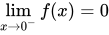
The limit, as decreases in value approaching ( approaches "from the right"[3] or "from above"), is denoted:[1][2]
The limit, as increases in value approaching ( approaches "from the left"[4][5] or "from below"), is denoted:[1][2]
If the limits from the left and right both exist and are equal, then the limit of as approaches exists. Conversely, if the limit of as approaches exists, then the limits from left and right both exist and are equal. Consequently, the limit as approaches is sometimes called a "two-sided limit".[citation needed] It is denoted:
In some cases in which the two-sided limit does not exist, the two individual one-sided limits nonetheless exist and they are then necessarily unequal.
It is possible for only one of the two one-sided limits to exist. It is also possible for neither of the two one-sided limits to exist.
If represents some interval that is contained in the domain of a function and if is a point in , then the right-sided limit as approaches can be rigorously defined as the value that satisfies:[6]
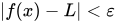
for all there exists some such that for all , if then ,
and the left-sided limit as approaches can be rigorously defined as the value that satisfies:
for all there exists some such that for all , if then .
These definitions can be represented more symbolically as follows: Let represent an interval, where and , then
In comparison to the formal definition for the limit of a function at a point, the one-sided limit (as the name would suggest) only deals with input values to one side of the approached input value.
For reference, the formal definition for the limit of a function at a point is as follows:
To define a one-sided limit, we must modify this inequality. Note that the absolute distance between and is
For the limit from the right, we want to be to the right of , which means that , so is positive. From above, is the distance between and . We want to bound this distance by our value of , giving the inequality . Putting together the inequalities and and using the transitivity property of inequalities, we have the compound inequality .
Similarly, for the limit from the left, we want to be to the left of , which means that . In this case, it is that is positive and represents the distance between and . Again, we want to bound this distance by our value of , leading to the compound inequality .
Now, when our value of is in its desired interval, we expect that the value of is also within its desired interval. The distance between and , the limiting value of the left sided limit, is . Similarly, the distance between and , the limiting value of the right sided limit, is . In both cases, we want to bound this distance by , so we get the following: for the left sided limit, and for the right sided limit.
Example 1. The limits from the left and from the right of as approaches are, respectively The reason why is because is always negative (since means that with all values of satisfying ), which implies that is always positive so that diverges[note 1] to (and not to ) as approaches from the left. Similarly, since all values of satisfy (said differently, is always positive) as approaches from the right, which implies that is always negative so that diverges to

Example 2. One example of a function with different one-sided limits is , where the limit from the left is and the limit from the right is To calculate these limits, first show that which is true because and so that consequently, whereas because the denominator diverges to infinity; that is, because . Since , the limit does not exist.
The one-sided limit to a point corresponds to the general definition of limit, with the domain of the function restricted to one side, by either allowing that the function domain is a subset of the topological space, or by considering a one-sided subspace, including [1][verification needed] Alternatively, one may consider the domain with a half-open interval topology.[citation needed]
A noteworthy theorem treating one-sided limits of certain power series at the boundaries of their intervals of convergence is Abel's theorem.[citation needed]
Source: Wikipedia. Article content is retrieved live through the MediaWiki API.

In calculus, a one-sided limit refers to either one of the two limits of a function f ( x ) {\displaystyle f(x)} of a real variable x {\displaystyle x} as x {\displaystyle x} approaches a specified point either from the left or from the right. The limit, as x {\displaystyle x} decreases in value approaching a {\displaystyle a} ( x {\displaystyle x} approaches a {\displaystyle a} "from the right" or "from above"), is denoted: lim x → a + f ( x ) or lim x ↓ a f ( x ) or lim x ↘ a f ( x ) or f ( a + ) . {\displaystyle \lim _{x\to a^{+}}f(x)\quad {\text{ or }}\quad \lim _{x\,\downarrow \,a}\,f(x)\quad {\text{ or }}\quad \lim _{x\searrow a}\,f(x)\quad {\text{ or }}\quad f(a+).} The limit, as x {\displaystyle x} increases in value approaching a {\displaystyle a} ( x {\displaystyle x} approaches a {\displaystyle a} "from the left" or "from below"), is denoted: lim x → a − f ( x ) or lim x ↑ a f ( x ) or lim x ↗ a f ( x ) or f ( a − ) . {\displaystyle \lim _{x\to a^{-}}f(x)\quad {\text{ or }}\quad \lim _{x\,\uparrow \,a}\,f(x)\quad {\text{ or }}\quad \lim _{x\nearrow a}\,f(x)\quad {\text{ or }}\quad f(a-).} If the limits from the left and right both exist and are equal, then the limit of f ( x ) {\displaystyle f(x)} as x {\displaystyle x} approaches a {\displaystyle a} exists. Conversely, if the limit of f ( x ) {\displaystyle f(x)} as x {\displaystyle x} approaches a {\displaystyle a} exists, then the limits from left and right both exist and are equal. Consequently, the limit as x {\displaystyle x} approaches a {\displaystyle a} is sometimes called a "two-sided limit". It is denoted: lim x → a f ( x ) . {\displaystyle \lim _{x\to a}f(x).} In some cases in which the two-sided limit does not exist, the two individual one-sided limits nonetheless exist and they are then necessarily unequal. It is possible for only one of the two one-sided limits to exist. It is also possible for neither of the two one-sided limits to exist.
One-sided may refer to: Biased One-sided argument, a logical fallacy In calculus, one-sided limit, either of the two limits of a function f(x) of a real variable x as x approaches a specified point One-sided (algebra) One-sided overhand bend, simple method of joining two cords or threads together One-sided test, a statistical test
Upper limit may refer to: Limit superior Confidence interval One-sided limit Maximum
Lower limit may refer to: Limit inferior Confidence interval One-sided limit Minimum
Before the 1921 destruction of Tulsa’s Greenwood District, Black residents had created a remarkable center of business and community life. The district included stores, professional offices, entertainment venues and homes owned by Black citizens. Understanding Greenwood means learning what was built—not only what was burned.
MORE →Brown v. Board of Education in 1954.