Civil Rights
Movements, leaders, victories and the continuing fight for equality.

Explore the people, places, events, achievements, struggles and stories that shaped our journey.
Movements, leaders, victories and the continuing fight for equality.
Innovation, patents, science, technology and world-changing contributions.
Pioneers, champions, Negro Leagues, records, activism and excellence.
Meet the people whose lives, choices and achievements shaped the journey.
Black towns, communities, institutions and places where history happened.
Moments that changed communities, movements, institutions and the nation.
Katherine Johnson’s mathematical calculations helped guide some of America’s most important early space missions while she confronted the racial and gender barriers faced by Black women in twentieth-century America.
MORE →Reflects the personal views, recollections, and perspective of the author, Mike Davis.
This is a personal recollection on the Move fire on May 13, 1985

In mathematics, a parametric equation expresses several quantities, such as the coordinates of a point, as functions of one or more variables called parameters.[1]
In the case of a single parameter, parametric equations are commonly used to express the trajectory of a moving point. For this case, the parameter is often, but not necessarily, time, and the point describes a curve, called a parametric curve. In the case of two parameters, the point describes a surface, called a parametric surface. In all cases, the equations are collectively called a parametric representation,[2] or parametric system,[3] or parameterization (also spelled parametrization, parametrisation) of the object.[1][4][5]
For example, the equations form a parametric representation of the unit circle, where t is the parameter: A point (x, y) is on the unit circle if and only if there is a value of t such that these two equations generate that point. Sometimes the parametric equations for the individual scalar output variables are combined into a single parametric equation in vectors:
Parametric representations are generally not unique (see § Parametric plane curves), so the same quantities may be expressed by a number of different parameterizations.[1]
In addition to curves and surfaces, parametric equations can describe manifolds and algebraic varieties of higher dimension, with the number of parameters being equal to the dimension of the manifold or variety, and the number of equations being equal to the dimension of the space in which the manifold or variety is considered (for curves the dimension is one and one parameter is used, for surfaces dimension two and two parameters, etc.).
Parametric equations are commonly used in kinematics, where the trajectory of an object is represented by equations depending on time as the parameter. Because of this application, a single parameter is often labeled t; however, parameters can represent other physical quantities (such as geometric variables) or can be selected arbitrarily for convenience. Parameterizations are non-unique; more than one set of parametric equations can specify the same curve.[6]
Converting a set of parametric equations to a single implicit equation involves eliminating the variable t from the simultaneous equations This process is called implicitization. If one of these equations can be solved for t, the expression obtained can be substituted into the other equation to obtain an equation involving x and y only: Solving to obtain and using this in gives the explicit equation while more complicated cases will give an implicit equation of the form
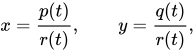
If the parametrization is given by rational functions
where p, q, and r are set-wise coprime polynomials, a resultant computation allows one to implicitize. More precisely, the implicit equation is the resultant with respect to t of xr(t) – p(t) and yr(t) – q(t).
In higher dimensions (either more than two coordinates or more than one parameter), the implicitization of rational parametric equations may by done with Gröbner basis computation; see Gröbner basis § Implicitization in higher dimension.
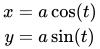
To take the example of the circle of radius a, the parametric equations
can be implicitized in terms of x and y by way of the Pythagorean trigonometric identity. With
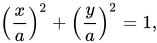
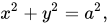
and we get and thus
which is the standard equation of a circle centered at the origin.
The simplest equation for a parabola,
can be (trivially) parameterized by using a free parameter t, and setting
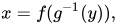
More generally, any curve given by an explicit equation
can be (trivially) parameterized by using a free parameter t, and setting
A more sophisticated example is the following. Consider the unit circle which is described by the ordinary (Cartesian) equation
This equation can be parameterized as follows:
With the Cartesian equation it is easier to check whether a point lies on the circle or not. With the parametric version it is easier to obtain points on a plot.
In some contexts, parametric equations involving only rational functions (that is fractions of two polynomials) are preferred, if they exist. In the case of the circle, such a rational parameterization is
With this pair of parametric equations, the point (−1, 0) is not represented by a real value of t, but by the limit of x and y when t tends to infinity.
An ellipse in canonical position (center at origin, major axis along the x-axis) with semi-axes a and b can be represented parametrically as
An ellipse in general position can be expressed as
as the parameter t varies from 0 to 2π. Here (Xc , Yc) is the center of the ellipse, and φ is the angle between the x-axis and the major axis of the ellipse.
Both parameterizations may be made rational by using the tangent half-angle formula and setting

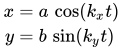
A Lissajous curve is similar to an ellipse, but the x and y sinusoids are not in phase. In canonical position, a Lissajous curve is given by where kx and ky are constants describing the number of lobes of the figure.
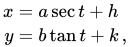
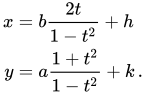
An east-west opening hyperbola can be represented parametrically by
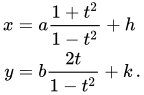
or, rationally
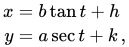
A north-south opening hyperbola can be represented parametrically as
or, rationally
In all these formulae (h , k) are the center coordinates of the hyperbola, a is the length of the semi-major axis, and b is the length of the semi-minor axis. Note that in the rational forms of these formulae, the points (−a , 0) and (0 , −a), respectively, are not represented by a real value of t, but are the limit of x and y as t tends to infinity.
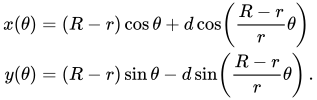
A hypotrochoid is a curve traced by a point attached to a circle of radius r rolling around the inside of a fixed circle of radius R, where the point is at a distance d from the center of the interior circle.


The parametric equations for the hypotrochoids are:
Some examples:


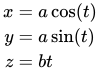
Parametric equations are convenient for describing curves in higher-dimensional spaces. For example:
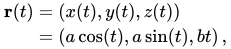
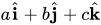
describes a three-dimensional curve, the helix, with a radius of a and rising by 2πb units per turn. The equations are identical in the plane to those for a circle. Such expressions as the one above are commonly written as
where r is a three-dimensional vector.
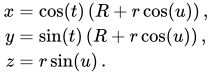
A torus with major radius R and minor radius r may be defined parametrically as
where the two parameters t and u both vary between 0 and 2π.

As u varies from 0 to 2π, the point on the surface moves about a short circle passing through the hole in the torus. As t varies from 0 to 2π, the point on the surface moves about a long circle around the hole in the torus.
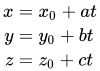
The parametric equation of the line through the point and parallel to the vector is[7]
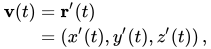
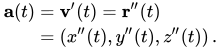
In kinematics, objects' paths through space are commonly described as parametric curves, with each spatial coordinate depending explicitly on an independent parameter (usually time). Used in this way, the set of parametric equations for the object's coordinates collectively constitute a vector-valued function for position. Such parametric curves can then be integrated and differentiated termwise. Thus, if a particle's position is described parametrically as
then its velocity can be found as
and its acceleration as
Another important use of parametric equations is in the field of computer-aided design (CAD).[8] For example, consider the following three representations, all of which are commonly used to describe planar curves.
| Type | Form | Example | Description |
|---|---|---|---|
| Explicit | Line | ||
| Implicit | Circle | ||
| Parametric | Line | ||
| Circle |
Each representation has advantages and drawbacks for CAD applications.
The explicit representation may be very complicated, or even may not exist. Moreover, it does not behave well under geometric transformations, and in particular under rotations. On the other hand, as a parametric equation and an implicit equation may easily be deduced from an explicit representation, when a simple explicit representation exists, it has the advantages of both other representations.
Implicit representations may make it difficult to generate points on the curve, and even to decide whether there are real points. On the other hand, they are well suited for deciding whether a given point is on a curve, or whether it is inside or outside of a closed curve.
Such decisions may be difficult with a parametric representation, but parametric representations are best suited for generating points on a curve, and for plotting it.[9]
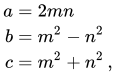
Numerous problems in integer geometry can be solved using parametric equations. A classical such solution is Euclid's parametrization of right triangles such that the lengths of their sides a, b and their hypotenuse c are coprime integers. As a and b are not both even (otherwise a, b and c would not be coprime), one may exchange them to have a even, and the parameterization is then
where the parameters m and n are positive coprime integers that are not both odd.
By multiplying a, b and c by an arbitrary positive integer, one gets a parametrization of all right triangles whose three sides have integer lengths.
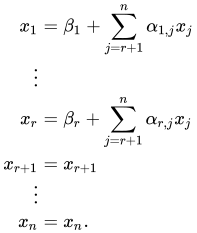
A system of m linear equations in n unknowns is underdetermined if it has more than one solution. This occurs when the matrix of the system and its augmented matrix have the same rank r and r < n. In this case, one can select n − r unknowns as parameters and represent all solutions as a parametric equation where all unknowns are expressed as linear combinations of the selected ones. That is, if the unknowns are one can reorder them for expressing the solutions as[10]
Such a parametric equation is called a parametric form of the solution of the system.[10]
The standard method for computing a parametric form of the solution is to use Gaussian elimination for computing a reduced row echelon form of the augmented matrix. Then the unknowns that can be used as parameters are the ones that correspond to columns not containing any leading entry (that is the left most non zero entry in a row or the matrix), and the parametric form can be straightforwardly deduced.[10]
Source: Wikipedia. Article content is retrieved live through the MediaWiki API.

In mathematics, a parametric equation expresses several quantities, such as the coordinates of a point, as functions of one or more variables called parameters. In the case of a single parameter, parametric equations are commonly used to express the trajectory of a moving point. For this case, the parameter is often, but not necessarily, time, and the point describes a curve, called a parametric curve. In the case of two parameters, the point describes a surface, called a parametric surface. In all cases, the equations are collectively called a parametric representation, or parametric system, or parameterization (also spelled parametrization, parametrisation) of the object. For example, the equations x = cos t y = sin t {\displaystyle {\begin{aligned}x&=\cos t\\y&=\sin t\end{aligned}}} form a parametric representation of the unit circle, where t is the parameter: A point (x, y) is on the unit circle if and only if there is a value of t such that these two equations generate that point. Sometimes the parametric equations for the individual scalar output variables are combined into a single parametric equation in vectors: ( x , y ) = ( cos t , sin t ) . {\displaystyle (x,y)=(\cos t,\sin t).} Parametric representations are generally not unique (see § Parametric plane curves), so the same quantities may be expressed by a number of different parameterizations. In addition to curves and surfaces, parametric equations can describe manifolds and algebraic varieties of higher dimension, with the number of parameters being equal to the dimension of the manifold or variety, and the number of equations being equal to the dimension of the space in which the manifold or variety is considered (for curves the dimension is one and one parameter is used, for surfaces dimension two and two parameters, etc.). Parametric equations are commonly used in kinematics, where the trajectory of an object is represented by equations depending on time as the parameter. Because of this application, a single parameter is often labeled t; however, parameters can represent other physical quantities (such as geometric variables) or can be selected arbitrarily for convenience. Parameterizations are non-unique; more than one set of parametric equations can specify the same curve.
In calculus, a parametric derivative is a derivative of a dependent variable with respect to another dependent variable that is taken when both variables depend on an independent third variable, usually thought of as "time" (that is, when the dependent variables are x and y and are given by parametric equations in t).

In mathematics, the Roman surface or Steiner surface is a self-intersecting mapping of the real projective plane into three-dimensional space, with an unusually high degree of symmetry. This mapping is not an immersion of the projective plane; however, the figure resulting from removing six singular points is one. Its name arises because it was discovered by Jakob Steiner when he was in Rome in 1844. The simplest construction is as the image of a sphere centered at the origin under the map f ( x , y , z ) = ( y z , x z , x y ) . {\displaystyle f(x,y,z)=(yz,xz,xy).} This gives an implicit formula of x 2 y 2 + y 2 z 2 + z 2 x 2 − r 2 x y z = 0. {\displaystyle x^{2}y^{2}+y^{2}z^{2}+z^{2}x^{2}-r^{2}xyz=0.\,} Also, taking a parametrization of the sphere in terms of longitude (θ) and latitude (φ), gives parametric equations for the Roman surface as follows: x = r 2 cos θ cos φ sin φ {\displaystyle x=r^{2}\cos \theta \cos \varphi \sin \varphi } y = r 2 sin θ cos φ sin φ {\displaystyle y=r^{2}\sin \theta \cos \varphi \sin \varphi } z = r 2 cos θ sin θ cos 2 φ {\displaystyle z=r^{2}\cos \theta \sin \theta \cos ^{2}\varphi } The origin is a triple point, and each of the xy-, yz-, and xz-planes are tangential to the surface there. The other places of self-intersection are double points, defining segments along each coordinate axis which terminate in six pinch points. The entire surface has tetrahedral symmetry. It is a particular type (called type 1) of Steiner surface, that is, a 3-dimensional linear projection of the Veronese surface.
In mathematics, and more specifically in geometry, parametrization (or parameterization; also parameterisation, parametrisation) is the process of finding parametric equations of a curve, a surface, or, more generally, a manifold or a variety, defined by an implicit equation. The inverse process is called implicitization. "To parameterize" by itself means "to express in terms of parameters". Parametrization is a mathematical process consisting of expressing the state of a system, process or model as a function of some independent quantities called parameters. The state of the system is generally determined by a finite set of coordinates, and the parametrization thus consists of one function of several real variables for each coordinate. The number of parameters is the number of degrees of freedom of the system. For example, the position of a point that moves on a curve in three-dimensional space is determined by the time needed to reach the point when starting from a fixed origin. If x, y, z are the coordinates of the point, the movement is thus described by a parametric equation x = f ( t ) y = g ( t ) z = h ( t ) , {\displaystyle {\begin{aligned}x&=f(t)\\y&=g(t)\\z&=h(t),\end{aligned}}} where t is the parameter and denotes the time. Such a parametric equation completely determines the curve, without the need of any interpretation of t as time, and is thus called a parametric equation of the curve (this is sometimes abbreviated by saying that one has a parametric curve). One similarly gets the parametric equation of a surface by considering functions of two parameters t and u.
Before the 1921 destruction of Tulsa’s Greenwood District, Black residents had created a remarkable center of business and community life. The district included stores, professional offices, entertainment venues and homes owned by Black citizens. Understanding Greenwood means learning what was built—not only what was burned.
MORE →Brown v. Board of Education in 1954.














![{\displaystyle {\begin{aligned}x&={\frac {1-t^{2}}{1+t^{2}}}\\[6pt]y&={\frac {2t}{1+t^{2}}}\,.\end{aligned}}}](https://wikimedia.org/api/rest_v1/media/math/render/svg/818bc58007751c7626fc15b56a0369f920951453)