Civil Rights
Movements, leaders, victories and the continuing fight for equality.

Explore the people, places, events, achievements, struggles and stories that shaped our journey.
Movements, leaders, victories and the continuing fight for equality.
Innovation, patents, science, technology and world-changing contributions.
Pioneers, champions, Negro Leagues, records, activism and excellence.
Meet the people whose lives, choices and achievements shaped the journey.
Black towns, communities, institutions and places where history happened.
Moments that changed communities, movements, institutions and the nation.
In August 1908, a white mob attacked Springfield, Illinois’s Black community, destroying homes and businesses and lynching two Black men. National outrage over the violence helped spur the movement that created the NAACP the following year.
MORE →Reflects the personal views, recollections, and perspective of the author, Mike Davis.
This is a personal recollection on the Move fire on May 13, 1985
Presburger arithmetic is the first-order theory of the natural numbers with addition, named in honor of Mojżesz Presburger, who introduced it in 1929. The signature of Presburger arithmetic contains only the addition operation and equality, omitting the multiplication operation entirely. The theory is computably axiomatizable; the axioms include a schema of induction.
Presburger arithmetic is much weaker than Peano arithmetic, which includes both addition and multiplication operations. Unlike Peano arithmetic, Presburger arithmetic is a decidable theory. This means it is possible to algorithmically determine, for any sentence in the language of Presburger arithmetic, whether that sentence is provable from the axioms of Presburger arithmetic. The asymptotic running-time computational complexity of this algorithm is at least doubly exponential, however, as shown by Fischer & Rabin (1974).
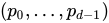
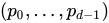
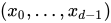
The language of Presburger arithmetic contains constants and and a binary function , interpreted as addition.
In this language, the axioms of Presburger arithmetic are the universal closures of the following:[1]
(5) is an axiom schema of induction, representing infinitely many axioms. These cannot be replaced by any finite number of axioms, that is, Presburger arithmetic is not finitely axiomatizable in first-order logic.[2]
Presburger arithmetic can be viewed as a first-order theory with equality containing precisely all consequences of the above axioms. Alternatively, it can be defined as the set of those sentences that are true in the intended interpretation: the structure of non-negative integers with constants , , and the addition of non-negative integers.
Presburger arithmetic is designed to be complete and decidable. Therefore, it cannot formalize concepts such as divisibility or primality, or, more generally, any number concept leading to multiplication of variables. However, it can formulate individual instances of divisibility; for example, it proves This states that every number is either even or odd.
Presburger (1929) proved Presburger arithmetic to be:
The decidability of Presburger arithmetic can be shown using quantifier elimination, supplemented by reasoning about arithmetical congruence.[3][4][5][6][7][8] The steps used to justify a quantifier elimination algorithm can be used to define computable axiomatizations that do not necessarily contain the axiom schema of induction.[3][9]
In contrast, Peano arithmetic, which is Presburger arithmetic augmented with multiplication, is not decidable, as proved by Church alongside the negative answer to the Entscheidungsproblem. By Gödel's incompleteness theorem, Peano arithmetic is incomplete and its consistency is not internally provable (but see Gentzen's consistency proof).
The decision problem for Presburger arithmetic is an interesting example in computational complexity theory and computation. Let n be the length of a statement in Presburger arithmetic. Then Fischer & Rabin (1974) proved that, in the worst case, the proof of the statement in first-order logic has length at least , for some constant c>0. Hence, their decision algorithm for Presburger arithmetic has runtime at least exponential. Fischer and Rabin also proved that for any reasonable axiomatization (defined precisely in their paper), there exist theorems of length n that have doubly exponential length proofs. Fischer and Rabin's work also implies that Presburger arithmetic can be used to define formulas that correctly calculate any algorithm as long as the inputs are less than relatively large bounds. The bounds can be increased, but only by using new formulas.
Recent work has also considered functional synthesis problems over Presburger arithmetic, including the identification of restricted fragments with more efficient solution procedures.[10]
On the other hand, a triply exponential upper bound on a decision procedure for Presburger arithmetic was proved by Oppen.[11][n 2]
A more tight complexity bound was shown using alternating complexity classes by Berman (1980). The set of true statements in Presburger arithmetic (PA) is shown complete for TimeAlternations(22nO(1), n). Thus, its complexity is between double exponential nondeterministic time (2-NEXP) and double exponential space (2-EXPSPACE). Completeness is under Karp reductions. (Also, note that while Presburger arithmetic is commonly abbreviated PA, in mathematics in general PA usually means Peano arithmetic.)
For a more fine-grained result, let PA(i) be the set of true Σi PA statements, and PA(i, j) the set of true Σi PA statements with each quantifier block limited to j variables. '<' is considered to be quantifier-free; here, bounded quantifiers are counted as quantifiers.
PA(1, j) is in P, while PA(1) is NP-complete.[12]
For i > 0 and j > 2, PA(i + 1, j) is ΣiP-complete. The hardness result only needs j>2 (as opposed to j=1) in the last quantifier block.
For i>0, PA(i+1) is ΣiEXP-complete.[13]
Short Presburger Arithmetic () is complete (and thus NP complete for ). Here, 'short' requires bounded (i.e. ) sentence size except that integer constants are unbounded (but their number of bits in binary counts against input size). Also, two variable PA (without the restriction of being 'short') is NP-complete.[14] Short (and thus ) PA is in P, and this extends to fixed-dimensional parametric integer linear programming.[15]
Because Presburger arithmetic is decidable, automatic theorem provers for Presburger arithmetic exist. For example, the Rocq and Lean proof assistant systems feature the tactic omega for Presburger arithmetic and the Isabelle proof assistant contains a verified quantifier elimination procedure by Nipkow (2010). The double exponential complexity of the theory makes it infeasible to use the theorem provers on complicated formulas, but this behavior occurs only in the presence of nested quantifiers: Nelson & Oppen (1978) describe an automatic theorem prover that uses the simplex algorithm on an extended Presburger arithmetic without nested quantifiers to prove some of the instances of quantifier-free Presburger arithmetic formulas. More recent satisfiability modulo theories solvers use complete integer programming techniques to handle quantifier-free fragment of Presburger arithmetic theory.[16]
Presburger arithmetic can express multiplication by constants, as an abbreviation for iterated addition: Most array subscript calculations then fall within the region of decidable problems.[n 3] This approach is the basis of several proof-of-correctness systems for computer programs, beginning with the Stanford Pascal Verifier in the late 1970s and continuing through to Microsoft's Spec# system of 2005. Languages influenced include Rocq and Lean (proof assistant).
Some properties are now given about integer relations definable in Presburger Arithmetic. For the sake of simplicity, all relations considered in this section are over non-negative integers.
A relation is Presburger-definable if and only if it is a semilinear set.[17]
A unary integer relation , that is, a set of non-negative integers, is Presburger-definable if and only if it is ultimately periodic. That is, if there exists a threshold and a positive period such that, for all integer such that , if and only if .
By the Cobham–Semenov theorem, a relation is Presburger-definable if and only if it is definable in Büchi arithmetic of base for all .[18][19] A relation definable in Büchi arithmetic of base and for and being multiplicatively independent integers is Presburger definable.
An integer relation is Presburger-definable if and only if all sets of integers that are definable in first-order logic with addition and (that is, Presburger arithmetic plus a predicate for ) are Presburger-definable.[20] Equivalently, for each relation that is not Presburger-definable, there exists a first-order formula with addition and that defines a set of integers that is not definable using only addition.
An integer function is Presburger-definable if and only if it is piecewise linear on a semilinear partition of its domain, with each linear piece having a periodic component.[21]
Presburger-definable relations admit another characterization: by Muchnik's theorem.[22] It is more complicated to state, but led to the proof of the two former characterizations. Before Muchnik's theorem can be stated, some additional definitions must be introduced.
Let be a set, the section of , for and is defined as
Given two sets and a -tuple of integers , the set is called -periodic in if, for all such that then if and only if . For , the set is said to be -periodic in if it is -periodic for some such that
Finally, for let
denote the cube of size whose lesser corner is .
Muchnik's Theorem— is Presburger-definable if and only if:
Intuitively, the integer represents the length of a shift, the integer is the size of the cubes and is the threshold before the periodicity. This result remains true when the condition
is replaced either by or by .
This characterization led to the so-called "definable criterion for definability in Presburger arithmetic", that is: there exists a first-order formula with addition and a -ary predicate that holds if and only if is interpreted by a Presburger-definable relation. Muchnik's theorem also allows one to prove that it is decidable whether an automatic sequence accepts a Presburger-definable set.
a is an array of 4 bytes element size, the expression a[i] can be translated to abaseadr+i+i+i+i, which fits the restrictions of Presburger arithmetic.
In this paper a procedure for constructing an automaton that decides Presburger arithmetic is explained.
Hyper-textbook for students
Source: Wikipedia. Article content is retrieved live through the MediaWiki API.
Presburger arithmetic is the first-order theory of the natural numbers with addition, named in honor of Mojżesz Presburger, who introduced it in 1929. The signature of Presburger arithmetic contains only the addition operation and equality, omitting the multiplication operation entirely. The theory is computably axiomatizable; the axioms include a schema of induction. Presburger arithmetic is much weaker than Peano arithmetic, which includes both addition and multiplication operations. Unlike Peano arithmetic, Presburger arithmetic is a decidable theory. This means it is possible to algorithmically determine, for any sentence in the language of Presburger arithmetic, whether that sentence is provable from the axioms of Presburger arithmetic. The asymptotic running-time computational complexity of this algorithm is at least doubly exponential, however, as shown by Fischer & Rabin (1974).
In mathematical logic, the Peano axioms (; [peˈaːno]), also known as the Dedekind–Peano axioms or the Peano postulates, are axioms for the natural numbers presented by the 19th-century Italian mathematician Giuseppe Peano. These axioms have been used nearly unchanged in a number of metamathematical investigations, including research into fundamental questions of whether number theory is consistent and complete. The axiomatization of arithmetic provided by Peano axioms is commonly called Peano arithmetic. The importance of formalizing arithmetic was not well appreciated until the work of Hermann Grassmann, who showed in the 1860s that many facts in arithmetic could be derived from more basic facts about the successor operation and induction. In 1881, Charles Sanders Peirce provided an axiomatization of natural-number arithmetic. In 1888, Richard Dedekind proposed another axiomatization of natural-number arithmetic, and in 1889, Peano published a simplified version of them as a collection of axioms in his book The principles of arithmetic presented by a new method (Latin: Arithmetices principia, nova methodo exposita). Peano’s axioms can be divided into groups according to their subject matter. The first axiom asserts the existence of at least one member of the set of natural numbers. The next four are general statements about equality; in modern treatments these are often not taken as part of the Peano axioms, but rather as axioms of the "underlying logic". The next three axioms are first-order statements about natural numbers expressing the fundamental properties of the successor operation. The ninth, final, axiom is a second-order statement of the principle of mathematical induction over the natural numbers, which makes this formulation close to second-order arithmetic. A weaker first-order system is obtained by explicitly adding the addition and multiplication operation symbols and replacing the second-order induction axiom with a first-order axiom schema. The term Peano arithmetic is sometimes used for specifically naming this restricted system.
In mathematics, Robinson arithmetic is a finitely axiomatized fragment of first-order Peano arithmetic (PA), first set out by Raphael M. Robinson in 1950. It is usually denoted Q. Q is PA without the axiom schema of mathematical induction. Q is weaker than PA but it has the same language, and both theories are incomplete. Q is important and interesting because it is a finitely axiomatized fragment of PA that is recursively incompletable and essentially undecidable.
In mathematical logic, second-order arithmetic is a collection of axiomatic systems that formalize the natural numbers and their subsets. It is an alternative to axiomatic set theory as a foundation for much, but not all, of mathematics. A precursor to second-order arithmetic that involves third-order parameters was introduced by David Hilbert and Paul Bernays in their book Grundlagen der Mathematik. The standard axiomatization of second-order arithmetic is denoted by Z2. Second-order arithmetic includes, but is significantly stronger than, its first-order counterpart Peano arithmetic. Unlike Peano arithmetic, second-order arithmetic allows quantification over sets of natural numbers as well as numbers themselves. Because real numbers can be represented as (infinite) sets of natural numbers in well-known ways, and because second-order arithmetic allows quantification over such sets, it is possible to formalize the real numbers in second-order arithmetic. For this reason, second-order arithmetic is sometimes called "analysis". Second-order arithmetic can also be seen as a weak version of set theory in which every element is either a natural number or a set of natural numbers. Although it is much weaker than Zermelo–Fraenkel set theory, second-order arithmetic can prove essentially all of the results of classical mathematics expressible in its language. A subsystem of second-order arithmetic is a theory in the language of second-order arithmetic each axiom of which is a theorem of full second-order arithmetic (Z2). Such subsystems are essential to reverse mathematics, a research program investigating how much of classical mathematics can be derived in certain weak subsystems of varying strength. Much of core mathematics can be formalized in these weak subsystems, some of which are defined below. Reverse mathematics also clarifies the extent and manner in which classical mathematics is nonconstructive.
Before the 1921 destruction of Tulsa’s Greenwood District, Black residents had created a remarkable center of business and community life. The district included stores, professional offices, entertainment venues and homes owned by Black citizens. Understanding Greenwood means learning what was built—not only what was burned.
MORE →Brown v. Board of Education in 1954.