Civil Rights
Movements, leaders, victories and the continuing fight for equality.

Explore the people, places, events, achievements, struggles and stories that shaped our journey.
Movements, leaders, victories and the continuing fight for equality.
Innovation, patents, science, technology and world-changing contributions.
Pioneers, champions, Negro Leagues, records, activism and excellence.
Meet the people whose lives, choices and achievements shaped the journey.
Black towns, communities, institutions and places where history happened.
Moments that changed communities, movements, institutions and the nation.
Wilmington, North Carolina once had a thriving Black middle class and an elected interracial government. In 1898 white supremacists used violence to overthrow that government, kill Black residents and drive many others from the city.
MORE →Reflects the personal views, recollections, and perspective of the author, Mike Davis.
This is a personal recollection on the Move fire on May 13, 1985
 |

| Censorship |
|---|
 |
Pixelization (in British English pixelisation) or mosaic processing is any technique used in editing images or video, whereby an image is blurred by displaying part or all of it at a markedly lower resolution. It is primarily used for censorship. The effect is a standard graphics filter, available in all but the most basic bitmap graphics editors.
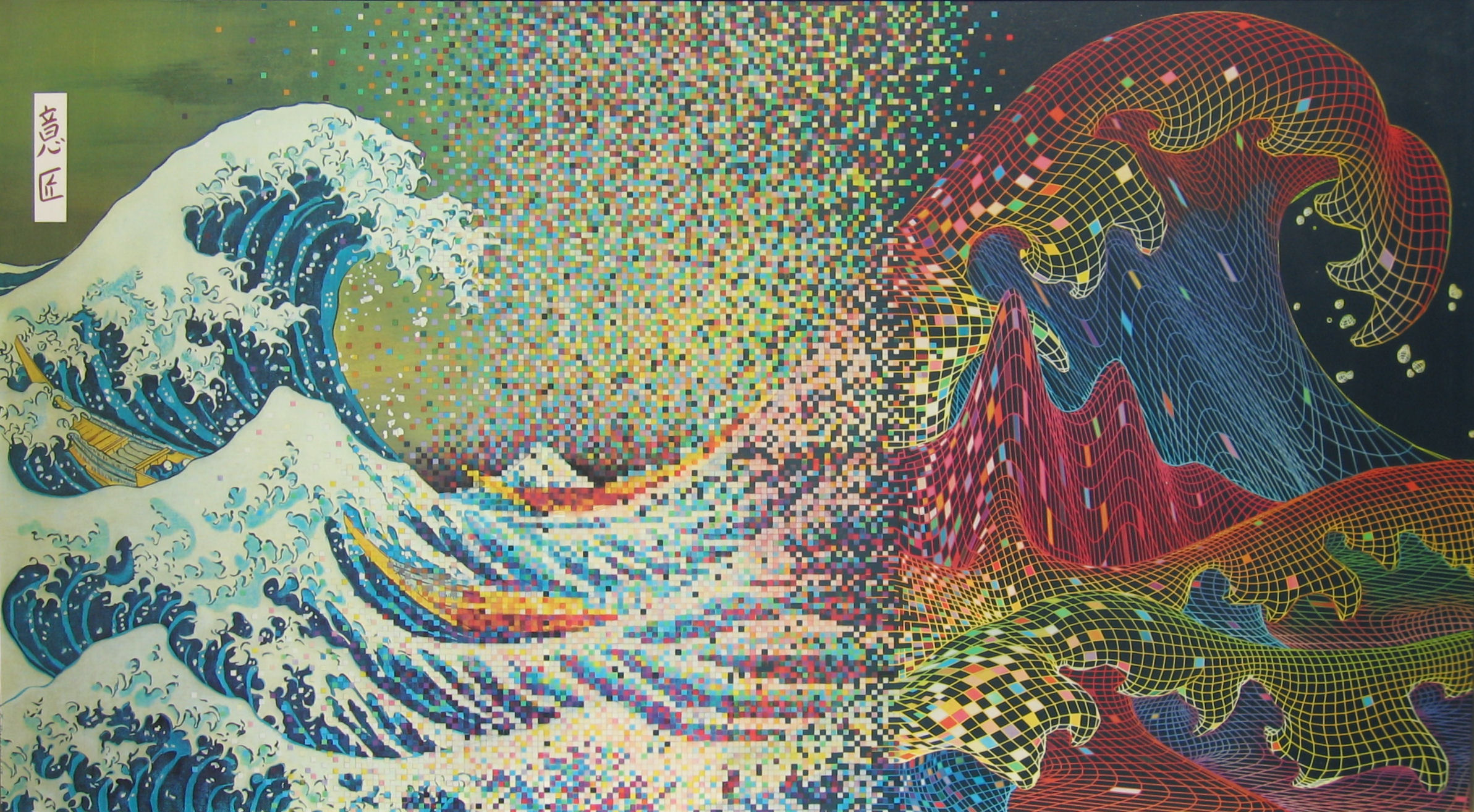
Pixelization has also been used for artistic effect, notably in the art print The Wave of the Future, a reinterpretation of Katsushika Hokusai's The Great Wave off Kanagawa. In this updated print, the image of the large ocean wave shifts from the traditional style of the Japanese woodcut print to a pixelized image and finally to a wireframe model computer graphics image.[1][2] Westworld (1973) was the first feature film to use digital image processing to pixelize photography to simulate an android's point of view.
The 2010 third-person cover shooter Kane & Lynch 2: Dog Days also used pixelization for artistic purposes, as nudity and headshots are pixelated in the game, to make the game appear more like user-generated content.

A black rectangular or square box (known as censor bars) may be used to occlude parts of images completely (for example, a black bar covering the eyes instead of the entire face being pixelized). Censor bars were extensively used as a graphic device in the January 2012 protests against SOPA and PIPA.
A drawback of pixelization is that any differences between the large pixels can be exploited in moving images to reconstruct the original, unpixelized image;[3] squinting at a pixelized, moving image can sometimes achieve a similar result. In both cases, integration of the large pixels over time allows smaller, more accurate pixels to be constructed in a still image result. Completely obscuring the censored area with pixels of a constant color or pixels of random colors escapes this drawback but can be more aesthetically jarring.
An additional drawback, when pixelization is used to reduce the repulsing, disturbing or, more generally shocking, aspect of an image, is that all information contained in the pixelized area is lost for the audience.[4] Other visual processing techniques can help reduce the shocking aspect of images or videos while preserving most of the information of the media.[4][5]
Nudity is obscured on broadcast television stations in the United States. The Federal Communications Commission states it is a violation of federal law to air obscene, indecent, and profane programming at any time, especially during certain hours. Monetary penalties and revocation of licenses are issued for law breakers.[6] Japanese pornography laws require that genitals in films (including animated works) and other forms of adult media (such as eroge, drawings, etc) be obscured. Article 175 of Penal Code (Act No.45 of 1907) still in effect today in Japan forbids any person and imprisons anyone who distributes, sells or displays in public an obscene document, drawing or other objects of such nature.[7] In Thailand, restrictions are placed on television broadcast depiction of cigarettes being smoked,[8] alcohol being consumed, or guns being pointed at people. Pixelization is one method of censoring this content.
Article 175


Source: Wikipedia. Article content is retrieved live through the MediaWiki API.

Pixelization (in British English pixelisation) or mosaic processing is any technique used in editing images or video, whereby an image is blurred by displaying part or all of it at a markedly lower resolution. It is primarily used for censorship. The effect is a standard graphics filter, available in all but the most basic bitmap graphics editors.

Fogging, also known as blurring, is a type of visual used for censorship or privacy. A visual area of a picture, tv show, video, or a movie is blurred to obscure it from sight. This type of form of censorship is used for sexually related images/scenes, hiding genitals, pubic hair, buttocks, female nipples/breasts, someone saying offensive words on lip reading, or sexual activity of any sort. Pixelization is a form of fogging. In Japan, where it is called bokashi, fogging is employed on most films aired on public television that feature adult content of any kind, or on most films that show pubic hair or genitals, including hardcore pornography. This form of editing also appears in television programs where an individual's face may not be shown due to legal or privacy concerns. As it does not contrast with the surrounding image very much, it is arguably preferable over most other forms of censorship. However, unlike other forms of visual censoring, it does not allow the preservation of any information about the original stimulus. Fogging is also used if a scene is too bloody and gruesome to be rendered even in black and white, and also used when obscene language is being censored by an audible bleep, and when the "finger" gesture is shown, as well as on vehicle license plates (to protect the identity of a vehicle's owner), and over branded items and specific company names to prevent trademark or copyright issues. Although it is generally effective for obscuring details from the naked eye, fogging is not a sure method of removing information from images, as it is often possible to recover at least some information using blind deconvolution techniques.
Censor bars, also known as black bars, are a form of text, photography, or video censorship in which sensitive content is occluded by rectangular monochrome boxes. Since the creation of digital editing software which can apply less obtrusive effects such as pixelization and blurring, censor bars are typically used for satire. but remain in use to address privacy concerns. Censor bars are also used in art forms such as blackout poetry. Censor bars may also have the words "censored", "redacted", "private information", "sensitive information", etc. to indicate their presence. Alternative methods of obscuring content include overlaid images such as fig leaves.
Easy Delivery Co. is a job simulation video game by indie developer Sam C. and published by Oro Interactive. The game takes place in a set of mountainous, snow-filled towns where the player, an anthropomorphic cat, delivers packages between shops and houses with their kei truck. As the story progresses, the player unravels a mystery that affects the personalities of the various shopkeepers in the game. Following his final year at a game development course, Sam Cameron began developing a split-screen racing game, which would eventually change into a delivery game. The game's graphics emulate the style of a PlayStation 1 game, using lower fidelity graphics and pixelization. A demo for the game was released in April 2025, only including one of the three areas accessible in the full game. Easy Delivery Co. was released on 18 September 2025 on Windows, and has been given generally favorable reviews.
Before the 1921 destruction of Tulsa’s Greenwood District, Black residents had created a remarkable center of business and community life. The district included stores, professional offices, entertainment venues and homes owned by Black citizens. Understanding Greenwood means learning what was built—not only what was burned.
MORE →Mae Jemison, aboard Space Shuttle Endeavour in 1992.