Civil Rights
Movements, leaders, victories and the continuing fight for equality.

Explore the people, places, events, achievements, struggles and stories that shaped our journey.
Movements, leaders, victories and the continuing fight for equality.
Innovation, patents, science, technology and world-changing contributions.
Pioneers, champions, Negro Leagues, records, activism and excellence.
Meet the people whose lives, choices and achievements shaped the journey.
Black towns, communities, institutions and places where history happened.
Moments that changed communities, movements, institutions and the nation.
In August 1908, a white mob attacked Springfield, Illinois’s Black community, destroying homes and businesses and lynching two Black men. National outrage over the violence helped spur the movement that created the NAACP the following year.
MORE →Reflects the personal views, recollections, and perspective of the author, Mike Davis.
This is a personal recollection on the Move fire on May 13, 1985
In mathematics, a projective bundle is a fiber bundle whose fibers are projective spaces.
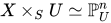
By definition, a scheme X over a Noetherian scheme S is a Pn-bundle if it is locally a projective n-space; i.e., and transition automorphisms are linear. Over a regular scheme S such as a smooth variety, every projective bundle is of the form for some vector bundle (locally free sheaf) E.[1]
Every vector bundle over a variety X gives a projective bundle by taking the projective spaces of the fibers, but not all projective bundles arise in this way: there is an obstruction in the cohomology group H2(X,O*). To see why, recall that a projective bundle comes equipped with transition functions on double intersections of a suitable open cover. On triple overlaps, any lift of these transition functions satisfies the cocycle condition up to an invertible function. The collection of these functions forms a 2-cocycle which vanishes in H2(X,O*) only if the projective bundle is the projectivization of a vector bundle. In particular, if X is a compact Riemann surface then H2(X,O*)=0, and so this obstruction vanishes.
The projective bundle of a vector bundle E is the same thing as the Grassmann bundle of 1-planes in E.
The projective bundle P(E) of a vector bundle E is characterized by the universal property that says:[2]
For example, taking f to be p, one gets the line subbundle O(-1) of p*E, called the tautological line bundle on P(E). Moreover, this O(-1) is a universal bundle in the sense that when a line bundle L gives a factorization f = p ∘ g, L is the pullback of O(-1) along g. See also Cone#O(1) for a more explicit construction of O(-1).
On P(E), there is a natural exact sequence (called the tautological exact sequence):
where Q is called the tautological quotient-bundle.
Let E ⊂ F be vector bundles (locally free sheaves of finite rank) on X and G = F/E. Let q: P(F) → X be the projection. Then the natural map O(-1) → q*F → q*G is a global section of the sheaf hom Hom(O(-1), q*G) = q* G ⊗ O(1). Moreover, this natural map vanishes at a point exactly when the point is a line in E; in other words, the zero-locus of this section is P(E).
A particularly useful instance of this construction is when F is the direct sum E ⊕ 1 of E and the trivial line bundle (i.e., the structure sheaf). Then P(E) is a hyperplane in P(E ⊕ 1), called the hyperplane at infinity, and the complement of P(E) can be identified with E. In this way, P(E ⊕ 1) is referred to as the projective completion (or "compactification") of E.
The projective bundle P(E) is stable under twisting E by a line bundle; precisely, given a line bundle L, there is the natural isomorphism:
such that [3] (In fact, one gets g by the universal property applied to the line bundle on the right.)
Many non-trivial examples of projective bundles can be found using fibrations over such as Lefschetz fibrations. For example, an elliptic K3 surface is a K3 surface with a fibration
such that the fibers for are generically elliptic curves. Because every elliptic curve is a genus 1 curve with a distinguished point, there exists a global section of the fibration. Because of this global section, there exists a model of giving a morphism to the projective bundle[4]
defined by the Weierstrass equation
where represent the local coordinates of , respectively, and the coefficients
are sections of sheaves on . Note this equation is well-defined because each term in the Weierstrass equation has total degree (meaning the degree of the coefficient plus the degree of the monomial. For example, ).
The contact bundles, and more generally Grassmann bundles, are projective bundles. The unit tangent bundle of a Riemannian manifold is a double cover of its projectivized tangent bundle.
Let X be a complex smooth projective variety and E a complex vector bundle of rank r on it. Let p: P(E) → X be the projective bundle of E. Then the cohomology ring H*(P(E)) is an algebra over H*(X) through the pullback p*. Then the first Chern class ζ = c1(O(1)) generates H*(P(E)) with the relation
where ci(E) is the i-th Chern class of E. One interesting feature of this description is that one can define Chern classes as the coefficients in the relation; this is the approach taken by Grothendieck.
Over fields other than the complex field, the same description remains true with Chow ring in place of cohomology ring (still assuming X is smooth). In particular, for Chow groups, there is the direct sum decomposition
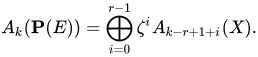
As it turned out, this decomposition remains valid even if X is not smooth nor projective.[5] In contrast, Ak(E) = Ak-r(X), via the Gysin homomorphism, morally because that the fibers of E, the vector spaces, are contractible.
Source: Wikipedia. Article content is retrieved live through the MediaWiki API.
In mathematics, a projective bundle is a fiber bundle whose fibers are projective spaces. By definition, a scheme X over a Noetherian scheme S is a Pn-bundle if it is locally a projective n-space; i.e., X × S U ≃ P U n {\displaystyle X\times _{S}U\simeq \mathbb {P} _{U}^{n}} and transition automorphisms are linear. Over a regular scheme S such as a smooth variety, every projective bundle is of the form P ( E ) {\displaystyle \mathbb {P} (E)} for some vector bundle (locally free sheaf) E.
In mathematics, the tautological bundle is a vector bundle occurring over a Grassmannian in a natural tautological way: for a Grassmannian of k {\displaystyle k} -dimensional subspaces of V {\displaystyle V} , given a point in the Grassmannian corresponding to a k {\displaystyle k} -dimensional vector subspace W ⊆ V {\displaystyle W\subseteq V} , the fiber over W {\displaystyle W} is the subspace W {\displaystyle W} itself. In the case of projective space the tautological bundle is known as the tautological line bundle. The tautological bundle is also called the universal bundle since any vector bundle (over a compact space) is a pullback of the tautological bundle; this is to say a Grassmannian is a classifying space for vector bundles. Because of this, the tautological bundle is important in the study of characteristic classes. Tautological bundles are constructed both in algebraic topology and in algebraic geometry. In algebraic geometry, the tautological line bundle (as invertible sheaf) is O P n ( − 1 ) , {\displaystyle {\mathcal {O}}_{\mathbb {P} ^{n}}(-1),} the dual of the hyperplane bundle or Serre's twisting sheaf O P n ( 1 ) {\displaystyle {\mathcal {O}}_{\mathbb {P} ^{n}}(1)} . The hyperplane bundle is the line bundle corresponding to the hyperplane (divisor) P n − 1 {\displaystyle \mathbb {P} ^{n-1}} in P n {\displaystyle \mathbb {P} ^{n}} . The tautological line bundle and the hyperplane bundle are exactly the two generators of the Picard group of the projective space. In Michael Atiyah's "K-theory", the tautological line bundle over a complex projective space is called the standard line bundle. The sphere bundle of the standard bundle is usually called the Hopf bundle. (cf. Bott generator.) More generally, there are also tautological bundles on a projective bundle of a vector bundle, as well as a Grassmann bundle. The older term canonical bundle has dropped out of favour, on the grounds that canonical is already a heavily overloaded term, in both mathematical terminology and confusion with the canonical class in algebraic geometry could scarcely be avoided.
In algebraic geometry, the Grassmann d-plane bundle of a vector bundle E on an algebraic scheme X is a scheme over X: p : G d ( E ) → X {\displaystyle p:G_{d}(E)\to X} such that the fiber p − 1 ( x ) = G d ( E x ) {\displaystyle p^{-1}(x)=G_{d}(E_{x})} is the Grassmannian of the d-dimensional vector subspaces of E x {\displaystyle E_{x}} . For example, G 1 ( E ) = P ( E ) {\displaystyle G_{1}(E)=\mathbb {P} (E)} is the projective bundle of E. In the other direction, a Grassmann bundle is a special case of a (partial) flag bundle. Concretely, the Grassmann bundle can be constructed as a Quot scheme. The Grassmann bundle of the tangent bundle is the contact bundle. Like the usual Grassmannian, the Grassmann bundle comes with natural vector bundles on it; namely, there are universal or tautological subbundle S and universal quotient bundle Q that fit into 0 → S → p ∗ E → Q → 0 {\displaystyle 0\to S\to p^{*}E\to Q\to 0} . Specifically, if V is in the fiber p−1(x), then the fiber of S over V is V itself; thus, S has rank r = d = dim(V) and ∧ d S {\displaystyle \wedge ^{d}S} is the determinant line bundle. Now, by the universal property of a projective bundle, the injection ∧ r S → p ∗ ( ∧ r E ) {\displaystyle \wedge ^{r}S\to p^{*}(\wedge ^{r}E)} corresponds to the morphism over X: G d ( E ) → P ( ∧ r E ) {\displaystyle G_{d}(E)\to \mathbb {P} (\wedge ^{r}E)} , which is nothing but a family of Plücker embeddings. The relative tangent bundle TGd(E)/X of Gd(E) is given by T G d ( E ) / X = Hom ( S , Q ) = S ∨ ⊗ Q , {\displaystyle T_{G_{d}(E)/X}=\operatorname {Hom} (S,Q)=S^{\vee }\otimes Q,} which morally is given by the second fundamental form. In the case d = 1, it is given as follows: if V is a finite-dimensional vector space, then for each line l {\displaystyle l} in V passing through the origin (a point of P ( V ) {\displaystyle \mathbb {P} (V)} ), there is the natural identification (see Chern class#Complex projective space for example): Hom ( l , V / l ) = T l P ( V ) {\displaystyle \operatorname {Hom} (l,V/l)=T_{l}\mathbb {P} (V)} and the above is the family-version of this identification. (The general care is a generalization of this.) In the case d = 1, the early exact sequence tensored with the dual of S = O(-1) gives: 0 → O P ( E ) → p ∗ E ⊗ O P ( E ) ( 1 ) → T P ( E ) / X → 0 {\displaystyle 0\to {\mathcal {O}}_{\mathbb {P} (E)}\to p^{*}E\otimes {\mathcal {O}}_{\mathbb {P} (E)}(1)\to T_{\mathbb {P} (E)/X}\to 0} , which is the relative version of the Euler sequence.
In mathematics, the Euler sequence is a particular exact sequence of sheaves on n-dimensional projective space over a ring. It shows that the sheaf of relative differentials is stably isomorphic to an ( n + 1 ) {\displaystyle (n+1)} -fold sum of the dual of the Serre twisting sheaf. The Euler sequence generalizes to that of a projective bundle as well as a Grassmann bundle (see the latter article for this generalization.)
Before the 1921 destruction of Tulsa’s Greenwood District, Black residents had created a remarkable center of business and community life. The district included stores, professional offices, entertainment venues and homes owned by Black citizens. Understanding Greenwood means learning what was built—not only what was burned.
MORE →The Greenwood District.