Civil Rights
Movements, leaders, victories and the continuing fight for equality.

Explore the people, places, events, achievements, struggles and stories that shaped our journey.
Movements, leaders, victories and the continuing fight for equality.
Innovation, patents, science, technology and world-changing contributions.
Pioneers, champions, Negro Leagues, records, activism and excellence.
Meet the people whose lives, choices and achievements shaped the journey.
Black towns, communities, institutions and places where history happened.
Moments that changed communities, movements, institutions and the nation.
Mansa Musa was the ruler of the Mali Empire in West Africa. Details recorded here should be sourced; unknown information is left blank.
MORE →Reflects the personal views, recollections, and perspective of the author, Mike Davis.
This is a personal recollection on the Move fire on May 13, 1985

Prony analysis (Prony's method) was developed by Gaspard Riche de Prony in 1795. However, practical use of the method awaited the digital computer.[1] Similar to the Fourier transform, Prony's method extracts valuable information from a uniformly sampled signal and builds a series of damped complex exponentials or damped sinusoids. This allows the estimation of frequency, amplitude, phase and damping components of a signal.
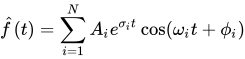
Let be a signal consisting of evenly spaced samples. Prony's method fits a function
to the observed . After some manipulation utilizing Euler's formula, the following result is obtained, which allows more direct computation of terms:
where
Prony's method is essentially a decomposition of a signal with complex exponentials via the following process:
Regularly sample so that the -th of samples may be written as
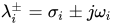
If happens to consist of damped sinusoids, then there will be pairs of complex exponentials such that
where
Because the summation of complex exponentials is the homogeneous solution to a linear difference equation, the following difference equation will exist:
The key to Prony's Method is that the coefficients in the difference equation are related to the following polynomial:
These facts lead to the following three steps within Prony's method:
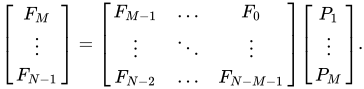
1) Construct and solve the matrix equation for the values:
Note that if , a generalized matrix inverse may be needed to find the values .
2) After finding the values, find the roots (numerically if necessary) of the polynomial
The -th root of this polynomial will be equal to .
3) With the values, the values are part of a system of linear equations that may be used to solve for the values:
where unique values are used. It is possible to use a generalized matrix inverse if more than samples are used.
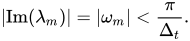
Note that solving for will yield ambiguities, since only was solved for, and for an integer . This leads to the same Nyquist sampling criterion to which discrete Fourier transforms are subject
Source: Wikipedia. Article content is retrieved live through the MediaWiki API.

Prony analysis (Prony's method) was developed by Gaspard Riche de Prony in 1795. However, practical use of the method awaited the digital computer. Similar to the Fourier transform, Prony's method extracts valuable information from a uniformly sampled signal and builds a series of damped complex exponentials or damped sinusoids. This allows the estimation of frequency, amplitude, phase and damping components of a signal.

The Prony brake is a device invented by Gaspard de Prony in 1821 to measure the torque produced by an engine. The term "brake horsepower" is one measurement of power derived from this method of measuring torque. (Power is calculated by multiplying torque by rotational speed.) Essentially the measurement is made by wrapping a cord or belt around the output shaft of the engine and measuring the force transferred to the belt through friction. The friction is increased by tightening the belt until the frequency of rotation of the shaft is reduced to a desired rotational speed. In practice more engine power can then be applied until the limit of the engine is reached. In its simplest form an engine is connected to a rotating drum by means of an output shaft. A friction band is wrapped around half the drum's circumference and each end attached to a separate spring balance. A substantial pre-load is then applied to the ends of the band, so that each spring balance has an initial and identical reading. When the engine is running, the frictional force between the drum and the band will increase the force reading on one balance and decrease it on the other. The difference between the two readings multiplied by the radius of the driven drum is equal to the torque. If the engine speed is measured with a tachometer, the brake horsepower is easily calculated. An alternate mechanism is to clamp a lever to the shaft and measure using a single balance. The torque is then related to the lever length, shaft diameter and measured force. The device is generally used over a range of engine speeds to obtain power and torque curves for the engine, since there is a non-linear relationship between torque and engine speed for most engine types. Power output in SI units may be calculated as follows: Rotary power (in newton-meters per second, N·m/s) = 2π × the distance from the center-line of the drum (the friction device) to the point of measurement (in meters, m) × rotational speed (in revolutions per second) × measured force (in newtons, N). Or in Imperial units: Rotary power (in pound-feet per second, lbf·ft/s) = 2π × distance from center-line of the drum (the friction device) to the point of measurement (in feet, ft) × rotational speed (in revolutions per second) × measured force (in pounds, lbf).

Generalized pencil-of-function method (GPOF), also known as matrix pencil method, is a signal processing technique for estimating a signal or extracting information with complex exponentials. Being similar to Prony and original pencil-of-function methods, it is generally preferred to those for its robustness and computational efficiency. The method was originally developed by Yingbo Hua and Tapan Sarkar for estimating the behaviour of electromagnetic systems by its transient response, building on Sarkar's past work on the original pencil-of-function method. The method has a plethora of applications in electrical engineering, particularly related to problems in computational electromagnetics, microwave engineering and antenna theory.

A Kater's pendulum is a reversible free swinging pendulum invented by British physicist and army captain Henry Kater in 1817 (made public on 29 January 1818), for use as a gravimeter instrument to measure the local acceleration of gravity. Its advantage is that, unlike previous pendulum gravimeters, the pendulum's centre of gravity and center of oscillation do not have to be determined, allowing a greater accuracy. For about a century, until the 1930s, Kater's pendulum and its various refinements remained the standard method for measuring the strength of the Earth's gravity during geodetic surveys. It is now used only for demonstrating pendulum principles.
Before the 1921 destruction of Tulsa’s Greenwood District, Black residents had created a remarkable center of business and community life. The district included stores, professional offices, entertainment venues and homes owned by Black citizens. Understanding Greenwood means learning what was built—not only what was burned.
MORE →Madam C.J. Walker






![{\displaystyle {\hat {f}}(\Delta _{t}n)=\sum _{m=1}^{M}{\hat {f}}[\Delta _{t}(n-m)]P_{m},\quad n=M,\dots ,N-1.}](https://wikimedia.org/api/rest_v1/media/math/render/svg/b05e63816d999af78956c38f9f0d64f531728659)