Civil Rights
Movements, leaders, victories and the continuing fight for equality.

Explore the people, places, events, achievements, struggles and stories that shaped our journey.
Movements, leaders, victories and the continuing fight for equality.
Innovation, patents, science, technology and world-changing contributions.
Pioneers, champions, Negro Leagues, records, activism and excellence.
Meet the people whose lives, choices and achievements shaped the journey.
Black towns, communities, institutions and places where history happened.
Moments that changed communities, movements, institutions and the nation.
Katherine Johnson’s mathematical calculations helped guide some of America’s most important early space missions while she confronted the racial and gender barriers faced by Black women in twentieth-century America.
MORE →Reflects the personal views, recollections, and perspective of the author, Mike Davis.
This is a personal recollection on the Move fire on May 13, 1985
In aerospace engineering, concerning aircraft, rocket and spacecraft design, overall propulsion system efficiency is the efficiency with which the energy contained in a vehicle's fuel is converted into kinetic energy of the vehicle, to accelerate it, or to replace losses due to aerodynamic drag or gravity. Mathematically, it is represented as ,[1] where is the cycle efficiency and is the propulsive efficiency.
The cycle efficiency is expressed as the percentage of the heat energy in the fuel that is converted to mechanical energy in the engine, and the propulsive efficiency is expressed as the proportion of the mechanical energy actually used to propel the aircraft. The propulsive efficiency is always less than one, because conservation of momentum requires that the exhaust have some of the kinetic energy, and the propulsive mechanism (whether propeller, jet exhaust, or ducted fan) is never perfectly efficient. It is greatly dependent on exhaust expulsion velocity and airspeed.
Most aerospace vehicles are propelled by heat engines of some kind, usually an internal combustion engine. The efficiency of a heat engine relates how much useful work is output for a given amount of heat energy input.
From the laws of thermodynamics:
In other words, a heat engine absorbs heat from some heat source, converting part of it to useful work, and delivering the rest to a heat sink at lower temperature. In an engine, efficiency is defined as the ratio of useful work done to energy expended.
The theoretical maximum efficiency of a heat engine, the Carnot efficiency, depends only on its operating temperatures. Mathematically, this is because in reversible processes, the cold reservoir would gain the same amount of entropy as that lost by the hot reservoir (i.e., ), for no change in entropy. Thus:
where is the absolute temperature of the hot source and that of the cold sink, usually measured in kelvins. Note that is positive while is negative; in any reversible work-extracting process, entropy is overall not increased, but rather is moved from a hot (high-entropy) system to a cold (low-entropy one), decreasing the entropy of the heat source and increasing that of the heat sink.
Propulsive efficiency is defined as the ratio of propulsive power (i.e. thrust times velocity of the vehicle) to work done on the fluid. In generic terms, the propulsive power can be calculated as follows:
The thrust can be computed from intake and exhaust massflows ( and ) and velocities ( and ):
The work done by the engine to the flow, on the other hand, is the change in kinetic energy per time. This does not take into account the efficiency of the engine used to generate the power, nor of the propeller, fan or other mechanism used to accelerate air. It merely refers to the work done to the flow, by any means, and can be expressed as the difference between exhausted kinetic energy flux and incoming kinetic energy flux:
The propulsive efficiency can therefore be computed as:
Depending on the type of propulsion used, this equation can be simplified in different ways, demonstrating some of the peculiarities of different engine types. The general equation already shows, however, that propulsive efficiency improves when using large massflows and small velocities compared to small mass-flows and large velocities, since the squared terms in the denominator grow faster than the non-squared terms.
The losses modelled by propulsive efficiency are explained by the fact that any mode of aero propulsion leaves behind a jet moving into the opposite direction of the vehicle. The kinetic energy flux in this jet is for the case that .

The propulsive efficiency formula for air-breathing engines is given below.[2][3] It can be derived by setting in the general equation, and assuming that . This cancels out the mass-flow and leads to:
For pure jet engines, particularly with afterburner, a small amount of accuracy can be gained by not assuming the intake and exhaust massflow to be equal, since the exhaust gas also contains the added mass of the fuel injected. For turbofan engines, the exhaust massflow may be marginally smaller than the intake massflow because the engine supplies "bleed air" from the compressor to the aircraft. In most circumstances, this is not taken into account, as it makes no significant difference to the computed propulsive efficiency.
By computing the exhaust velocity from the equation for thrust (while still assuming ), we can also obtain the propulsive efficiency as a function of specific thrust ():
A corollary of this is that, particularly in air breathing engines, it is more energy efficient to accelerate a large amount of air by a small amount, than it is to accelerate a small amount of air by a large amount, even though the thrust is the same. This is why turbofan engines are more efficient than simple jet engines at subsonic speeds.

A rocket engine's is usually high due to the high combustion temperatures and pressures, and the long converging-diverging nozzle used. It varies slightly with altitude due to changing atmospheric pressure, but can be up to 70%. Most of the remainder is lost as heat in the exhaust.
Rocket engines have a slightly different propulsive efficiency () than air-breathing jet engines, as the lack of intake air changes the form of the equation. This also allows rockets to exceed their exhaust's velocity.
Similarly to jet engines, matching the exhaust speed and the vehicle speed gives optimum efficiency, in theory. However, in practice, this results in a very low specific impulse, causing much greater losses due to the need for exponentially larger masses of propellant. Unlike ducted engines, rockets give thrust even when the two speeds are equal.
In 1903, Konstantin Tsiolkovsky discussed the average propulsive efficiency of a rocket, which he called the utilization (utilizatsiya), the "portion of the total work of the explosive material transferred to the rocket" as opposed to the exhaust gas.[6]

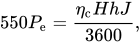
The calculation is somewhat different for reciprocating and turboprop engines which rely on a propeller for propulsion since their output is typically expressed in terms of power rather than thrust. The equation for heat added per unit time, Q, can be adopted as follows:
where H = calorific value of the fuel in BTU/lb, h = fuel consumption rate in lb/hr and J = mechanical equivalent of heat = 778.24 ft.lb/BTU, where is engine output in horsepower, converted to foot-pounds/second by multiplication by 550. Given that specific fuel consumption is Cp = h/Pe and H = 20 052 BTU/lb for gasoline, the equation is simplified to:
expressed as a percentage.
Assuming a typical propeller efficiency of 86% (for the optimal airspeed and air density conditions for the given propeller design[citation needed]), maximum overall propulsion efficiency is estimated as:
Source: Wikipedia. Article content is retrieved live through the MediaWiki API.
In aerospace engineering, concerning aircraft, rocket and spacecraft design, overall propulsion system efficiency η {\displaystyle \eta } is the efficiency with which the energy contained in a vehicle's fuel is converted into kinetic energy of the vehicle, to accelerate it, or to replace losses due to aerodynamic drag or gravity. Mathematically, it is represented as η = η c η p {\displaystyle \eta =\eta _{\mathrm {c} }\eta _{\mathrm {p} }} , where η c {\displaystyle \eta _{\mathrm {c} }} is the cycle efficiency and η p {\displaystyle \eta _{\mathrm {p} }} is the propulsive efficiency. The cycle efficiency is expressed as the percentage of the heat energy in the fuel that is converted to mechanical energy in the engine, and the propulsive efficiency is expressed as the proportion of the mechanical energy actually used to propel the aircraft. The propulsive efficiency is always less than one, because conservation of momentum requires that the exhaust have some of the kinetic energy, and the propulsive mechanism (whether propeller, jet exhaust, or ducted fan) is never perfectly efficient. It is greatly dependent on exhaust expulsion velocity and airspeed.

An ion thruster, ion drive, or ion engine is a form of electric propulsion used for spacecraft propulsion. An ion thruster creates a cloud of positive ions from a neutral gas by ionizing it to extract some electrons from its atoms. The ions are then accelerated using electricity to create thrust. Ion thrusters are categorized as either electrostatic or electromagnetic. Electrostatic thruster ions are accelerated by the Coulomb force along the electric field direction. Temporarily stored electrons are reinjected by a neutralizer in the cloud of ions after it has passed through the electrostatic grid, so the gas becomes neutral again and can freely disperse in space without any further electrical interaction with the thruster. By contrast, electromagnetic thruster ions are accelerated by the Lorentz force to accelerate all species (free electrons as well as positive and negative ions) in the same direction whatever their electric charge, and are specifically referred to as plasma propulsion engines, where the electric field is not in the direction of the acceleration. Ion thrusters in operation typically consume 1–7 kW of power, have exhaust velocities around 20–50 km/s (12–30 mi/s, Isp 2000–5000 s), and possess thrusts of 25–250 mN and a propulsive efficiency of 65–80%; experimental ion thrusters have achieved 100 kW (130 hp), 5 N (1.1 lbf). The 1998 Deep Space 1 spacecraft changed velocity by 4.3 km/s (2.7 mi/s) with its ion thruster, and consumed 73.4 kg (162 lb) of xenon. The 2007 Dawn spacecraft achieved velocity change of 11.5 km/s (7.1 mi/s), though with less efficiency, having consumed 425 kg (937 lb) of xenon. Applications include control of the orientation and position of orbiting satellites (some satellites have dozens of low-power ion thrusters), use as a main propulsion engine for low-mass robotic space vehicles (such as Deep Space 1 and Dawn), and serving as propulsion thrusters for crewed spacecraft and space stations (e.g. Tiangong). Ion thrust engines are generally practical only in the vacuum of space as the engine's minuscule thrust cannot overcome any significant air resistance without radical design changes, as may be found in the 'Atmosphere Breathing Electric Propulsion' concept. The Massachusetts Institute of Technology (MIT) has created designs that are able to fly for short distances and at low speeds at ground level, using ultra-light materials and low drag aerofoils. An ion engine cannot usually generate sufficient thrust to achieve initial liftoff from any celestial body with significant surface gravity. For these reasons, spacecraft must rely on other methods such as conventional chemical rockets or non-rocket launch technologies to reach their initial orbit.

The bypass ratio (BPR) of a turbofan engine is the ratio between the mass flow rate of the bypass stream to the mass flow rate entering the core. A 10:1 bypass ratio, for example, means that 10 kg of air passes through the bypass duct for every 1 kg of air passing through the core. Turbofan engines are usually described in terms of BPR, which together with engine pressure ratio, turbine inlet temperature and fan pressure ratio are important design parameters. In addition, BPR is quoted for turboprop and unducted fan installations because their high propulsive efficiency gives them the overall efficiency characteristics of very high bypass turbofans. This allows them to be shown together with turbofans on plots which show trends of reducing specific fuel consumption (SFC) with increasing BPR. BPR is also quoted for lift fan installations where the fan airflow is remote from the engine and doesn't physically touch the engine core. Bypass provides a lower fuel consumption for the same thrust, measured as thrust specific fuel consumption (grams/second fuel per unit of thrust in kN using SI units). Lower fuel consumption that comes with high bypass ratios applies to turboprops, using a propeller rather than a ducted fan. High bypass designs are the dominant type for commercial passenger aircraft and both civilian and military jet transports. Business jets use medium BPR engines. Combat aircraft use engines with low bypass ratios to compromise between fuel economy and the requirements of combat: high power-to-weight ratios, supersonic performance, and the ability to use afterburners.

The fuel economy in aircraft is the measure of the transport energy efficiency of aircraft. Fuel efficiency is increased with better aerodynamics and by reducing weight, and with improved engine brake-specific fuel consumption and propulsive efficiency or thrust-specific fuel consumption. Endurance and range can be maximized with the optimum airspeed, and economy is better at optimum altitudes, usually higher. An airline efficiency depends on its fleet fuel burn, seating density, air cargo and passenger load factor, while operational procedures like maintenance and routing can save fuel. Average fuel burn of new aircraft fell 45% from 1968 to 2014, a compounded annual reduction 1.3% with a variable reduction rate. In 2018, CO2 emissions totalled 747 million tonnes for passenger transport, for 8.5 trillion revenue passenger kilometers (RPK), giving an average of 88 grams CO2 per RPK; this represents 28 g of fuel per kilometer, or a 3.5 L/100 km (67 mpg‑US; 81 mpg‑imp) fuel consumption per passenger, on average. The worst-performing flights are short trips of from 500 to 1500 kilometers because the fuel used for takeoff is relatively large compared to the amount expended in the cruise segment, and because less fuel-efficient regional jets are typically used on shorter flights. New technology can reduce engine fuel consumption, like higher pressure and bypass ratios, geared turbofans, open rotors, hybrid electric or fully electric propulsion; and airframe efficiency with retrofits, better materials and systems and advanced aerodynamics.
Before the 1921 destruction of Tulsa’s Greenwood District, Black residents had created a remarkable center of business and community life. The district included stores, professional offices, entertainment venues and homes owned by Black citizens. Understanding Greenwood means learning what was built—not only what was burned.
MORE →Shirley Chisholm, elected in 1968.