Civil Rights
Movements, leaders, victories and the continuing fight for equality.

Explore the people, places, events, achievements, struggles and stories that shaped our journey.
Movements, leaders, victories and the continuing fight for equality.
Innovation, patents, science, technology and world-changing contributions.
Pioneers, champions, Negro Leagues, records, activism and excellence.
Meet the people whose lives, choices and achievements shaped the journey.
Black towns, communities, institutions and places where history happened.
Moments that changed communities, movements, institutions and the nation.
Wilmington, North Carolina once had a thriving Black middle class and an elected interracial government. In 1898 white supremacists used violence to overthrow that government, kill Black residents and drive many others from the city.
MORE →Reflects the personal views, recollections, and perspective of the author, Mike Davis.
This is a personal recollection on the Move fire on May 13, 1985


In mathematics, an annulus (pl.: annuli or annuluses) is the region between two concentric circles. Informally, it is shaped like a ring or a hardware washer. The word "annulus" is borrowed from the Latin word anulus or annulus meaning 'little ring'. The adjectival form is annular (as in annular eclipse).
The open annulus is topologically equivalent to both the open cylinder S1 × (0,1) and the punctured plane.
The area of an annulus is the difference in the areas of the larger circle of radius R and the smaller one of radius r:

The area of an annulus is determined by the length of the longest line segment within the annulus, which is the chord tangent to the inner circle, 2d in the accompanying diagram. That can be shown using the Pythagorean theorem since this line is tangent to the smaller circle and perpendicular to its radius at that point, so d and r are sides of a right-angled triangle with hypotenuse R, and the area of the annulus is given by
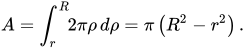
The area can also be obtained via calculus by dividing the annulus up into an infinite number of annuli of infinitesimal width dρ and area 2πρ dρ and then integrating from ρ = r to ρ = R:
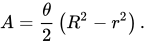
The area of an annulus sector (the region between two circular sectors with overlapping radii) of angle θ, with θ measured in radians, is given by
In complex analysis an annulus ann(a; r, R) in the complex plane is an open region defined as
If , the region is known as the punctured disk (a disk with a point hole in the center) of radius R around the point a.
As a subset of the complex plane, an annulus can be considered as a Riemann surface. The complex structure of an annulus depends only on the ratio r/R. Each annulus ann(a; r, R) can be holomorphically mapped to a standard one centered at the origin and with outer radius 1 by the map
The inner radius is then r/R < 1.
The Hadamard three-circle theorem is a statement about the maximum value a holomorphic function may take inside an annulus.
The Joukowsky transform conformally maps an annulus onto an ellipse with a slit cut between foci.

Source: Wikipedia. Article content is retrieved live through the MediaWiki API.

In mathematics, an annulus (pl.: annuli or annuluses) is the region between two concentric circles. Informally, it is shaped like a ring or a hardware washer. The word "annulus" is borrowed from the Latin word anulus or annulus meaning 'little ring'. The adjectival form is annular (as in annular eclipse). The open annulus is topologically equivalent to both the open cylinder S1 × (0,1) and the punctured plane.
In topology, puncturing a manifold is removing a finite set of points from that manifold. The set of points can be small as a single point. In this case, the manifold is known as once-punctured. With the removal of a second point, it becomes twice-punctured, and so on. Examples of punctured manifolds include the open disk (which is a sphere with a single puncture), the cylinder (which is a sphere with two punctures), and the Möbius strip (which is a projective plane with a single puncture). The set of non-zero complex numbers is the complex plane once punctured at the origin, sometimes denoted C ∗ {\displaystyle \mathbb {C} ^{*}} .

In mathematics, the complex plane is the plane formed by the complex numbers, with a Cartesian coordinate system such that the horizontal x-axis, called the real axis, is formed by the real numbers, and the vertical y-axis, called the imaginary axis, is formed by the imaginary numbers. The complex plane allows for a geometric interpretation of complex numbers. Under addition, they add like vectors. The multiplication of two complex numbers can be expressed more easily in polar coordinates: the magnitude or modulus of the product is the product of the two absolute values, or moduli, and the angle or argument of the product is the sum of the two angles, or arguments. In particular, multiplication by a complex number of modulus 1 acts as a rotation (the circle group). The complex plane is sometimes called the Argand plane or Gauss plane.

In mathematics, the polar coordinate system specifies a given point in a plane by using a distance and an angle as its two coordinates. These are the point's distance from a reference point called the pole, and the point's direction from the pole relative to the direction of the polar axis, a ray drawn from the pole. The distance from the pole is called the radial coordinate, radial distance or simply radius, and the angle is called the angular coordinate, polar angle, or azimuth. The pole is analogous to the origin in a Cartesian coordinate system. Polar coordinates are most appropriate in any context where the phenomenon being considered is inherently tied to direction and length from a center point in a plane, such as spirals. Planar physical systems with bodies moving around a central point, or phenomena originating from a central point, are often simpler and more intuitive to model using polar coordinates. The polar coordinate system is extended to three dimensions in two ways: the cylindrical coordinate system adds a second distance coordinate, and the spherical coordinate system adds a second angular coordinate. Grégoire de Saint-Vincent and Bonaventura Cavalieri independently introduced the system's concepts in the mid-17th century, though the actual term polar coordinates has been attributed to Gregorio Fontana in the 18th century. The initial motivation for introducing the polar system was the study of circular and orbital motion.
Before the 1921 destruction of Tulsa’s Greenwood District, Black residents had created a remarkable center of business and community life. The district included stores, professional offices, entertainment venues and homes owned by Black citizens. Understanding Greenwood means learning what was built—not only what was burned.
MORE →Mae Jemison, aboard Space Shuttle Endeavour in 1992.