Civil Rights
Movements, leaders, victories and the continuing fight for equality.

Explore the people, places, events, achievements, struggles and stories that shaped our journey.
Movements, leaders, victories and the continuing fight for equality.
Innovation, patents, science, technology and world-changing contributions.
Pioneers, champions, Negro Leagues, records, activism and excellence.
Meet the people whose lives, choices and achievements shaped the journey.
Black towns, communities, institutions and places where history happened.
Moments that changed communities, movements, institutions and the nation.
Wilmington, North Carolina once had a thriving Black middle class and an elected interracial government. In 1898 white supremacists used violence to overthrow that government, kill Black residents and drive many others from the city.
MORE →Reflects the personal views, recollections, and perspective of the author, Mike Davis.
This is a personal recollection on the Move fire on May 13, 1985
| Separation axioms in topological spaces | |
|---|---|
| Kolmogorov classification | |
| T0 | Kolmogorov |
| T1 | Fréchet |
| T2 | Hausdorff |
| T2½ | Urysohn |
| completely T2 | completely Hausdorff |
| T3 | regular Hausdorff |
| T3½ | Tychonoff |
| T4 | normal Hausdorff |
| T5 | completely normal Hausdorff |
| T6 | perfectly normal Hausdorff |
In topology and related branches of mathematics, a T1 space is a topological space in which, for every pair of distinct points, each has a neighborhood not containing the other point.[1] An R0 space is one in which this holds for every pair of topologically distinguishable points. The properties T1 and R0 are examples of separation axioms.
Let X be a topological space and let x and y be points in X. We say that x and y are separated if each lies in a neighbourhood that does not contain the other point.
A T1 space is also called an accessible space or a space with Fréchet topology and an R0 space is also called a symmetric space. (The term Fréchet space also has an entirely different meaning in functional analysis. For this reason, the term T1 space is preferred. There is also a notion of a Fréchet–Urysohn space as a type of sequential space. The term symmetric space also has another meaning.)
A topological space is a T1 space if and only if it is both an R0 space and a Kolmogorov (or T0) space (i.e., a space in which distinct points are topologically distinguishable). A topological space is an R0 space if and only if its Kolmogorov quotient is a T1 space.
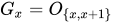
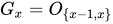
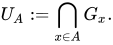
If is a topological space then the following conditions are equivalent:
If is a topological space then the following conditions are equivalent:[3] (where denotes the closure of )
In any topological space we have, as properties of any two points, the following implications
If the first arrow can be reversed the space is R0. If the second arrow can be reversed the space is T0. If the composite arrow can be reversed the space is T1. A space is T1 if and only if it is both R0 and T0.
A finite T1 space is necessarily discrete (since every set is closed).
A space that is locally T1, in the sense that each point has a T1 neighbourhood (when given the subspace topology), is also T1.[4] Similarly, a space that is locally R0 is also R0. In contrast, the corresponding statement does not hold for T2 spaces. For example, the line with two origins is not a Hausdorff space but is locally Hausdorff.
The terms "T1", "R0", and their synonyms can also be applied to such variations of topological spaces as uniform spaces, Cauchy spaces, and convergence spaces. The characteristic that unites the concept in all of these examples is that limits of fixed ultrafilters (or constant nets) are unique (for T1 spaces) or unique up to topological indistinguishability (for R0 spaces).
As it turns out, uniform spaces, and more generally Cauchy spaces, are always R0, so the T1 condition in these cases reduces to the T0 condition. But R0 alone can be an interesting condition on other sorts of convergence spaces, such as pretopological spaces.
| Fields |  | |
|---|---|---|
| Key concepts | ||
| Metrics and properties | ||
| Key results | ||
Source: Wikipedia. Article content is retrieved live through the MediaWiki API.
In topology and related branches of mathematics, a T1 space is a topological space in which, for every pair of distinct points, each has a neighborhood not containing the other point. An R0 space is one in which this holds for every pair of topologically distinguishable points. The properties T1 and R0 are examples of separation axioms.
A symmetric space is, in differential geometry and representation theory, a smooth manifold whose group of symmetries contains an "inversion symmetry" about every point. Examples include: Riemannian symmetric space Hermitian symmetric space Quaternion-Kähler symmetric space Weakly symmetric space In topology, symmetric space may also refer to: R0 space, a topological space in which two topologically distinguishable points can be separated In computational complexity theory, symmetric space may refer to undirected or reversible analogues of nondeterministic space complexity, for instance: SL (complexity), the class of problems solvable in logarithmic symmetric space

EGS-z11-R0 is a high-redshift galaxy located in the constellation Boötes. It was discovered in March 2026 using the James Webb Space Telescope. The object stands out among other galaxies from that period due to an anomalously high concentration of cosmic dust and a mature chemical composition, earning it the unofficial nickname "red monster".

The Earth-centered, Earth-fixed coordinate system (acronym ECEF), also known as the geocentric coordinate system, is a cartesian spatial reference system that represents locations in the vicinity of the Earth (including its surface, interior, atmosphere, and surrounding outer space) as X, Y, and Z measurements from its center of mass. Its most common use is in tracking the orbits of satellites and in satellite navigation systems for measuring locations on the surface of the Earth, but it is also used in applications such as tracking crustal motion. The distance from a given point of interest to the center of Earth is called the geocentric distance, R = X 2 + Y 2 + Z 2 {\displaystyle R={\sqrt {X^{2}+Y^{2}+Z^{2}}}} , which is a generalization of the geocentric radius, R0, not restricted to points on the reference ellipsoid surface. The geocentric altitude is a type of altitude defined as the difference between the two aforementioned quantities: h′ = R − R0; it is not to be confused for the geodetic altitude. Conversions between ECEF and geodetic coordinates (latitude and longitude) are discussed at geographic coordinate conversion.
Before the 1921 destruction of Tulsa’s Greenwood District, Black residents had created a remarkable center of business and community life. The district included stores, professional offices, entertainment venues and homes owned by Black citizens. Understanding Greenwood means learning what was built—not only what was burned.
MORE →The Greenwood District.