Civil Rights
Movements, leaders, victories and the continuing fight for equality.

Explore the people, places, events, achievements, struggles and stories that shaped our journey.
Movements, leaders, victories and the continuing fight for equality.
Innovation, patents, science, technology and world-changing contributions.
Pioneers, champions, Negro Leagues, records, activism and excellence.
Meet the people whose lives, choices and achievements shaped the journey.
Black towns, communities, institutions and places where history happened.
Moments that changed communities, movements, institutions and the nation.
In 1968 Shirley Chisholm became the first Black woman elected to the United States Congress. In 1972 she launched a campaign for the Democratic presidential nomination, breaking another political barrier.
MORE →Reflects the personal views, recollections, and perspective of the author, Mike Davis.
This is a personal recollection on the Move fire on May 13, 1985
Source: National Museum of African American History and Culture, Smithsonian Institution. Rights and restrictions shown above are supplied by the Smithsonian record.

The Jim Crow laws were state and local laws introduced in the Southern United States from the late 19th century to the mid-20th century that enforced racial segregation. The origin of the term Jim Crow is obscure, but probably refers to a minstrel show song called "Jump Jim Crow". Formal and informal racial segregation policies were present in other areas of the United States as well, even as several states outside the South had banned discrimination in public accommodations and voting. Southern laws were enacted by white-dominated state legislatures (Redeemers) to disenfranchise and remove political and economic gains made by African Americans during the Reconstruction era. Such continuing racial segregation was also supported by the successful Lily-white movement. In practice, Jim Crow laws mandated racial segregation in all public facilities in the South, beginning in the 1870s. Jim Crow laws were upheld in 1896 in the case of Plessy v. Ferguson, in which the Supreme Court laid out its "separate but equal" legal doctrine concerning facilities for African Americans. Public education had essentially been segregated since it began during the Reconstruction era after 1863. Companion laws excluded most African Americans from the vote in the South. Although in theory the "equal" segregation doctrine governed public facilities and transportation, facilities for African Americans were consistently inferior and underfunded compared to facilities for white Americans; sometimes, there were no facilities for black people at all. Far from equality, as a body of law, Jim Crow institutionalized economic, educational, political and social disadvantages and second-class citizenship for most African Americans living in the United States. After the National Association for the Advancement of Colored People (NAACP) was founded in 1909, it became involved in a sustained public protest and campaigns against the Jim Crow laws, and the so-called "separate but equal" doctrine. In 1954, segregation of public schools (state-sponsored) was declared unconstitutional by the U.S. Supreme Court in the landmark case Brown v. Board of Education of Topeka. In some states, it took many years to implement this decision, while the Warren Court continued to rule against Jim Crow legislation in other cases such as Heart of Atlanta Motel, Inc. v. United States (1964). Most remaining Jim Crow laws were overturned by the Civil Rights Act of 1964 and the Voting Rights Act of 1965, and Southern states' anti-miscegenation laws were overturned in the 1967 case of Loving v. Virginia.

The nadir of American race relations is a historical period defined by historian Rayford Logan as the worst time for race relations in the United States after the Civil War ended slavery. It overlapped with the Gilded Age and the Progressive Era, following the Reconstruction era and the financial Panic of 1873, amid a continuing decline in cotton prices. The period was characterized by the legal solidification of Jim Crow laws, the rise of lynchings and racial massacres, and the nationwide institution of sundown towns. Historians differ on the period's date range. Logan's 1954 book The Negro in American Life and Thought defines "The Nadir, 1877–1901" when "the Negro's status in American society" fell lowest, arguing for 1901 as the turning point when race relations started to improve. Others, such as John Hope Franklin and Henry Arthur Callis, argue for ending dates as late as 1923. James W. Loewen (2006) argues for a later starting date, seeing the post-Reconstruction era as one of widespread hope for racial equity due to idealistic Northern support for civil rights. In Loewen's view, the true nadir only began when Northern Republicans ceased supporting Southern black people's rights around 1890, and it lasted until the American entry into World War II in 1941. Logan's focus was exclusively on African Americans in the Southern United States, but the period also represents the worst of anti-Chinese and anti-Asian discrimination, when fear of the so-called Yellow Peril incited harassment and violence on the West Coast and the destruction of Denver's Chinatown.
Plessy v. Ferguson, 163 U.S. 537 (1896), was a landmark United States Supreme Court decision ruling that racial segregation laws did not violate the U.S. Constitution as long as the facilities for each race were equal in quality, a doctrine that came to be known as "separate but equal". The decision legitimized the many "Jim Crow laws" re-establishing racial segregation that had been passed in the American South after the end of the Reconstruction era in 1877. The underlying case began in 1892 when Homer Plessy, a mixed-race man, deliberately boarded a whites-only train car in New Orleans. By boarding the whites-only car, Plessy violated Louisiana's Separate Car Act of 1890, which required "equal, but separate" railroad accommodations for white and black passengers. Plessy was charged under the Act, and at his trial his lawyers argued that judge John Howard Ferguson should dismiss the charges on the grounds that the Act was unconstitutional. Ferguson denied the request, and the Louisiana Supreme Court upheld Ferguson's ruling on appeal. Plessy then appealed to the U.S. Supreme Court. In May 1896, the Supreme Court issued a 7–1 decision against Plessy, ruling that the Louisiana law did not violate the Fourteenth Amendment to the U.S. Constitution. It held that although the Fourteenth Amendment established the legal equality of whites and blacks, it did not and could not require the elimination of all "distinctions based upon color". The Court rejected Plessy's lawyers' arguments that the Louisiana law inherently implied that black people were inferior. It gave great deference to American state legislatures' inherent power to make laws regulating health, safety, and morals—the "police power"—and to determine the reasonableness of the laws they passed. Justice John Marshall Harlan was the lone dissenter from the Court's decision, writing that the U.S. Constitution "is color-blind, and neither knows nor tolerates classes among citizens", and so the laws distinguishing races should have been found unconstitutional. Plessy is widely regarded as one of the worst decisions in U.S. Supreme Court history. Despite its infamy, the decision has never been overruled explicitly; however, beginning in 1954 with Brown v. Board of Education, a series of the Court's later decisions have severely weakened Plessy to the point that it is usually considered de facto overruled.

The Reconstruction era, often simply called Reconstruction, was a period in United States history that followed the American Civil War (1861–1865) and was dominated by the legal, social, and political challenges of the abolition of slavery and federal control over, and reintegration of, the former Confederate States into the United States. Three amendments were added to the United States Constitution to grant citizenship and equal civil rights to the newly freed slaves. To circumvent these, former Confederate states imposed poll taxes and literacy tests and sought to intimidate and control the Black population and discourage or prevent them from voting. Throughout the war, the Union was confronted with the issue of how to administer captured areas and handle slaves escaping to Union lines. The United States Army played a vital role in establishing a free labor economy in the South, protecting freedmen's rights and creating educational and religious institutions. Despite its reluctance to interfere with slavery, Congress passed the Confiscation Acts to seize Confederates' slaves, providing a precedent for President Abraham Lincoln to issue the Emancipation Proclamation. Congress established a Freedmen's Bureau to provide much-needed food and shelter to the newly freed slaves. As it became clear the Union would win, Congress debated the process for readmission of seceded states. Radical and moderate Republicans disagreed over the nature of secession, conditions for readmission, and desirability of social reforms. Lincoln favored the "ten percent plan" and vetoed the Wade–Davis Bill which proposed strict conditions for readmission. Lincoln was assassinated in 1865, just as fighting was drawing to a close. He was replaced by Andrew Johnson, who vetoed Radical Republican bills, pardoned Confederate leaders, and allowed Southern states to enact draconian Black Codes that restricted the rights of freedmen. His actions outraged many Northerners and stoked fears the Southern elite would regain power. Radical Republicans swept to power in the 1866 midterm elections, gaining majorities in both houses of Congress. In 1867–68, the Radical Republicans enacted the Reconstruction Acts over Johnson's vetoes, setting the terms by which former Confederate states could be readmitted to the Union. Constitutional conventions held throughout the South gave Black men the right to vote. New state governments were established by a coalition of freedmen, supportive white Southerners, and Northern transplants. They were opposed by "Redeemers" who sought to restore white supremacy and reestablish Democratic Party control of Southern governments and society. Violent groups, including the Ku Klux Klan, White League, and Red Shirts, engaged in paramilitary insurgency and terrorism to disrupt Reconstruction governments and terrorize Republicans. Congressional anger at Johnson's vetoes of Radical Republican legislation led to his impeachment by the House of Representatives, but he was not convicted by the Senate and therefore was not removed from office. Under President Ulysses S. Grant, Radical Republicans enacted additional legislation to enforce civil rights, such as the Ku Klux Klan Act and Civil Rights Act of 1875. However, resistance to Reconstruction by Southern whites and its high cost contributed to its losing support in the North. The 1876 presidential election was marked by Black voter suppression in the South, and the result was close and contested. An Electoral Commission resulted in the Compromise of 1877 which awarded the election to Republican Rutherford B. Hayes on the understanding that federal troops would cease to play an active role in regional politics. Hayes accordingly removed the last federal troops from the South, which historians generally mark as the end of Reconstruction. Efforts to enforce federal civil rights in the South ended in 1890 with the failure of the Lodge Bill. Historians disagree about the legacy of Reconstruction. Criticism focuses on the failure to prevent violence, corruption, starvation and disease. Some consider the Union's policy toward freed slaves as inadequate and toward former slaveholders as too lenient. However, Reconstruction is credited with restoring the federal Union, limiting reprisals against the South, and establishing a legal framework for racial equality via constitutional rights to national birthright citizenship, due process, equal protection of the laws, and male suffrage regardless of race.
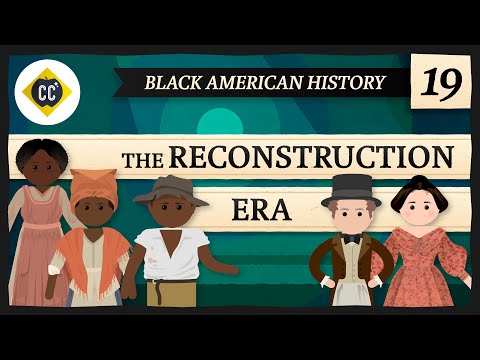
At the end of the Civil War, the United States was still a very divided place. 700000 people had died in a bitter fight over slavery.

Caption
Caption
Description
Description

Before the 1921 destruction of Tulsa’s Greenwood District, Black residents had created a remarkable center of business and community life. The district included stores, professional offices, entertainment venues and homes owned by Black citizens. Understanding Greenwood means learning what was built—not only what was burned.
MORE →The Greenwood District.