Civil Rights
Movements, leaders, victories and the continuing fight for equality.

Explore the people, places, events, achievements, struggles and stories that shaped our journey.
Movements, leaders, victories and the continuing fight for equality.
Innovation, patents, science, technology and world-changing contributions.
Pioneers, champions, Negro Leagues, records, activism and excellence.
Meet the people whose lives, choices and achievements shaped the journey.
Black towns, communities, institutions and places where history happened.
Moments that changed communities, movements, institutions and the nation.
Wilmington, North Carolina once had a thriving Black middle class and an elected interracial government. In 1898 white supremacists used violence to overthrow that government, kill Black residents and drive many others from the city.
MORE →Reflects the personal views, recollections, and perspective of the author, Mike Davis.
This is a personal recollection on the Move fire on May 13, 1985
 | This article needs more citations. (November 2022) |
In graph theory, a regular graph is a graph where each vertex has the same number of neighbors; i.e. every vertex has the same degree or valency. A regular directed graph must also satisfy the stronger condition that the indegree and outdegree of each internal vertex are equal to each other.[1] A regular graph with vertices of degree k is called a k‑regular graph or regular graph of degree k.
Regular graphs of degree at most 2 are easy to classify: a 0-regular graph consists of disconnected vertices, a 1-regular graph consists of disconnected edges, and a 2-regular graph consists of a disjoint union of cycles and infinite chains.
In analogy with the terminology for polynomials of low degrees, a 3-regular or 4-regular graph often is called a cubic graph or a quartic graph, respectively. Similarly, it is possible to denote k-regular graphs with as quintic, sextic, septic, octic, et cetera.
A strongly regular graph is a regular graph where every adjacent pair of vertices has the same number l of neighbors in common, and every non-adjacent pair of vertices has the same number n of neighbors in common. The smallest graphs that are regular but not strongly regular are the cycle graph and the circulant graph on 6 vertices.
The complete graph Km is strongly regular for any m.


By the degree sum formula, a k-regular graph with n vertices has edges. In particular, at least one of the order n and the degree k must be an even number.
A theorem by Nash-Williams says that every k‑regular graph on 2k + 1 vertices has a Hamiltonian cycle.
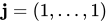
Let A be the adjacency matrix of a graph. Then the graph is regular if and only if is an eigenvector of A.[2] Its eigenvalue will be the constant degree of the graph. Eigenvectors corresponding to other eigenvalues are orthogonal to , so for such eigenvectors , we have .
A regular graph of degree k is connected if and only if the eigenvalue k has multiplicity one. The "only if" direction is a consequence of the Perron–Frobenius theorem.[2]
There is also a criterion for regular and connected graphs : a graph is connected and regular if and only if the matrix of ones J, with , is in the adjacency algebra of the graph (meaning it is a linear combination of powers of A).[3]
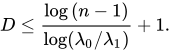
Let G be a k-regular graph with diameter D and eigenvalues of adjacency matrix . If G is not bipartite, then
There exists a -regular graph of order if and only if the natural numbers n and k satisfy the inequality and that is even.
Proof: If a graph with n vertices is k-regular, then the degree k of any vertex v cannot exceed the number of vertices different from v, and indeed at least one of n and k must be even, whence so is their product.
Conversely, if n and k are two natural numbers satisfying both the inequality and the parity condition, then indeed there is a k-regular circulant graph of order n (where the denote the minimal `jumps' such that vertices with indices differing by an are adjacent). If in addition k is even, then , and a possible choice is . Else k is odd, whence n must be even, say with , and then and the `jumps' may be chosen as .
If , then this circulant graph is complete.
Fast algorithms exist to generate, up to isomorphism, all regular graphs with a given degree and number of vertices.[5]
Source: Wikipedia. Article content is retrieved live through the MediaWiki API.
In graph theory, a regular graph is a graph where each vertex has the same number of neighbors; i.e. every vertex has the same degree or valency. A regular directed graph must also satisfy the stronger condition that the indegree and outdegree of each internal vertex are equal to each other. A regular graph with vertices of degree k is called a k‑regular graph or regular graph of degree k.

In graph theory, a strongly regular graph (SRG) is a regular graph G = (V, E) with v vertices and degree k such that for some given integers λ , μ ≥ 0 {\displaystyle \lambda ,\mu \geq 0} every two adjacent vertices have λ common neighbours, and every two non-adjacent vertices have μ common neighbours. Such a strongly regular graph is denoted by srg(v, k, λ, μ). Its complement graph is also strongly regular: it is an srg(v, v − k − 1, v − 2 − 2k + μ, v − 2k + λ). If a graph G is strongly regular with μ > 0, then G is distance-regular with diameter 2. Likewise, if G is strongly regular with λ = 1, then it is locally linear.
In the mathematical field of graph theory, a distance-regular graph is a regular graph such that for any two vertices v and w, the number of vertices at distance j from v and at distance k from w depends only upon j, k, and the distance between v and w. Some authors exclude the complete graphs and disconnected graphs from this definition. Every distance-transitive graph is distance regular. Indeed, distance-regular graphs were introduced as a combinatorial generalization of distance-transitive graphs, having the numerical regularity properties of the latter without necessarily having a large automorphism group.
A random r-regular graph is a graph selected from G n , r {\displaystyle {\mathcal {G}}_{n,r}} , which denotes the probability space of all r-regular graphs on n {\displaystyle n} vertices, where 3 ≤ r < n {\displaystyle 3\leq r
Before the 1921 destruction of Tulsa’s Greenwood District, Black residents had created a remarkable center of business and community life. The district included stores, professional offices, entertainment venues and homes owned by Black citizens. Understanding Greenwood means learning what was built—not only what was burned.
MORE →Shirley Chisholm, elected in 1968.