Civil Rights
Movements, leaders, victories and the continuing fight for equality.

Explore the people, places, events, achievements, struggles and stories that shaped our journey.
Movements, leaders, victories and the continuing fight for equality.
Innovation, patents, science, technology and world-changing contributions.
Pioneers, champions, Negro Leagues, records, activism and excellence.
Meet the people whose lives, choices and achievements shaped the journey.
Black towns, communities, institutions and places where history happened.
Moments that changed communities, movements, institutions and the nation.
Katherine Johnson’s mathematical calculations helped guide some of America’s most important early space missions while she confronted the racial and gender barriers faced by Black women in twentieth-century America.
MORE →Reflects the personal views, recollections, and perspective of the author, Mike Davis.
This is a personal recollection on the Move fire on May 13, 1985
| Moscow Mathematical Papyrus | |
|---|---|
 14th problem of the Moscow Mathematical Papyrus (V. Struve, 1930) | |
| Length | c. 5 meters |
| Width | 7.6 cm |
| Created | c. 1725 BC |
| Discovered | 1892 or 1893 Luxor, Egypt |
| Present location | Pushkin State Museum of Fine Arts, Moscow, Russia |
| Language | Hieratic |
The Moscow Mathematical Papyrus, also named the Golenishchev Mathematical Papyrus after its first non-Egyptian owner, Egyptologist Vladimir Golenishchev, is an ancient Egyptian mathematical papyrus containing several problems in arithmetic, geometry, and algebra. Golenishchev bought the papyrus in 1892 or 1893 in Thebes. It later entered the collection of the Pushkin State Museum of Fine Arts in Moscow, where it remains today.
Based on the palaeography and orthography of the hieratic text, the text was most likely written down in the 13th Dynasty and based on older material probably dating to the 12th Dynasty of Egypt, around 1850 BC.[1] Around 5.5 m (18 ft) long and varying between 3.8 and 7.6 cm (1.5 and 3 in) wide, its format was divided by the Soviet Orientalist Vasily Struve[2] in 1930[3] into 25 problems with solutions.
It is a well-known mathematical papyrus, usually referenced together with the Rhind Mathematical Papyrus. The Moscow Mathematical Papyrus is older than the Rhind Mathematical Papyrus, while the latter is the larger of the two.[4]
The problems in the Moscow Papyrus follow no particular order, and the solutions of the problems provide much less detail than those in the Rhind Mathematical Papyrus. The papyrus is well known for some of its geometry problems. Problems 10 and 14 compute a surface area and the volume of a frustum respectively. The remaining problems are more common in nature.[1]
Problems 2 and 3 are ship's part problems. One of the problems calculates the length of a ship's rudder and the other computes the length of a ship's mast given that it is 1/3 + 1/5 of the length of a cedar log originally 30 cubits long.[1]
| |||
| ꜥḥꜥ (aha) in hieroglyphs | |||
|---|---|---|---|
| Era: New Kingdom (1550–1069 BC) | |||
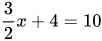
Aha problems involve finding unknown quantities (referred to as aha, "stack") if the sum of the quantity and part(s) of it are given. The Rhind Mathematical Papyrus also contains four of these types of problems. Problems 1, 19, and 25 of the Moscow Papyrus are Aha problems. For instance, problem 19 asks one to calculate a quantity taken 1+1⁄2 times and added to 4 to make 10.[1] In other words, in modern mathematical notation one is asked to solve .
Most of the problems are pefsu problems (see: Egyptian algebra): 10 of the 25 problems. A pefsu measures the strength of the beer made from a hekat of grain
A higher pefsu number means weaker bread or beer. The pefsu number is mentioned in many offering lists. For example, problem 8 translates as:
Problems 11 and 23 are Baku problems. These calculate the output of workers. Problem 11 asks if someone brings in 100 logs measuring 5 by 5, then how many logs measuring 4 by 4 does this correspond to? Problem 23 finds the output of a shoemaker given that he has to cut and decorate sandals.[1]
Seven of the 25 problems are geometry problems and range from computing areas of triangles, to finding the surface area of a hemisphere (problem 10) and finding the volume of a frustum (a truncated pyramid).[1]
The tenth problem of the Moscow Mathematical Papyrus asks for a calculation of the surface area of a hemisphere (Struve, Gillings) or possibly the area of a semi-cylinder (Peet). Below we assume that the problem refers to the area of a hemisphere.
The text of problem 10 runs like this: "Example of calculating a basket. You are given a basket with a mouth of 4 1/2. What is its surface? Take 1/9 of 9 (since) the basket is half an egg-shell. You get 1. Calculate the remainder which is 8. Calculate 1/9 of 8. You get 2/3 + 1/6 + 1/18. Find the remainder of this 8 after subtracting 2/3 + 1/6 + 1/18. You get 7 + 1/9. Multiply 7 + 1/9 by 4 + 1/2. You get 32. Behold this is its area. You have found it correctly."[1][5]
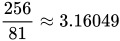
The solution amounts to computing the area as
The formula calculates for the area of a hemisphere, where the scribe of the Moscow Papyrus used to approximate π.

The 14th problem of the Moscow Mathematical calculates the volume of a frustum.
Problem 14 states that a pyramid has been truncated in such a way that the top area is a square of length 2 units, the bottom a square of length 4 units, and the height 6 units, as shown. The volume is found to be 56 cubic units, which is correct.[1]
The text of the example runs like this: "If you are told: a truncated pyramid of 6 for the vertical height by 4 on the base by 2 on the top: You are to square the 4; result 16. You are to double 4; result 8. You are to square this 2; result 4. You are to add the 16 and the 8 and the 4; result 28. You are to take 1/3 of 6; result 2. You are to take 28 twice; result 56. See, it is of 56. You will find [it] right" [6]
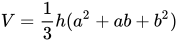
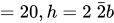
The solution to the problem indicates that the Egyptians knew the correct formula for obtaining the volume of a truncated pyramid:
where a and b are the base and top side lengths of the truncated pyramid and h is the height. Researchers have speculated how the Egyptians might have arrived at the formula for the volume of a frustum but the derivation of this formula is not given in the papyrus.[7]
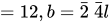
Richard J. Gillings gave a cursory summary of the Papyrus's contents.[8] Numbers with overlines denote the unit fraction having that number as denominator, e.g. ; unit fractions were common objects of study in ancient Egyptian mathematics.
| No. | Detail |
|---|---|
| 1 | Damaged and unreadable. |
| 2 | Damaged and unreadable. |
| 3 | A cedar mast. of . Unclear. |
| 4 | Area of a triangle. of . |
| 5 | Pesus of loaves and bread. Same as No. 8. |
| 6 | Rectangle, area . Find and . |
| 7 | Triangle, area . Find and . |
| 8 | Pesus of loaves and bread. |
| 9 | Pesus of loaves and bread. |
| 10 | Area of curved surface of a hemisphere (or cylinder). |
| 11 | Loaves and basket. Unclear. |
| 12 | Pesu of beer. Unclear. |
| 13 | Pesus of loaves and beer. Same as No. 9. |
| 14 | Volume of a truncated pyramid. . |
| 15 | Pesu of beer. |
| 16 | Pesu of beer. Similar to No. 15. |
| 17 | Triangle, area . Find and . |
| 18 | Measuring cloth in cubits and palms. Unclear. |
| 19 | Solve the equation . Clear. |
| 20 | Pesu of 1000 loaves. Horus-eye fractions. |
| 21 | Mixing of sacrificial bread. |
| 22 | Pesus of loaves and beer. Exchange. |
| 23 | Computing the work of a cobbler. Unclear. Peet says very difficult. |
| 24 | Exchange of loaves and beer. |
| 25 | Solve the equation . Elementary and clear. |
Other mathematical texts from Ancient Egypt include:
General papyri:
For the 2/n tables see:
While it has been generally accepted that the Egyptians were well acquainted with the formula for the volume of the complete square pyramid, it has not been easy to establish how they were able to deduce the formula for the truncated pyramid, with the mathematics at their disposal, in its most elegant and far from obvious form.
| International | |
|---|---|
| National | |
Source: Wikipedia. Article content is retrieved live through the MediaWiki API.

The Rhind Mathematical Papyrus (RMP; also designated as papyrus British Museum 10057, pBM 10058, and Brooklyn Museum 37.1784Ea-b) is one of the best known examples of ancient Egyptian mathematics. It is one of two well-known mathematical papyri, along with the Moscow Mathematical Papyrus. The Rhind Papyrus is the larger, but younger, of the two. In the papyrus' opening paragraphs, Ahmes presents the papyrus as giving "Accurate reckoning for inquiring into things, and the knowledge of all things, mysteries ... all secrets". He continues: This book was copied in regnal year 33, month 4 of Akhet, under the majesty of the King of Upper and Lower Egypt, Awserre, given life, from an ancient copy made in the time of the King of Upper and Lower Egypt Nimaatre. The scribe Ahmose writes this copy. Several books and articles about the Rhind Mathematical Papyrus have been published, and a handful of these stand out. The Rhind Papyrus was published in 1923 by the English Egyptologist T. Eric Peet and contains a discussion of the text that followed Francis Llewellyn Griffith's Book I, II and III outline. Arnold Buffum Chace published a compendium in 1927–1929 which included photographs of the text. A more recent overview of the Rhind Papyrus was published in 1987 by Robins and Shute. The Rhind Mathematical Papyrus contains on its verso or back another regnal year with this important entry: Regnal Year 11, second month of Shemu, Heliopolis was entered. First month of Akhet, day 23, "he of the South" broke into Tjaru [Greek Sile, modern Tell El-Hebwa], Both the Egyptologists Thomas Schneider and Irene Forstner-Mueller agree that the "He of the South" must refer to the Theban king Ahmose I. As Thomas Schneider writes: "Since "he of the South" must denote the Theban ruler Ahmose, the regnal year 11 can only be assigned to the successor of the Hyksos king Apepi: Khamudi. The Hyksos capital Avaris will have fallen to Ahmose not much later."
The Rhind Mathematical Papyrus, an ancient Egyptian mathematical work, includes a mathematical table for converting rational numbers of the form 2/n into Egyptian fractions (sums of distinct unit fractions), the form the Egyptians used to write fractional numbers. The text describes the representation of 50 rational numbers. It was written during the Second Intermediate Period of Egypt (approximately 1650–1550 BCE) by Ahmes, the first writer of mathematics whose name is known. Aspects of the document may have been copied from an unknown 1850 BCE text.

The Moscow Mathematical Papyrus, also named the Golenishchev Mathematical Papyrus after its first non-Egyptian owner, Egyptologist Vladimir Golenishchev, is an ancient Egyptian mathematical papyrus containing several problems in arithmetic, geometry, and algebra. Golenishchev bought the papyrus in 1892 or 1893 in Thebes. It later entered the collection of the Pushkin State Museum of Fine Arts in Moscow, where it remains today. Based on the palaeography and orthography of the hieratic text, the text was most likely written down in the 13th Dynasty and based on older material probably dating to the 12th Dynasty of Egypt, around 1850 BC. Around 5.5 m (18 ft) long and varying between 3.8 and 7.6 cm (1.5 and 3 in) wide, its format was divided by the Soviet Orientalist Vasily Struve in 1930 into 25 problems with solutions. It is a well-known mathematical papyrus, usually referenced together with the Rhind Mathematical Papyrus. The Moscow Mathematical Papyrus is older than the Rhind Mathematical Papyrus, while the latter is the larger of the two.
Rhind may refer to: Aaron Rhind (born 1991), Australian swimmer Alex Rhind, Scottish footballer, played in the 1872 Scotland v England football match Alexander Rhind (1821–1897), American naval officer USS Rhind (DD-404), US destroyer named after Alexander Rhind Alexander Henry Rhind (1833–1863), Scottish lawyer Rhind Lectures, a series of lectures on topics of archaeology originally funded by a bequeath from Alexander Henry Rhind Rhind Mathematical Papyrus, Egyptian papyrus named after Alexander Henry Rhind David Rhind (1808–1883), Scottish architect David William Rhind (1943–2025), British geographer Ethel Rhind, Irish artist James Robert Rhind (1854–1918), Scottish architect John Rhind (architect) (1836–1889), Scottish architect John Rhind (1828–1892), Scottish sculptor, father of William Birnie Rhind and J. Massey Rhind John Stevenson Rhind, Scottish sculptor J. Massey Rhind (1860–1936), Scottish-American architectural sculptor Julian Rhind-Tutt (born 1967) English actor Neil Rhind (born 1937), English writer and historian Robert Rhind, Scottish footballer Sir Thomas Duncan Rhind (1871–1927), Scottish architect and military figure William Birnie Rhind (1853–1933), Scottish architectural sculptor
Before the 1921 destruction of Tulsa’s Greenwood District, Black residents had created a remarkable center of business and community life. The district included stores, professional offices, entertainment venues and homes owned by Black citizens. Understanding Greenwood means learning what was built—not only what was burned.
MORE →Shirley Chisholm, elected in 1968.