Civil Rights
Movements, leaders, victories and the continuing fight for equality.

Explore the people, places, events, achievements, struggles and stories that shaped our journey.
Movements, leaders, victories and the continuing fight for equality.
Innovation, patents, science, technology and world-changing contributions.
Pioneers, champions, Negro Leagues, records, activism and excellence.
Meet the people whose lives, choices and achievements shaped the journey.
Black towns, communities, institutions and places where history happened.
Moments that changed communities, movements, institutions and the nation.
Wilmington, North Carolina once had a thriving Black middle class and an elected interracial government. In 1898 white supremacists used violence to overthrow that government, kill Black residents and drive many others from the city.
MORE →Reflects the personal views, recollections, and perspective of the author, Mike Davis.
This is a personal recollection on the Move fire on May 13, 1985
| Part of a series of articles about |
| Calculus |
|---|
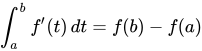
In symbolic computation, the Risch algorithm is a method of indefinite integration used in some computer algebra systems to find antiderivatives. It is named after the American mathematician Robert Henry Risch, a specialist in computer algebra who developed it in 1968.
The algorithm transforms the problem of integration into a problem in algebra. It is based on the form of the function being integrated and on methods for integrating rational functions, radicals, logarithms, and exponential functions. Risch called it a decision procedure, because it is a method for deciding whether a function has an elementary function as an indefinite integral, and if it does, for determining that indefinite integral. However, the algorithm does not always succeed in identifying whether or not the antiderivative of a given function in fact can be expressed in terms of elementary functions.[example needed] Specifically, the algorithm cannot solve the constant problem, which is undecidable when it needs to determine whether an arbitrary complex number expression is equal to zero.
The complete description of the Risch algorithm takes over 100 pages.[1] The Risch–Norman algorithm is a simpler, faster, but less powerful variant that was developed in 1976 by Arthur Norman.
Some significant progress has been made in computing the logarithmic part of a mixed transcendental-algebraic integral by Brian L. Miller.[2]
The Risch algorithm is used to integrate elementary functions. These are functions obtained by composing exponentials, logarithms, radicals, trigonometric functions, and the four arithmetic operations (+ − × ÷). Laplace solved this problem for the case of rational functions, as he showed that the indefinite integral of a rational function is the sum of a rational function and a finite number of constant multiples of logarithms of rational functions.[citation needed] The algorithm suggested by Laplace is usually described in calculus textbooks; as a computer program, it was finally implemented in the 1960s.[citation needed]
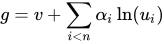
Liouville formulated the problem that is solved by the Risch algorithm. Liouville proved by analytical means that if there is an elementary solution g to the equation g′ = f then there exist constants αi and functions ui and v in the field generated by f such that the solution is of the form
Risch developed a method that allows one to consider only a finite set of functions of Liouville's form.
The intuition for the Risch algorithm comes from the behavior of the exponential and logarithm functions under differentiation. For the function f eg, where f and g are differentiable functions, we have
so if eg were in the result of an indefinite integration, it should be expected to be inside the integral. Also, as
then if (ln g)n were in the result of an integration, then only a few powers of the logarithm should be expected.
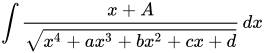
Finding an elementary antiderivative is very sensitive to details. For instance, the following algebraic function (posted to sci.math.symbolic by Henri Cohen in 1993[3]) has an elementary antiderivative, as Wolfram Mathematica since version 13 shows (however, Mathematica does not use the Risch algorithm to compute this integral):[4][5]
namely:
But if the constant term 71 is changed to 72, it is not possible to represent the antiderivative in terms of elementary functions,[6] as FriCAS also shows. Some computer algebra systems may here return an antiderivative in terms of non-elementary functions (i.e. elliptic integrals), which are outside the scope of the Risch algorithm. For example, Mathematica returns a result with the functions EllipticPi and EllipticF. Integrals in the form were solved by Chebyshev (and in what cases it is elementary),[7] but the strict proof for it was ultimately done by Zolotarev.[6]
The following is a more complex example that involves both algebraic and transcendental functions:[8]
In fact, the antiderivative of this function has a fairly short form that can be found using substitution (SymPy can solve it while FriCAS fails with "implementation incomplete (constant residues)" error in Risch algorithm):
Some Davenport "theorems"[definition needed] are still being clarified. For example in 2020 a counterexample to such a "theorem" was found, where it turns out that an elementary antiderivative exists after all.[9]
Transforming Risch's theoretical algorithm into an algorithm that can be effectively executed by a computer was a complex task which took a long time.
The case of the purely transcendental functions (which do not involve roots of polynomials) is relatively easy and was implemented early in most computer algebra systems. The first implementation was done by Joel Moses in Macsyma soon after the publication of Risch's paper.[10]
The case of purely algebraic functions was partially solved and implemented in Reduce by James H. Davenport – for simplicity it could only deal with square roots and repeated square roots and not general radicals or other non-quadratic algebraic relations between variables.[11]
The general case was solved and almost fully implemented in Scratchpad, a precursor of Axiom, by Manuel Bronstein, there is Axiom's fork FriCAS, with active Risch and other algorithm development on GitHub.[12][13] However, the implementation did not include some of the branches for special cases completely.[14][15] As of 2025[update], there is no full implementation of the Risch algorithm.[16]
The Risch algorithm applied to general elementary functions is not an algorithm but a semi-algorithm because it needs to check, as a part of its operation, if certain expressions are equivalent to zero (constant problem), in particular in the constant field. For expressions that involve only functions commonly taken to be elementary it is not known whether an algorithm performing such a check exists (current computer algebra systems use heuristics); moreover, if one adds the absolute value function to the list of elementary functions, then it is known that no such algorithm exists; see Richardson's theorem.[clarification needed]
This issue also arises in the polynomial division algorithm; this algorithm will fail if it cannot correctly determine whether coefficients vanish identically.[17] Virtually every non-trivial algorithm relating to polynomials uses the polynomial division algorithm, the Risch algorithm included. If the constant field is computable, i.e., for elements not dependent on x, then the problem of zero-equivalence is decidable, so the Risch algorithm is a complete algorithm. Examples of computable constant fields are ℚ and ℚ(y), i.e., rational numbers and rational functions in y with rational-number coefficients, respectively, where y is an indeterminate that does not depend on x.
This is also an issue in the Gaussian elimination matrix algorithm (or any algorithm that can compute the nullspace of a matrix), which is also necessary for many parts of the Risch algorithm. Gaussian elimination will produce incorrect results if it cannot correctly determine whether a pivot is identically zero.[citation needed]
Source: Wikipedia. Article content is retrieved live through the MediaWiki API.
In symbolic computation, the Risch algorithm is a method of indefinite integration used in some computer algebra systems to find antiderivatives. It is named after the American mathematician Robert Henry Risch, a specialist in computer algebra who developed it in 1968. The algorithm transforms the problem of integration into a problem in algebra. It is based on the form of the function being integrated and on methods for integrating rational functions, radicals, logarithms, and exponential functions. Risch called it a decision procedure, because it is a method for deciding whether a function has an elementary function as an indefinite integral, and if it does, for determining that indefinite integral. However, the algorithm does not always succeed in identifying whether or not the antiderivative of a given function in fact can be expressed in terms of elementary functions. Specifically, the algorithm cannot solve the constant problem, which is undecidable when it needs to determine whether an arbitrary complex number expression is equal to zero. The complete description of the Risch algorithm takes over 100 pages. The Risch–Norman algorithm is a simpler, faster, but less powerful variant that was developed in 1976 by Arthur Norman. Some significant progress has been made in computing the logarithmic part of a mixed transcendental-algebraic integral by Brian L. Miller.
Robert Henry Risch (born 1939) is an American mathematician who worked on computer algebra and is known for his work on symbolic integration, specifically the Risch algorithm. This result was cited as a milestone in the development of mathematics: Calculus students worldwide depend on the algorithm, whenever they appeal to Wolfram Alpha to do their homework. He is also known for results on algebraic properties of elementary functions. He received his PhD from the University of California, Berkeley in 1968 under the supervision of Maxwell A. Rosenlicht. After his PhD, he worked at the Thomas J. Watson Research Center Mathematics of AI group and, between 1970 and 1972, the Institute for Advanced Study.
In mathematics, an elementary function is a function of a single variable (real or complex) that is typically encountered by beginners. The basic elementary functions are polynomial functions, rational functions, the trigonometric functions, the exponential and logarithm functions, the n-th root, and the inverse trigonometric functions, as well as those functions obtained by addition, multiplication, division, and composition of these. Some functions which are encountered by beginners are not elementary, such as piecewise-defined functions. More generally, in some modern treatments, elementary functions comprise the set of functions previously enumerated, all algebraic functions, and all functions obtained by roots of a polynomial whose coefficients are elementary. The elementary functions were originally defined by Joseph Liouville in 1833. A key property is that all elementary functions have derivatives of any order, which are also elementary, and can be algorithmically computed by applying the differentiation rules (or the rules for implicit differentiation in the case of roots). The Taylor series of an elementary function converges in a neighborhood of every point of its domain. More generally, they are global analytic functions, defined (possibly with multiple values, such as the elementary function z {\displaystyle {\sqrt {z}}} or log z {\displaystyle \log z} ) for every complex argument, except at isolated points. In contrast, antiderivatives of elementary functions need not be elementary and is difficult to decide whether a specific elementary function has an elementary antiderivative. Liouville's result is that, if an elementary function has an elementary antiderivative, then this antiderivative is a linear combination of logarithms, where the coefficients and the arguments of the logarithms are elementary functions involved, in some sense, in the definition of the function. The Risch algorithm (1968) can decide whether an elementary function has an elementary antiderivative, and, if so, to compute it. However, as of 2025, there is no full implementation.
In mathematics, a nonelementary antiderivative of a given elementary function is an antiderivative (or indefinite integral) that is, itself, not an elementary function. A theorem by Liouville in 1835 provided the first proof that nonelementary antiderivatives exist. This theorem also provides a basis for the Risch algorithm for determining (with difficulty) which elementary functions have elementary antiderivatives.
Before the 1921 destruction of Tulsa’s Greenwood District, Black residents had created a remarkable center of business and community life. The district included stores, professional offices, entertainment venues and homes owned by Black citizens. Understanding Greenwood means learning what was built—not only what was burned.
MORE →Brown v. Board of Education in 1954.