Civil Rights
Movements, leaders, victories and the continuing fight for equality.

Explore the people, places, events, achievements, struggles and stories that shaped our journey.
Movements, leaders, victories and the continuing fight for equality.
Innovation, patents, science, technology and world-changing contributions.
Pioneers, champions, Negro Leagues, records, activism and excellence.
Meet the people whose lives, choices and achievements shaped the journey.
Black towns, communities, institutions and places where history happened.
Moments that changed communities, movements, institutions and the nation.
Katherine Johnson’s mathematical calculations helped guide some of America’s most important early space missions while she confronted the racial and gender barriers faced by Black women in twentieth-century America.
MORE →Reflects the personal views, recollections, and perspective of the author, Mike Davis.
This is a personal recollection on the Move fire on May 13, 1985
 | This article needs more citations. (July 2026) |

An end effector or tool head is the device at the end of a robotic arm designed to interact with the environment, typically a gripper or a tool. Its exact nature depends on the application of the robot.
In the strict definition, which originates from serial robotic manipulators, the term denotes the last link (or 'end') of the robot. At this endpoint, the tools are attached. In a wider sense, an end effector can be seen as the part of a robot that interacts with the work environment. This does not refer to the wheels of a mobile robot or the feet of a humanoid robot, which are not end effectors but rather part of a robot's mobility.
When referring to robotic prehension there are four general categories of robot grippers:[1]
These categories describe the physical effects used to achieve a stable grasp between a gripper and the object to be grasped.[3] Industrial grippers (also known as "gripsters") may employ mechanical, suction, or magnetic means. Vacuum cups and electromagnets dominate the automotive field and metal sheet handling. Bernoulli grippers exploit the airflow between the gripper and the part, in which a lifting force brings the gripper and part close each other (using Bernoulli's principle). Bernoulli grippers are a type of contactless grippers; the object remains confined in the force field generated by the gripper without coming into direct contact with it. Bernoulli grippers have been adopted in photovoltaic cell handling, silicon wafer handling, and in the textile and leather industries.
Other principles are less used at the macro scale (part size >5mm), but in the last ten years, have demonstrated interesting applications in micro-handling. These adopted principles include: Electrostatic grippers and van der Waals grippers based on electrostatic charges (i.e. van der Waals' force); capillary grippers; cryogenic grippers, based on a liquid medium; ultrasonic grippers; and laser grippers, the latter two being contactless-grasping principles. Electrostatic grippers use a charge-difference between gripper and part (electrostatic force) often activated by the gripper itself, while van der Waals grippers are based on the low force (still electrostatic) of atomic attraction between the molecules of the gripper and those of the object.
Capillary grippers use the surface tension of a liquid meniscus between the gripper and the part to center, align and grasp a part. Cryogenic grippers freeze a small amount of liquid, with the resulting ice supplying the necessary force to lift and handle the object (this principle is used also in food handling and in textile grasping). Even more complex are ultrasonic grippers, where pressure standing waves are used to lift up a part and trap it at a certain level (example of levitation are both at the micro level, in screw- and gasket-handling, and at the macro scale, in solar cell or silicon-wafer handling), and laser source that produces a pressure sufficient to trap and move microparts in a liquid medium (mainly cells). Laser grippers are known also as laser tweezers.
A particular category of friction/jaw grippers is that of needle grippers. These are called intrusive grippers, exploiting both friction and form-closure as standard mechanical grippers.
The most known mechanical gripper can be of two, three or even five fingers.

A common form of robotic grasping is force closure.[4]
Generally, the gripping mechanism is done by the grippers or mechanical fingers. Two-finger grippers tend to be used for industrial robots performing specific tasks in less-complex applications.[citation needed] The fingers are replaceable.[citation needed]
Two types of mechanisms used in two-finger gripping account for the shape of the surface to be gripped, and the force required to grip the object.
The shape of the fingers' gripping surface can be chosen according to the shape of the objects to be manipulated. For example, if a robot is designed to lift a round object, the gripper surface shape can be a concave impression of it to make the grip efficient. For a square shape, the surface can be a plane.
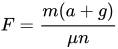
Though there are numerous forces acting over the body that has been lifted by a robotic arm, the main force is the frictional force. The gripping surface can be made of a soft material with high coefficient of friction so that the surface of the object is not damaged. The robotic gripper must withstand not only the weight of the object but also acceleration and the motion that is caused by frequent movement of the object. To find out the force required to grip the object, the following formula is used
where:
| is | the force required to grip the object, | |
| is | the mass of the object, | |
| is | the acceleration of the object, | |
| is | the coefficient of friction and | |
| is | the number of fingers in the gripper. |
A more complete equation would account for the direction of movement. For example, when the body is moved upwards, against gravitational force, the force required will be more than that towards the gravitational force. Hence, another term is introduced and the formula becomes:
Here, the value of should be taken as the acceleration due to gravity and the acceleration due to movement.
For many physically interactive manipulation tasks, such as writing and handling a screwdriver, a task-related grasp criterion can be applied in order to choose grasps that are most appropriate to meeting specific task requirements. Several task-oriented grasp quality metrics[5] were proposed to guide the selection of a good grasp that would satisfy the task requirements.
The end effectors that can be used as tools serve various purposes, including spot-welding in an assembly, spray-painting where uniformity of painting is necessary, and other purposes where the working conditions are dangerous for human beings. Surgical robots have end effectors that are specifically manufactured for the purpose.
The end effector of an assembly-line robot would typically be a welding head, or a paint spray gun. A surgical robot's end effector could be a scalpel or other tool used in surgery. Other possible end effectors might be machine tools such as a drill or milling cutters. The end effector on the Space Shuttle's robotic arm uses a pattern of wires which close like the aperture of a camera around a handle or other grasping point.[citation needed]


Source: Wikipedia. Article content is retrieved live through the MediaWiki API.

An end effector or tool head is the device at the end of a robotic arm designed to interact with the environment, typically a gripper or a tool. Its exact nature depends on the application of the robot.
Robot calibration is a process used to improve the accuracy of robots, particularly industrial robots which are highly repeatable but not accurate. Robot calibration is the process of identifying certain parameters in the kinematic structure of an industrial robot, such as the relative position of robot links. Depending on the type of errors modeled, the calibration can be classified in three different ways. Level-1 calibration only models differences between actual and reported joint displacement values, (also known as mastering). Level-2 calibration, also known as kinematic calibration, concerns the entire geometric robot calibration which includes angle offsets and joint lengths. Level-3 calibration, also called a non-kinematic calibration, models errors other than geometric defaults such as stiffness, joint compliance, and friction. Often Level-1 and Level-2 calibration are sufficient for most practical needs. Parametric robot calibration is the process of determining the actual values of kinematic and dynamic parameters of an industrial robot (IR). Kinematic parameters describe the relative position and orientation of links and joints in the robot while the dynamic parameters describe arm and joint masses and internal friction. Non-parametric robot calibration circumvents the parameter identification. Used with serial robots, it is based on the direct compensation of mapped errors in the workspace. Used with parallel robots, non-parametric calibration can be performed by the transformation of the configuration space. Robot calibration can remarkably improve the accuracy of robots programmed offline. A calibrated robot has a higher absolute as well as relative positioning accuracy compared to an uncalibrated one; i.e., the real position of the robot end effector corresponds better to the position calculated from the mathematical model of the robot. Absolute positioning accuracy is particularly relevant in connection with robot exchangeability and off-line programming of precision applications. Besides the calibration of the robot, the calibration of its tools and the workpieces it works with (the so-called cell calibration) can minimize occurring inaccuracies and improve process security.
A gripper is something that grips things or makes it easier to grip things. It may refer to: grippers, tools for building hand strength a Robot end effector, the "hand" of a robot a person working in a grip (job), a position held in filmmaking
RoboLogix is a robotics simulator which uses a physics engine to emulate robotics applications. The advantages of using robotics simulation tools such as RoboLogix are that they save time in the design of robotics applications and they can also increase the level of safety associated with robotic equipment since various "what if" scenarios can be tried and tested before the system is activated. RoboLogix provides a platform to teach, test, run, and debug programs that have been written using a five-axis industrial robot in a range of applications and functions. These applications include pick-and-place, palletizing, welding, and painting. RoboLogix was developed by Colin Simpson and John (Bud) Skinner. It is primarily intended as an educational resource, and is used by high schools, colleges, and universities to provide laboratory simulation of industrial robots. Some institutions, such as George Brown College use RoboLogix as part of an online robotics distance education program. The simulation software allows for verification of the robot's reaching ability, travel ranges and collisions. This type of simulation software provides an increased level of reliability in the planning process and program development as well as reducing the overall completion/commissioning time. The ability to preview the behavior of a robotic system in a virtual world allows for a variety of mechanisms, devices, configurations and controllers to be tried and tested before being applied to a "real world" system. RoboLogix has the capacity of real-time simulation of the motion of an industrial robot using both geometric modeling and kinematics modeling. RoboLogix enables programmers to write their own robot programs and use sensors such as video cameras, which are used for obtaining the desired position of the robot end effector. In addition, a teach pendant control panel is included with the simulator that allows the user to command the robot to pick up a tracked object and return it to a home location through jogged commands or pre-programmed positions.
Before the 1921 destruction of Tulsa’s Greenwood District, Black residents had created a remarkable center of business and community life. The district included stores, professional offices, entertainment venues and homes owned by Black citizens. Understanding Greenwood means learning what was built—not only what was burned.
MORE →The Greenwood District.