Civil Rights
Movements, leaders, victories and the continuing fight for equality.

Explore the people, places, events, achievements, struggles and stories that shaped our journey.
Movements, leaders, victories and the continuing fight for equality.
Innovation, patents, science, technology and world-changing contributions.
Pioneers, champions, Negro Leagues, records, activism and excellence.
Meet the people whose lives, choices and achievements shaped the journey.
Black towns, communities, institutions and places where history happened.
Moments that changed communities, movements, institutions and the nation.
Mansa Musa was the ruler of the Mali Empire in West Africa. Details recorded here should be sourced; unknown information is left blank.
MORE →Reflects the personal views, recollections, and perspective of the author, Mike Davis.
This is a personal recollection on the Move fire on May 13, 1985
| Part of a series on |
| Earthquakes |
|---|
 |
In solid mechanics, S waves, secondary waves, or shear waves (sometimes called elastic S waves) are a type of elastic wave and are one of the two main types of elastic body waves, so named because they move through the body of an object, unlike surface waves.[1]
S waves are transverse waves, meaning that the direction of particle movement of an S wave is perpendicular to the direction of wave propagation, and the main restoring force comes from shear stress.[2] Therefore, S waves cannot propagate in liquids[3] with zero (or very low) viscosity; however, they may propagate in liquids with high viscosity.[4][5] Similarly, S waves cannot travel through gases.
The name secondary wave comes from the fact that they are the second type of wave to be detected by an earthquake seismograph, after the compressional primary wave, or P wave, because S waves travel more slowly in solids. Unlike P waves, S waves cannot travel through the molten outer core of the Earth, and this causes a shadow zone for S waves opposite to their origin. They can still propagate through the solid inner core: when a P wave strikes the boundary of molten and solid cores at an oblique angle, S waves will form and propagate in the solid medium. When these S waves hit the boundary again at an oblique angle, they will in turn create P waves that propagate through the liquid medium. This property allows seismologists to determine some physical properties of the Earth's inner core.[6]
In 1830, the mathematician Siméon Denis Poisson presented to the French Academy of Sciences an essay ("memoir") with a theory of the propagation of elastic waves in solids. In his memoir, he states that an earthquake would produce two different waves: one having a certain speed and the other having a speed . At a sufficient distance from the source, when they can be considered plane waves in the region of interest, the first kind consists of expansions and compressions in the direction perpendicular to the wavefront (that is, parallel to the wave's direction of motion); while the second consists of stretching motions occurring in directions parallel to the front (perpendicular to the direction of motion).[7]

For the purpose of this explanation, a solid medium is considered isotropic if its strain (deformation) in response to stress is the same in all directions. Let be the displacement vector of a particle of such a medium from its "resting" position due elastic vibrations, understood to be a function of the rest position and time . The deformation of the medium at that point can be described by the strain tensor , the 3×3 matrix whose elements are
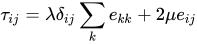
where denotes partial derivative with respect to position coordinate . The strain tensor is related to the 3×3 stress tensor by the equation
Here is the Kronecker delta (1 if , 0 otherwise) and and are the Lamé parameters ( being the material's shear modulus). It follows that
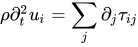
From Newton's law of inertia, one also gets where is the density (mass per unit volume) of the medium at that point, and denotes partial derivative with respect to time. Combining the last two equations one gets the seismic wave equation in homogeneous media
Using the nabla operator notation of vector calculus, , with some approximations, this equation can be written as
Taking the curl of this equation and applying vector identities, one gets
This formula is the wave equation applied to the vector quantity , which is the material's shear strain. Its solutions, the S waves, are linear combinations of sinusoidal plane waves of various wavelengths and directions of propagation, but all with the same speed . Assuming that the medium of propagation is linear, elastic, isotropic, and homogeneous, this equation can be rewritten as [8] where ω is the angular frequency and k is the wavenumber. Thus, .
Taking the divergence of seismic wave equation in homogeneous media, instead of the curl, yields a wave equation describing propagation of the quantity , which is the material's compression strain. The solutions of this equation, the P waves, travel at the faster speed .
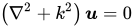
The steady state SH waves are defined by the Helmholtz equation[9] where k is the wave number.
Similar to in an elastic medium, in a viscoelastic material, the speed of a shear wave is described by a similar relationship , however, here, is a complex, frequency-dependent shear modulus and is the frequency dependent phase velocity.[8] One common approach to describing the shear modulus in viscoelastic materials is through the Voigt Model which states: , where is the stiffness of the material and is the viscosity.[8]
Magnetic resonance elastography (MRE) is a method for studying the properties of biological materials in living organisms by propagating shear waves at desired frequencies throughout the desired organic tissue.[10] This method uses a vibrator to send the shear waves into the tissue and magnetic resonance imaging to view the response in the tissue.[11] The measured wave speed and wavelengths are then measured to determine elastic properties such as the shear modulus. MRE has seen use in studies of a variety of human tissues including liver, brain, and bone tissues.[10]
S-wave.
| Investigation and instrumentation |
| ||||||
|---|---|---|---|---|---|---|---|
| Soil |
| ||||||
| Structures (Interaction) |
| ||||||
| Mechanics |
| ||||||
| Numerical analysis software | |||||||
| Related fields | |||||||
Source: Wikipedia. Article content is retrieved live through the MediaWiki API.

In solid mechanics, S waves, secondary waves, or shear waves (sometimes called elastic S waves) are a type of elastic wave and are one of the two main types of elastic body waves, so named because they move through the body of an object, unlike surface waves. S waves are transverse waves, meaning that the direction of particle movement of an S wave is perpendicular to the direction of wave propagation, and the main restoring force comes from shear stress. Therefore, S waves cannot propagate in liquids with zero (or very low) viscosity; however, they may propagate in liquids with high viscosity. Similarly, S waves cannot travel through gases. The name secondary wave comes from the fact that they are the second type of wave to be detected by an earthquake seismograph, after the compressional primary wave, or P wave, because S waves travel more slowly in solids. Unlike P waves, S waves cannot travel through the molten outer core of the Earth, and this causes a shadow zone for S waves opposite to their origin. They can still propagate through the solid inner core: when a P wave strikes the boundary of molten and solid cores at an oblique angle, S waves will form and propagate in the solid medium. When these S waves hit the boundary again at an oblique angle, they will in turn create P waves that propagate through the liquid medium. This property allows seismologists to determine some physical properties of the Earth's inner core.

In mathematics and physical science, a wave is a propagating dynamic disturbance (change from equilibrium) of one or more quantities. Periodic waves oscillate repeatedly about an equilibrium (resting) value at some frequency. When the entire waveform moves in one direction, it is said to be a traveling wave; by contrast, a pair of identical superimposed periodic waves traveling in opposite directions makes a standing wave. In a standing wave, the amplitude of vibration has nulls at some positions where the wave amplitude appears smaller or even zero. There are two types of waves that are most commonly studied in classical physics: mechanical waves and electromagnetic waves. In a mechanical wave, stress and strain fields oscillate about a mechanical equilibrium. A mechanical wave is a local deformation (strain) in some physical medium that propagates from particle to particle by creating local stresses that cause strain in neighboring particles too. For example, sound waves are variations of the local pressure and particle motion that propagate through the medium. Other examples of mechanical waves are seismic waves, gravity waves, surface waves and string vibrations. In an electromagnetic wave (such as light), coupling between the electric and magnetic fields sustains propagation of waves involving these fields according to Maxwell's equations. Electromagnetic waves can travel through a vacuum and through some dielectric media (at wavelengths where they are considered transparent). Electromagnetic waves, as determined by their frequencies (or wavelengths), have more specific designations including radio waves, infrared radiation, terahertz waves, visible light, ultraviolet radiation, X-rays and gamma rays. Other types of waves include gravitational waves, which are disturbances in spacetime that propagate according to general relativity; heat diffusion waves; plasma waves that combine mechanical deformations and electromagnetic fields; reaction–diffusion waves, such as in the Belousov–Zhabotinsky reaction; and many more. Mechanical and electromagnetic waves transfer energy, momentum and information. In the case of waves in a liquid medium, matter can also be transferred (see Stokes drift). In mathematics and electronics waves are studied as signals. On the other hand, some waves have envelopes which do not move at all such as standing waves (which are fundamental to music) and hydraulic jumps. A physical wave field is almost always confined to some finite region of space, called its domain. For example, the seismic waves generated by earthquakes are significant only in the interior and surface of the planet, so they can be ignored outside it. However, waves with infinite domain, that extend over the whole space, are commonly studied in mathematics, and are very valuable tools for understanding physical waves in finite domains. A plane wave is an important mathematical idealization where the disturbance is identical along any (infinite) plane normal to a specific direction of travel. Mathematically, the simplest wave is a sinusoidal plane wave in which at any point the field experiences simple harmonic motion at one frequency. In linear media, complicated waves can generally be decomposed as the sum of many sinusoidal plane waves having different directions of propagation and/or different frequencies. A plane wave is classified as a transverse wave if the field disturbance at each point is described by a vector perpendicular to the direction of propagation (also the direction of energy transfer); or longitudinal wave if those vectors are aligned with the propagation direction. Mechanical waves include both transverse and longitudinal waves; on the other hand electromagnetic plane waves are strictly transverse while sound waves in fluids (such as air) can only be longitudinal. That physical direction of an oscillating field relative to the propagation direction is also referred to as the wave's polarization, which can be an important attribute.
In physics, a transverse wave is a wave that oscillates perpendicularly to the direction of the wave's advance. In contrast, a longitudinal wave travels in the direction of its oscillations. All waves move energy from place to place without transporting the matter in the transmission medium if there is one. Electromagnetic waves are transverse without requiring a medium. The designation “transverse” indicates the direction of the wave is perpendicular to the displacement of the particles of the medium through which it passes, or in the case of EM waves, the oscillation is perpendicular to the direction of the wave. A simple example is given by the waves that can be created on a horizontal length of string by anchoring one end and moving the other end up and down. Another example is the waves that are created on the membrane of a drum. The waves propagate in directions that are parallel to the membrane plane, but each point in the membrane itself gets displaced up and down, perpendicular to that plane. Light is another example of a transverse wave, where the oscillations are the electric and magnetic fields, which point at right angles to the ideal light rays that describe the direction of propagation. Transverse waves commonly occur in elastic solids due to the shear stress generated; the oscillations in this case are the displacement of the solid particles away from their relaxed position, in directions perpendicular to the propagation of the wave. These displacements correspond to a local shear deformation of the material. Hence a transverse wave of this nature is called a shear wave. Since fluids cannot resist shear forces while at rest, propagation of transverse waves inside the bulk of fluids is not possible. In seismology, shear waves are also called secondary waves or S-waves. Transverse waves are contrasted with longitudinal waves, where the oscillations occur in the direction of the wave. The standard example of a longitudinal wave is a sound wave or "pressure wave" in gases, liquids, or solids, whose oscillations cause compression and expansion of the material through which the wave is propagating. Pressure waves are also called "primary waves", or "P-waves" in geophysics, because they appear first in a seismogram due to their higher propagation velocity in comparison with shear waves that come second. Water waves involve both longitudinal and transverse motions.

The QRS complex is the combination of three of the graphical deflections seen on a typical electrocardiogram (ECG or EKG). It is usually the central and most visually obvious part of the tracing. It corresponds to the depolarization of the right and left ventricles of the heart and contraction of the large ventricular muscles. In adults, the QRS complex normally lasts 80 to 100 ms; in children it may be shorter. The Q, R, and S waves occur in rapid succession, do not all appear in all leads, and reflect a single event and thus are usually considered together. A Q wave is any downward deflection immediately following the P wave. An R wave follows as an upward deflection, and the S wave is any downward deflection after the R wave. The T wave follows the S wave, and in some cases, an additional U wave follows the T wave. To measure the QRS interval start at the end of the PR interval (or beginning of the Q wave) to the end of the S wave. Normally this interval is 0.08 to 0.10 seconds. When the duration is longer it is considered a wide QRS complex.
Before the 1921 destruction of Tulsa’s Greenwood District, Black residents had created a remarkable center of business and community life. The district included stores, professional offices, entertainment venues and homes owned by Black citizens. Understanding Greenwood means learning what was built—not only what was burned.
MORE →Brown v. Board of Education in 1954.