Civil Rights
Movements, leaders, victories and the continuing fight for equality.

Explore the people, places, events, achievements, struggles and stories that shaped our journey.
Movements, leaders, victories and the continuing fight for equality.
Innovation, patents, science, technology and world-changing contributions.
Pioneers, champions, Negro Leagues, records, activism and excellence.
Meet the people whose lives, choices and achievements shaped the journey.
Black towns, communities, institutions and places where history happened.
Moments that changed communities, movements, institutions and the nation.
In August 1908, a white mob attacked Springfield, Illinois’s Black community, destroying homes and businesses and lynching two Black men. National outrage over the violence helped spur the movement that created the NAACP the following year.
MORE →Reflects the personal views, recollections, and perspective of the author, Mike Davis.
This is a personal recollection on the Move fire on May 13, 1985

In electronics, noise is an unwanted disturbance in an electrical signal.[1]: 5
Noise generated by electronic devices varies greatly as it is produced by several different effects.
In particular, noise is inherent in physics and central to thermodynamics. Any conductor with electrical resistance will generate thermal noise inherently. The final elimination of thermal noise in electronics can only be achieved cryogenically, and even then quantum noise would remain inherent.
Electronic noise is a common component of noise in signal processing.
In communication systems, noise is an error or undesired random disturbance of a useful information signal in a communication channel. The noise is a summation of unwanted or disturbing energy from natural and sometimes man-made sources. Noise is, however, typically distinguished from interference,[a] for example in the signal-to-noise ratio (SNR), signal-to-interference ratio (SIR) and signal-to-noise plus interference ratio (SNIR) measures. Noise is also typically distinguished from distortion, which is an unwanted systematic alteration of the signal waveform by the communication equipment, for example in signal-to-noise and distortion ratio (SINAD) and total harmonic distortion plus noise (THD+N) measures.
While noise is generally unwanted, it can serve a useful purpose in some applications, such as random number generation or dither.
Uncorrelated noise sources add according to the sum of their powers.[2]
Different types of noise are generated by different devices and different processes. Thermal noise is unavoidable at non-zero temperature (see fluctuation-dissipation theorem), while other types depend mostly on device type (such as shot noise,[1][3] which needs a steep potential barrier) or manufacturing quality and semiconductor defects, such as conductance fluctuations, including 1/f noise.
Johnson–Nyquist noise[1] (more often thermal noise) is unavoidable, and generated by the random thermal motion of charge carriers (usually electrons), inside an electrical conductor, which happens regardless of any applied voltage.
Thermal noise is approximately white, meaning that its power spectral density is nearly equal throughout the frequency spectrum. The amplitude of the signal has very nearly a Gaussian probability density function. A communication system affected by thermal noise is often modelled as an additive white Gaussian noise (AWGN) channel.
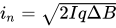
Shot noise in electronic devices results from unavoidable random statistical fluctuations of the electric current when the charge carriers (such as electrons) traverse a gap. If electrons flow across a barrier, then they have discrete arrival times. Those discrete arrivals exhibit shot noise. Typically, the barrier in a diode is used.[4] Shot noise is similar to the noise created by rain falling on a tin roof. The flow of rain may be relatively constant, but the individual raindrops arrive discretely.[5]
The root-mean-square value of the shot noise current in is given by the Schottky formula.
where I is the DC current, q is the charge of an electron, and ΔB is the bandwidth in hertz. The Schottky formula assumes independent arrivals.
Vacuum tubes exhibit shot noise because the electrons randomly leave the cathode and arrive at the anode (plate). A tube may not exhibit the full shot noise effect: the presence of a space charge tends to smooth out the arrival times (and thus reduce the randomness of the current). Pentodes and screen-grid tetrodes exhibit more noise than triodes because the cathode current splits randomly between the screen grid and the anode.
Conductors and resistors typically do not exhibit shot noise because the electrons thermalize and move diffusively within the material; the electrons do not have discrete arrival times. Shot noise has been demonstrated in mesoscopic resistors when the size of the resistive element becomes shorter than the electron–phonon scattering length.[6]
Where current divides between two (or more) paths,[7] noise occurs as a result of random fluctuations that occur during this division.
For this reason, a transistor will have more noise than the combined shot noise from its two PN junctions.
Flicker noise, also known as 1/f noise, is a signal or process with a frequency spectrum that falls off steadily into the higher frequencies, with a pink spectrum. It occurs in almost all electronic devices and results from a variety of effects.
Burst noise consists of sudden step-like transitions between two or more discrete voltage or current levels, as high as several hundred microvolts, at random and unpredictable times. Each shift in offset voltage or current lasts for several milliseconds to seconds. It is also known as popcorn noise for the popping or crackling sounds it produces in audio circuits.
If the time taken by the electrons to travel from emitter to collector in a transistor becomes comparable to the period of the signal being amplified, that is, at frequencies above VHF and beyond, the transit-time effect takes place and the noise input impedance of the transistor decreases. From the frequency at which this effect becomes significant, it increases with frequency and quickly dominates other sources of noise.[8]
While noise may be generated in the electronic circuit itself, additional noise energy can be coupled into a circuit from the external environment, by inductive coupling or capacitive coupling, or through the antenna of a radio receiver.
In many cases noise found on a signal in a circuit is unwanted. There are many different noise reduction techniques that can reduce the noise picked up by a circuit.
Thermal noise can be reduced by cooling of circuits - this is typically only employed in high accuracy high-value applications such as radio telescopes.
The noise level in an electronic system is typically measured as an electrical power N in watts or dBm, a root mean square (RMS) voltage (identical to the noise standard deviation) in volts, dBμV or a mean squared error (MSE) in volts squared. Examples of electrical noise-level measurement units are dBu, dBm0, dBrn, dBrnC, and dBrn(f1 − f2), dBrn(144-line). Noise may also be characterized by its probability distribution and noise spectral density N0(f) in watts per hertz.
A noise signal is typically considered as a linear addition to a useful information signal. Typical signal quality measures involving noise are signal-to-noise ratio (SNR or S/N), signal-to-quantization noise ratio (SQNR) in analog-to-digital conversion and compression, peak signal-to-noise ratio (PSNR) in image and video coding and noise figure in cascaded amplifiers. In a carrier-modulated passband analogue communication system, a certain carrier-to-noise ratio (CNR) at the radio receiver input would result in a certain signal-to-noise ratio in the detected message signal. In a digital communications system, a certain Eb/N0 (normalized signal-to-noise ratio) would result in a certain bit error rate. Telecommunication systems strive to increase the ratio of signal level to noise level in order to effectively transfer data. Noise in telecommunication systems is a product of both internal and external sources to the system.
Noise is a random process, characterized by stochastic properties such as its variance, distribution, and spectral density. The spectral distribution of noise can vary with frequency, so its power density is measured in watts per hertz (W/Hz). Since the power in a resistive element is proportional to the square of the voltage across it, noise voltage (density) can be described by taking the square root of the noise power density, resulting in volts per root hertz (). Integrated circuit devices, such as operational amplifiers commonly quote equivalent input noise level in these terms (at room temperature).
If the noise source is correlated with the signal, such as in the case of quantisation error, the intentional introduction of additional noise, called dither, can reduce overall noise in the bandwidth of interest. This technique allows retrieval of signals below the nominal detection threshold of an instrument. This is an example of stochastic resonance.
 This article incorporates public domain material from Federal Standard 1037C. General Services Administration. Archived from the original on 2022-01-22. (in support of MIL-STD-188).
| Authority control databases: National |
|---|
Source: Wikipedia. Article content is retrieved live through the MediaWiki API.

In electronics, noise is an unwanted disturbance in an electrical signal. Noise generated by electronic devices varies greatly as it is produced by several different effects. In particular, noise is inherent in physics and central to thermodynamics. Any conductor with electrical resistance will generate thermal noise inherently. The final elimination of thermal noise in electronics can only be achieved cryogenically, and even then quantum noise would remain inherent. Electronic noise is a common component of noise in signal processing. In communication systems, noise is an error or undesired random disturbance of a useful information signal in a communication channel. The noise is a summation of unwanted or disturbing energy from natural and sometimes man-made sources. Noise is, however, typically distinguished from interference, for example in the signal-to-noise ratio (SNR), signal-to-interference ratio (SIR) and signal-to-noise plus interference ratio (SNIR) measures. Noise is also typically distinguished from distortion, which is an unwanted systematic alteration of the signal waveform by the communication equipment, for example in signal-to-noise and distortion ratio (SINAD) and total harmonic distortion plus noise (THD+N) measures. While noise is generally unwanted, it can serve a useful purpose in some applications, such as random number generation or dither. Uncorrelated noise sources add according to the sum of their powers.

Naif Saleh Abdulaziz Alrajhi (Arabic: نايف صالح الراجحي), a Saudi entrepreneur, investor, philanthropist and businessman. He is the founder and CEO of Naif Alrajhi Investment, Vice Chairman of the Board of Directors at Memar Investment & Real Estate Development Company, Vice Chairman of the Board of Directors at Gulf Training & Education Company, and Board Member at Sinad Holding Company. In 2001, Naif Alrajhi launched his career in commerce. In 2003, he began working in real estate development. He developed several projects and residential towers like "The Time Place", the first towers in Dubai Marina. In 2011, he launched the first real estate fund in Saudi Arabia, and in 2015, a closed fund was introduced with Riyad Capital named Riyadh Real Estate Income Fund which was listed as the first REIT fund in the Saudi Stock Exchange. In 2019, He was awarded the "Most Innovative Diversified Investment Portfolio" at the International Finance Awards 2019, he was listed in Top 50 Most Influential 2021 by Arabian Business, and Forbes "Top 100 Arab Family Businesses in the Middle East".
In signal processing, distortion is the alteration of the original shape (or other characteristic) of a signal. In communications and electronics it means the alteration of the waveform of an information-bearing signal, such as an audio signal representing sound or a video signal representing images, in an electronic device or communication channel. Distortion is usually unwanted, and so engineers strive to eliminate or minimize it. In some situations, however, distortion may be desirable. For example, in noise reduction systems like the Dolby system, an audio signal is deliberately distorted in ways that emphasize aspects of the signal that are subject to electrical noise, then it is symmetrically "undistorted" after passing through a noisy communication channel, reducing the noise in the received signal. Distortion is also used as a musical effect, particularly with electric guitars. The addition of noise or other outside signals (hum, interference) is not considered distortion, though the effects of quantization distortion are sometimes included in noise. Quality measures that reflect both noise and distortion include the signal-to-noise and distortion (SINAD) ratio and total harmonic distortion plus noise (THD+N).
In adaptive high-frequency (HF) radio, link quality analysis (LQA) is the overall process by which measurements of radio signal quality are made, assessed, and analyzed. In LQA, signal quality is determined by measuring, assessing, and analyzing link parameters, such as bit error ratio (BER), and the levels of the ratio of signal-plus-noise-plus-distortion to noise-plus-distortion (SINAD). Measurements are stored at—and exchanged between—stations, for use in making decisions about link establishment. For adaptive HF radio, LQA is automatically performed and is usually based on analyses of pseudo-BERs and SINAD readings.
Before the 1921 destruction of Tulsa’s Greenwood District, Black residents had created a remarkable center of business and community life. The district included stores, professional offices, entertainment venues and homes owned by Black citizens. Understanding Greenwood means learning what was built—not only what was burned.
MORE →Shirley Chisholm, elected in 1968.