Civil Rights
Movements, leaders, victories and the continuing fight for equality.

Explore the people, places, events, achievements, struggles and stories that shaped our journey.
Movements, leaders, victories and the continuing fight for equality.
Innovation, patents, science, technology and world-changing contributions.
Pioneers, champions, Negro Leagues, records, activism and excellence.
Meet the people whose lives, choices and achievements shaped the journey.
Black towns, communities, institutions and places where history happened.
Moments that changed communities, movements, institutions and the nation.
In 1968 Shirley Chisholm became the first Black woman elected to the United States Congress. In 1972 she launched a campaign for the Democratic presidential nomination, breaking another political barrier.
MORE →Reflects the personal views, recollections, and perspective of the author, Mike Davis.
This is a personal recollection on the Move fire on May 13, 1985
| Shear modulus | |
|---|---|
Common symbols | G, S, μ |
| SI unit | Pa |
Derivations from other quantities | G = τ / γ = E / [2(1 + ν)] |

In solid mechanics, the shear modulus or modulus of rigidity, denoted by G, or sometimes S or μ, is a measure of the elastic shear stiffness of a material and is defined as the ratio of shear stress to shear strain:[1] where is the shear stress, is the shear strain, is the force, is the area, is the traverse displacement, is the initial length or height.
The derived SI unit of shear modulus is the pascal (Pa), although it is usually expressed in gigapascals (GPa) or in thousand pounds per square inch (ksi). Its dimensional form is M1L−1T−2, replacing force by mass times acceleration.
| Material | Typical values for shear modulus (GPa) (at room temperature) |
|---|---|
| Diamond,[2] SC (111)[3]: Supp.Tbl.3 | 478.0 |
| Diamond, SC (100) | 443[3] |
| Steel[4] | 79.3 |
| Iron[5] | 52.5 |
| Copper[6] | 44.7 |
| Titanium[4] | 41.4 |
| Glass[4] | 26.2 |
| Aluminium[4] | 25.5 |
| Polyethylene[4] | 0.117 |
| Rubber[7] | 0.0006 |
| Granite[8][9] | 24 |
| Shale[8][9] | 1.6 |
| Limestone[8][9] | 24 |
| Chalk[8][9] | 3.2 |
| Sandstone[8][9] | 0.4 |
| Wood | 4 |
The shear modulus is one of several quantities for measuring the stiffness of materials. All of them arise in the generalized Hooke's law:
These moduli are not independent, and for isotropic materials they are connected via the equations[10]
The shear modulus is concerned with the deformation of a solid when it experiences a force perpendicular to one of its surfaces while its opposite face experiences an opposing force (such as friction). In the case of an object shaped like a rectangular prism, it will deform into a parallelepiped. Anisotropic materials such as wood, paper and also essentially all single crystals exhibit differing material response to stress or strain when tested in different directions. In this case, one may need to use the full tensor-expression of the elastic constants, rather than a single scalar value.
One possible definition of a fluid would be a material with zero shear modulus.

In homogeneous and isotropic solids, there are two kinds of waves, pressure waves and shear waves. The velocity of a shear wave, is controlled by the shear modulus,
where

The shear modulus of metals is usually observed to decrease with increasing temperature. At high pressures, the shear modulus also appears to increase with the applied pressure. Correlations between the melting temperature, vacancy formation energy, and the shear modulus have been observed in many metals.[14]
Several models exist that attempt to predict the shear modulus of metals (and possibly that of alloys). Shear modulus models that have been used in plastic flow computations include:
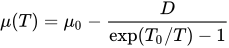
The Varshni–Chen–Gray model (sometimes referred to as the Varshni equation) has the form:
where is the shear modulus at , and and are material constants.
The Steinberg–Cochran–Guinan (SCG) shear modulus model is pressure dependent and has the form
where, μ0 is the shear modulus at the reference state (T = 300 K, p = 0, η = 1), p is the pressure, and T is the temperature.
The Nadal–Le Poac (NP) shear modulus model is a modified version of the SCG model. The empirical temperature dependence of the shear modulus in the SCG model is replaced with an equation based on Lindemann melting theory. The NP shear modulus model has the form:
where
and μ0 is the shear modulus at absolute zero and ambient pressure, ζ is an area, m is the atomic mass, and f is the Lindemann constant.
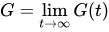
The shear relaxation modulus is the time-dependent generalization of the shear modulus[19] :
{{cite book}}: ISBN / Date incompatibility (help)CS1 maint: multiple names: authors list (link)
{{cite book}}: CS1 maint: multiple names: authors list (link) CS1 maint: numeric names: authors list (link)
| 3D Formulae | |||||||
|---|---|---|---|---|---|---|---|
| Knowns | Bulk modulus (K) | Young's modulus (E) | Lamé's first parameter (λ) | Shear modulus (G) | Poisson's ratio (ν) | P-wave modulus (M) | Notes |
| (K, E) | 3K(1 + 6K/E − 9K) | E/3 − E/3K | 1/2 − E/6K | 3K + E/3 − E/3K | |||
| (K, λ) | 9K(K − λ)/3K − λ | 3(K − λ)/2 | λ/3K − λ | 3K − 2λ | |||
| (K, G) | 9KG/3K + G | K − 2G/3 | 3K − 2G/6K + 2G | K + 4G/3 | |||
| (K, ν) | 3K(1 − 2ν) | 3Kν/1 + ν | 3K(1 − 2ν)/2(1 + ν) | 3K(1 − ν)/1 + ν | |||
| (K, M) | 9K(M − K)/3K + M | 3K − M/2 | 3(M − K)/4 | 3K − M/3K + M | |||
| (E, λ) | E + 3λ + R/6 | E − 3λ + R/4 | − E + R/4λ − 1/4 | E − λ + R/2 | R = ±(E2 + 9λ2 + 2Eλ)1/2 | ||
| (E, G) | EG/3(3G − E) | G(E − 2G)/3G − E | E/2G − 1 | G(4G − E)/3G − E | |||
| (E, ν) | E/3 − 6ν | Eν/(1 + ν)(1 − 2ν) | E/2(1 + ν) | E(1 − ν)/(1 + ν)(1 − 2ν) | |||
| (E, M) | 3M − E + S/6 | M − E + S/4 | 3M + E − S/8 | E + S/4M − 1/4 | S = ±(E2 + 9M2 − 10EM)1/2 | ||
| (λ, G) | λ + 2G/3 | G(3λ + 2G)/λ + G | λ/2(λ + G) | λ + 2G | |||
| (λ, ν) | λ/3(1 + 1/ν) | λ(1/ν − 2ν − 1) | λ(1/2ν − 1) | λ(1/ν − 1) | |||
| (λ, M) | M + 2λ/3 | (M − λ)(M+2λ)/M + λ | M − λ/2 | λ/M + λ | |||
| (G, ν) | 2G(1 + ν)/3 − 6ν | 2G(1 + ν) | 2 G ν/1 − 2ν | 2G(1 − ν)/1 − 2ν | |||
| (G, M) | M − 4G/3 | G(3M − 4G)/M − G | M − 2G | M − 2G/2M − 2G | |||
| (ν, M) | M(1 + ν)/3(1 − ν) | M(1 + ν)(1 − 2ν)/1 − ν | M ν/1 − ν | M(1 − 2ν)/2(1 − ν) | |||
| 2D Formulae | |||||||
| Knowns | (K) | (E) | (λ) | (G) | (ν) | (M) | Notes |
| (K2D, E2D) | 2K2D(2K2D − E2D)/4K2D − E2D | K2DE2D/4K2D − E2D | 2K2D − E2D/2K2D | 4K2D^2/4K2D − E2D | |||
| (K2D, λ2D) | 4K2D(K2D − λ2D)/2K2D − λ2D | K2D − λ2D | λ2D/2K2D − λ2D | 2K2D − λ2D | |||
| (K2D, G2D) | 4K2DG2D/K2D + G2D | K2D − G2D | K2D − G2D/K2D + G2D | K2D + G2D | |||
| (K2D, ν2D) | 2K2D(1 − ν2D) | 2K2Dν2D/1 + ν2D | K2D(1 − ν2D)/1 + ν2D | 2K2D/1 + ν2D | |||
| (E2D, G2D) | E2DG2D/4G2D − E2D | 2G2D(E2D − 2G2D)/4G2D − E2D | E2D/2G2D − 1 | 4G2D^2/4G2D − E2D | |||
| (E2D, ν2D) | E2D/2(1 − ν2D) | E2Dν2D/(1 + ν2D)(1 − ν2D) | E2D/2(1 + ν2D) | E2D/(1 + ν2D)(1 − ν2D) | |||
| (λ2D, G2D) | λ2D + G2D | 4G2D(λ2D + G2D)/λ2D + 2G2D | λ2D/λ2D + 2G2D | λ2D + 2G2D | |||
| (λ2D, ν2D) | λ2D(1 + ν2D)/2ν2D | λ2D(1 + ν2D)(1 − ν2D)/ν2D | λ2D(1 − ν2D)/2ν2D | λ2D/ν2D | |||
| (G2D, ν2D) | G2D(1 + ν2D)/1 − ν2D | 2G2D(1 + ν2D) | 2 G2D ν2D/1 − ν2D | 2G2D/1 − ν2D | |||
| (G2D, M2D) | M2D − G2D | 4G2D(M2D − G2D)/M2D | M2D − 2G2D | M2D − 2G2D/M2D | |||
Source: Wikipedia. Article content is retrieved live through the MediaWiki API.

In solid mechanics, the shear modulus or modulus of rigidity, denoted by G, or sometimes S or μ, is a measure of the elastic shear stiffness of a material and is defined as the ratio of shear stress to shear strain: G := τ x y γ x y = F A Δ x l = F l A Δ x τ x y = F A γ x y = Δ x l {\displaystyle {\begin{aligned}G&:={\frac {\tau _{xy}}{\gamma _{xy}}}={\frac {\frac {F}{A}}{\frac {\Delta x}{l}}}={\frac {Fl}{A\Delta x}}\\\tau _{xy}&={\frac {F}{A}}\\\gamma _{xy}&={\frac {\Delta x}{l}}\end{aligned}}} where τ x y {\textstyle \tau _{xy}} is the shear stress, γ x y {\textstyle \gamma _{xy}} is the shear strain, F {\textstyle F} is the force, A {\textstyle A} is the area, Δ x {\textstyle \Delta x} is the traverse displacement, l {\textstyle l} is the initial length or height. The derived SI unit of shear modulus is the pascal (Pa), although it is usually expressed in gigapascals (GPa) or in thousand pounds per square inch (ksi). Its dimensional form is M1L−1T−2, replacing force by mass times acceleration.

The bulk modulus ( K {\displaystyle K} or B {\displaystyle B} or k {\displaystyle k} ) of a substance is a measure of the resistance of a substance to bulk compression. It is defined as the ratio of the infinitesimal pressure increase to the resulting relative decrease of the volume. Other moduli describe the material's response (strain) to other kinds of stress: the shear modulus describes the response to shear stress and Young's modulus describes the response to normal (lengthwise stretching) stress. For a fluid, only the bulk modulus is meaningful. For a complex anisotropic solid such as wood or paper, these three moduli do not contain enough information to describe its behaviour, and one must use the full generalized Hooke's law. The reciprocal of the bulk modulus at fixed temperature is called the isothermal compressibility.

The speed of sound is the distance travelled per unit of time by a sound wave as it propagates through an elastic medium. More simply, the speed of sound is how fast vibrations travel. At 20 °C (68 °F), the speed of sound in air is about 343 m/s (1,125 ft/s; 1,235 km/h; 767 mph; 667 kn), or 1 km in 2.92 s or one mile in 4.69 s. It depends strongly on temperature as well as the medium through which a sound wave is propagating. At 0 °C (32 °F), the speed of sound in dry air (sea level 14.7 psi) is about 331 m/s (1,086 ft/s; 1,192 km/h; 740 mph; 643 kn). The speed of sound in an ideal gas depends only on its temperature and composition. The speed has a weak dependence on frequency and pressure in dry air, deviating slightly from ideal behavior. In colloquial speech, speed of sound refers to the speed of sound waves in air. The speed of sound varies from substance to substance, however: typically, sound travels most slowly in gases, faster in liquids, and fastest in solids. For example, while sound travels at 343 m/s in air, it travels in fresh water at 1481 m/s at a temperature of 20 °C (68 °F) (slightly more than 4.3 times as fast) and at 5120 m/s in iron (almost 15 times as fast). In an exceptionally stiff material such as diamond, sound travels at 12,000 m/s (39,000 ft/s), – about 35 times its speed in air and about the fastest it can travel under normal conditions. In theory, the speed of sound is actually the speed of vibrations. Sound waves in solids are composed of compression waves (just as in gases and liquids) and a different type of sound wave called a shear wave, which occurs only in solids. Shear waves in solids usually travel at different speeds than compression waves, as exhibited in seismology. The speed of compression waves in solids is determined by the medium's compressibility, shear modulus, and density. The speed of shear waves is determined only by the solid material's shear modulus and density. In fluid dynamics, the speed of sound in a fluid medium (gas or liquid) is used as a relative measure for the speed of an object moving through the medium. The ratio of the speed of an object to the speed of sound (in the same medium) is called the object's Mach number. Objects moving at speeds greater than the speed of sound (Mach1) are said to be traveling at supersonic speeds.

In materials science and solid mechanics, Poisson's ratio (symbol: ν (nu)) is a measure of the Poisson effect, the deformation (expansion or contraction) of a material in directions perpendicular to the specific direction of loading. The value of Poisson's ratio is the negative of the ratio of transverse strain to axial strain. For small values of these changes, ν is the amount of transversal elongation divided by the amount of axial compression. Most materials have Poisson's ratio values ranging between 0.0 and 0.5. For soft materials, such as rubber, where the bulk modulus is much higher than the shear modulus, Poisson's ratio is near 0.5. For open-cell polymer foams, Poisson's ratio is near zero, since the cells tend to collapse in compression. Many typical solids have Poisson's ratios in the range of 0.2 to 0.3. The ratio is named after the French mathematician and physicist Siméon Poisson.
Before the 1921 destruction of Tulsa’s Greenwood District, Black residents had created a remarkable center of business and community life. The district included stores, professional offices, entertainment venues and homes owned by Black citizens. Understanding Greenwood means learning what was built—not only what was burned.
MORE →Joe Louis.








![{\displaystyle \mu (p,T)={\frac {1}{{\mathcal {J}}\left({\hat {T}}\right)}}\left[\left(\mu _{0}+{\frac {\partial \mu }{\partial p}}{\frac {p}{\eta ^{\frac {1}{3}}}}\right)\left(1-{\hat {T}}\right)+{\frac {\rho }{Cm}}~T\right];\quad C:={\frac {\left(6\pi ^{2}\right)^{\frac {2}{3}}}{3}}f^{2}}](https://wikimedia.org/api/rest_v1/media/math/render/svg/2a44071b746c80d284fb8d0e0f1ac54b8b3e1d20)
![{\displaystyle {\mathcal {J}}({\hat {T}}):=1+\exp \left[-{\frac {1+1/\zeta }{1+\zeta /\left(1-{\hat {T}}\right)}}\right]\quad {\text{for}}\quad {\hat {T}}:={\frac {T}{T_{m}}}\in [0,6+\zeta ],}](https://wikimedia.org/api/rest_v1/media/math/render/svg/e1eaa94198fcbeba0ea126aea1b4e743ce62f1c4)