Civil Rights
Movements, leaders, victories and the continuing fight for equality.

Explore the people, places, events, achievements, struggles and stories that shaped our journey.
Movements, leaders, victories and the continuing fight for equality.
Innovation, patents, science, technology and world-changing contributions.
Pioneers, champions, Negro Leagues, records, activism and excellence.
Meet the people whose lives, choices and achievements shaped the journey.
Black towns, communities, institutions and places where history happened.
Moments that changed communities, movements, institutions and the nation.
In 1968 Shirley Chisholm became the first Black woman elected to the United States Congress. In 1972 she launched a campaign for the Democratic presidential nomination, breaking another political barrier.
MORE →Reflects the personal views, recollections, and perspective of the author, Mike Davis.
This is a personal recollection on the Move fire on May 13, 1985
 | ||||||||||||||||||||||||||||||||||||||||||||||||
| Greek alphabet | ||||||||||||||||||||||||||||||||||||||||||||||||
|---|---|---|---|---|---|---|---|---|---|---|---|---|---|---|---|---|---|---|---|---|---|---|---|---|---|---|---|---|---|---|---|---|---|---|---|---|---|---|---|---|---|---|---|---|---|---|---|---|
|
||||||||||||||||||||||||||||||||||||||||||||||||
| History | ||||||||||||||||||||||||||||||||||||||||||||||||
|
||||||||||||||||||||||||||||||||||||||||||||||||
| Diacritics and other symbols | ||||||||||||||||||||||||||||||||||||||||||||||||
| Related topics | ||||||||||||||||||||||||||||||||||||||||||||||||
Sigma (/ˈsɪɡmə/ ⓘ SIG-mə;[1] uppercase Σ, lowercase σ, lowercase in word-final position ς; Greek: σίγμα) is the eighteenth letter of the Greek alphabet. When it is used at the end of a letter-case word (one that does not use all caps), the final form (ς) is used. In Ὀδυσσεύς (Odysseus), for example, the two lowercase sigmas (σ) in the center of the name are distinct from the word-final sigma (ς) at the end.
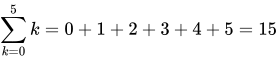
In the system of Greek numerals, sigma has a value of 200. In general mathematics, Σ is used as an operator for summation. The Latin letter S derives from sigma while the Cyrillic letter Es (С) derives from a lunate form of this letter.
The shape (Σς) and alphabetic position of sigma is derived from the Phoenician letter shin (𐤔).
Sigma's original name may have been san, but due to the complicated early history of the Greek epichoric alphabets, san came to be identified as a separate letter in the Greek alphabet, represented as Ϻ.[2] Herodotus reports that "san" was the name given by the Dorians to the same letter called "sigma" by the Ionians.[i][3]
According to one hypothesis,[4] the name "sigma" may continue that of Phoenician samekh (𐤎), the letter continued through Greek xi, represented as Ξ. Alternatively, the name may have been a Greek innovation that simply meant 'hissing', from the root of σίζω (sízō, from Proto-Greek *sig-jō 'I hiss').[2]


In handwritten Greek during the Hellenistic period (4th–3rd century BC), the epigraphic form of Σ was simplified into a C-like shape,[5] which has also been found on coins from the 4th century BC onward.[6] This became the universal standard form of sigma during late antiquity and the Middle Ages.
Today, it is known as lunate sigma (uppercase Ϲ, lowercase ϲ), because of its crescent-like shape, and is still widely used in decorative typefaces in Greece, especially in religious and church contexts (i.e. the Christogram ΙϹ ΧϹ), as well as in some modern print editions of classical Greek texts.
A dotted lunate sigma (sigma periestigmenon, Ͼ) was used by Aristarchus of Samothrace (220–143 BC) as an editorial sign indicating that the line thus marked is at an incorrect position. Similarly, a reversed sigma (antisigma, Ͻ), may mark a line that is out of place. A dotted antisigma (antisigma periestigmenon, Ͽ) may indicate a line after which rearrangements should be made, or to variant readings of uncertain priority.
In Greek inscriptions from the late first century BC onwards, Ͻ was an abbreviation indicating that a man's father's name is the same as his own name, thus Dionysodoros Dionysodorou (Dionysodoros son of Dionysodoros) would be written Διονυσόδωρος Ͻ.[7][8]
In Unicode, the above variations of lunate sigma are encoded as U+03F9 Ϲ GREEK CAPITAL LUNATE SIGMA SYMBOL; U+03FD Ͻ GREEK CAPITAL REVERSED LUNATE SIGMA SYMBOL, U+03FE Ͼ GREEK CAPITAL DOTTED LUNATE SIGMA SYMBOL, and U+03FF Ͽ GREEK CAPITAL REVERSED DOTTED LUNATE SIGMA SYMBOL.
Sigma was adopted in the Old Italic alphabets beginning in the 8th century BC. At that time a simplified three-stroke version, omitting the lowermost stroke, was already found in Western Greek alphabets, and was incorporated into classical Etruscan and Oscan, as well as in the earliest Latin epigraphy (early Latin S), such as the Duenos inscription. The alternation between three and four (and occasionally more than four) strokes was also adopted into the early runic alphabet (early form of the s-rune). Both the Anglo-Saxon runes and the Younger Futhark consistently use the simplified three-stroke version.
The letter С of Cyrillic script and Ⲥ of the Coptic script originates in the lunate form of Sigma.

σ normal stress
Source: Wikipedia. Article content is retrieved live through the MediaWiki API.
Sigma ( SIG-mə; uppercase Σ, lowercase σ, lowercase in word-final position ς; Greek: σίγμα) is the eighteenth letter of the Greek alphabet. When it is used at the end of a letter-case word (one that does not use all caps), the final form (ς) is used. In Ὀδυσσεύς (Odysseus), for example, the two lowercase sigmas (σ) in the center of the name are distinct from the word-final sigma (ς) at the end. In the system of Greek numerals, sigma has a value of 200. In general mathematics, Σ is used as an operator for summation. The Latin letter S derives from sigma while the Cyrillic letter Es (С) derives from a lunate form of this letter.

Sigma Chi (ΣΧ) is one of the largest North American social fraternities. The fraternity has 244 active undergraduate chapters and 152 alumni chapters in the United States and Canada and has initiated over 350,000 members. It was founded on June 28, 1855, at Miami University in Oxford, Ohio, by members who split from the Delta Kappa Epsilon fraternity. Sigma Chi is divided into seven operational entities: the Sigma Chi Fraternity, the Sigma Chi Foundation, the Sigma Chi Canadian Foundation, the Risk Management Foundation, Constantine Capital Inc., the Blue and Gold Travel Services, and the newly organized Sigma Chi Leadership Institute. According to the fraternity's constitution, "the purpose of this fraternity shall be to cultivate and maintain the high ideals of friendship, justice, and learning upon which Sigma Chi was founded."

Two Sigma Investments, LP is an American hedge fund headquartered in New York City. It uses a variety of technological methods, including artificial intelligence, machine learning, and distributed computing, for its trading strategies. The firm was run by John Overdeck and David Siegel until August 2024. Since September 30, 2024, Two Sigma has been led by co-CEOs Carter Lyons and Scott Hoffman, while founders John Overdeck and David Siegel remain co-chairmen.

The SIGMA 155 is a 155mm self-propelled howitzer manufactured by the Israeli defense company Elbit Systems being introduced into service in the Israel Defense Forces. It is slated to replace the M109 howitzer as the IDF's principal artillery system. The variant designed for Israeli use is the Ro'em, while the export variant is known as SIGMA. Both Ro'em and SIGMA are produced by Elbit America in Charleston, South Carolina. The SIGMA 155 consists of a 155mm L52 cannon mounted on an Oshkosh 10x10 LVSR based truck with a modified chassis, including an armored cabin to protect the crew. The modified truck is specially designed for SIGMA and called the Mobile Artillery Platform (MAP). The turret is remotely controlled, and the selection of ammunition rounds, loading, and gun laying functions are fully automated. The crew can conduct all firing operations from inside the cabin. The system is capable of firing eight rounds per minute, and can fire shells sequentially at different trajectories for a salvo effect. It can carry up to 40 rounds. The system can transition from travel to fire mode in one minute. During firing, hydraulically operated spades deploy on each side of the chassis to stabilize the vehicle and they retract after firing. The SIGMA 155 Ro'em has a firing range of 40 kilometers (25 miles). The variant designed for the export market is planned to have a firing range of 80 kilometers (50 miles). The SIGMA 155 system is designed for a crew of three: the mission commander, gunner, and driver. The SIGMA 155 saw its first operational firing by IDF gunners in June 2024. In December 2025 the first unit was delivered to the IDF. It is expected to be in IDF service for at least 50 years. The SIGMA 155 made its combat debut in April 2026 during the 2026 Lebanon war, when the IDF's 282nd Artillery Regiment employed it to strike rocket and anti-tank launching positions.
Before the 1921 destruction of Tulsa’s Greenwood District, Black residents had created a remarkable center of business and community life. The district included stores, professional offices, entertainment venues and homes owned by Black citizens. Understanding Greenwood means learning what was built—not only what was burned.
MORE →Brown v. Board of Education in 1954.