Civil Rights
Movements, leaders, victories and the continuing fight for equality.

Explore the people, places, events, achievements, struggles and stories that shaped our journey.
Movements, leaders, victories and the continuing fight for equality.
Innovation, patents, science, technology and world-changing contributions.
Pioneers, champions, Negro Leagues, records, activism and excellence.
Meet the people whose lives, choices and achievements shaped the journey.
Black towns, communities, institutions and places where history happened.
Moments that changed communities, movements, institutions and the nation.
In 1968 Shirley Chisholm became the first Black woman elected to the United States Congress. In 1972 she launched a campaign for the Democratic presidential nomination, breaking another political barrier.
MORE →Reflects the personal views, recollections, and perspective of the author, Mike Davis.
This is a personal recollection on the Move fire on May 13, 1985

In geometry, two triangles are said to be 5-Con or almost congruent if they are not congruent triangles but they are similar triangles and share two side lengths (of non-corresponding sides). The 5-Con triangles are important examples for understanding the solution of triangles. Indeed, knowing three angles and two sides (but not their sequence) is not enough to determine a triangle up to congruence. A triangle is said to be 5-Con capable if there is another triangle which is almost congruent to it.
The 5-Con triangles have been discussed by Pawley:,[1] and later by Jones and Peterson.[2] They are briefly mentioned by Martin Gardner in his book Mathematical Circus. Another reference is the following exercise[3]
Explain how two triangles can have five parts (sides, angles) of one triangle congruent to five parts of the other triangle, but not be congruent triangles.
A similar exercise dates back to 1955,[4] and there an earlier reference is mentioned. It is however not possible to date the first occurrence of such standard exercises about triangles.
There are infinitely many pairs of 5-Con triangles, even up to scaling.


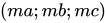
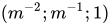
Defining almost congruent triangles gives a binary relation on the set of triangles. This relation is clearly not reflexive, but it is symmetric. It is not transitive: As a counterexample, consider the three triangles with side lengths (8;12;18), (12;18;27), and (18;27;40.5).
There are infinite sequences of triangles such that any two subsequent terms are 5-Con triangles. It is easy to construct such a sequence from any 5-Con capable triangle: To get an ascending (respectively, descending) sequence, keep the two greatest (respectively, smallest) side lengths and simply choose a third greater (respectively, smaller) side length to obtain a similar triangle. One may easily arrange the triangles in the sequence in a neat way, for example in a spiral.[1]
One generalization is considering 7-Con quadrilaterals, i.e. non-congruent (and not necessarily similar) quadrilaterals where four angles and three sides coincide or, more generally, (2n-1)-Con n-gons.[1]
Source: Wikipedia. Article content is retrieved live through the MediaWiki API.

In geometry, two triangles are said to be 5-Con or almost congruent if they are not congruent triangles but they are similar triangles and share two side lengths (of non-corresponding sides). The 5-Con triangles are important examples for understanding the solution of triangles. Indeed, knowing three angles and two sides (but not their sequence) is not enough to determine a triangle up to congruence. A triangle is said to be 5-Con capable if there is another triangle which is almost congruent to it. The 5-Con triangles have been discussed by Pawley:, and later by Jones and Peterson. They are briefly mentioned by Martin Gardner in his book Mathematical Circus. Another reference is the following exercise Explain how two triangles can have five parts (sides, angles) of one triangle congruent to five parts of the other triangle, but not be congruent triangles. A similar exercise dates back to 1955, and there an earlier reference is mentioned. It is however not possible to date the first occurrence of such standard exercises about triangles.
A similarity system of triangles is a specific configuration involving a set of triangles. A set of triangles is considered a configuration when all of the triangles share a minimum of one incidence relation with one of the other triangles present in the set. An incidence relation between triangles refers to when two triangles share a point. For example, the two triangles to the right, A H C {\displaystyle AHC} and B H C {\displaystyle BHC} , are a configuration made up of two incident relations, since points C {\displaystyle C} and H {\displaystyle H} are shared. The triangles that make up configurations are known as component triangles. Triangles must not only be a part of a configuration set to be in a similarity system, but must also be directly similar. Direct similarity implies that all angles are equal between two given triangle and that they share the same rotational sense. As is seen in the adjacent images, in the directly similar triangles, the rotation of B {\displaystyle B} onto C {\displaystyle C} and B 1 {\displaystyle B^{1}} onto C 1 {\displaystyle C^{1}} occurs in the same direction. In the opposite similar triangles, the rotation of B {\displaystyle B} onto C {\displaystyle C} and B 1 {\displaystyle B^{1}} onto C 1 {\displaystyle C^{1}} occurs in the opposite direction. In sum, a configuration is a similarity system when all triangles in the set, lie in the same plane and the following holds true: if there are n triangles in the set and n − 1 triangles are directly similar, then n triangles are directly similar.

In Euclidean geometry, two objects are similar if they have the same shape, or if one has the same shape as the mirror image of the other. More precisely, one can be obtained from the other by uniformly scaling (enlarging or reducing), possibly with additional translation, rotation and reflection. This means that either object can be rescaled, repositioned, and reflected, so as to coincide precisely with the other object. If two objects are similar, each is congruent to the result of a particular uniform scaling of the other. For example, all circles are similar to each other, all squares are similar to each other, and all equilateral triangles are similar to each other. On the other hand, ellipses are not generally similar to each other, rectangles are not generally similar to each other, and isosceles triangles are not generally similar to each other. This is because two ellipses can have different width to height ratios, two rectangles can have different length to breadth ratios, and two isosceles triangles can have different base angles. If two angles of a triangle have measures equal to the measures of two angles of another triangle, then the triangles are similar. Corresponding sides of similar polygons are in proportion, and corresponding angles of similar polygons have the same measure. Two congruent shapes are similar, with a scale factor of 1. However, some school textbooks specifically exclude congruent triangles from their definition of similar triangles by insisting that the sizes must be different if the triangles are to qualify as similar.
The intercept theorem, also known as Thales's theorem, basic proportionality theorem or side splitter theorem, is an important theorem in elementary geometry about the ratios of various line segments that are created if two rays with a common starting point are intercepted by a pair of parallels. It is equivalent to the theorem about ratios in similar triangles. It is traditionally attributed to Greek mathematician Thales. It was known to the ancient Babylonians and Egyptians, although its first known proof appears in Euclid's Elements. A mechanical device which produces geometrically-similar shapes is known as a pantograph.
Before the 1921 destruction of Tulsa’s Greenwood District, Black residents had created a remarkable center of business and community life. The district included stores, professional offices, entertainment venues and homes owned by Black citizens. Understanding Greenwood means learning what was built—not only what was burned.
MORE →Mae Jemison, aboard Space Shuttle Endeavour in 1992.