Civil Rights
Movements, leaders, victories and the continuing fight for equality.

Explore the people, places, events, achievements, struggles and stories that shaped our journey.
Movements, leaders, victories and the continuing fight for equality.
Innovation, patents, science, technology and world-changing contributions.
Pioneers, champions, Negro Leagues, records, activism and excellence.
Meet the people whose lives, choices and achievements shaped the journey.
Black towns, communities, institutions and places where history happened.
Moments that changed communities, movements, institutions and the nation.
Wilmington, North Carolina once had a thriving Black middle class and an elected interracial government. In 1898 white supremacists used violence to overthrow that government, kill Black residents and drive many others from the city.
MORE →Reflects the personal views, recollections, and perspective of the author, Mike Davis.
This is a personal recollection on the Move fire on May 13, 1985
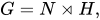
| Algebraic structure → Group theory Group theory |
|---|
 |
|
|
In abstract algebra, a normal subgroup (also known as an invariant subgroup or self-conjugate subgroup)[1] is a subgroup that is invariant under conjugation by members of the group of which it is a part. In other words, a subgroup of the group is normal in if and only if for all and The usual notation for this relation is
Normal subgroups are important because they (and only they) can be used to construct quotient groups of the given group. Furthermore, the normal subgroups of are precisely the kernels of group homomorphisms with domain which means that they can be used to internally classify those homomorphisms.
Évariste Galois was the first to realize the importance of the existence of normal subgroups.[2]
A subgroup of a group is called a normal subgroup of if it is invariant under conjugation; that is, the conjugation of an element of by an element of is always in [3] The usual notation for this relation is
For any subgroup of the following conditions are equivalent to being a normal subgroup of Therefore, any one of them may be taken as the definition.
For any group the trivial subgroup consisting of just the identity element of is always a normal subgroup of Likewise, itself is always a normal subgroup of (If these are the only normal subgroups, then is said to be simple.)[6] Other named normal subgroups of an arbitrary group include the center of the group (the set of elements that commute with all other elements) and the commutator subgroup [7][8] More generally, since conjugation is an isomorphism, any characteristic subgroup is a normal subgroup.[9]
If is an abelian group then every subgroup of is normal, because More generally, for any group , every subgroup of the center of is normal in . (In the special case that is abelian, the center is all of , hence the fact that all subgroups of an abelian group are normal.) A group that is not abelian but for which every subgroup is normal is called a Hamiltonian group.[10]
A concrete example of a normal subgroup is the subgroup of the symmetric group consisting of the identity and both three-cycles. In particular, one can check that every coset of is either equal to itself or is equal to On the other hand, the subgroup is not normal in since [11] This illustrates the general fact that any subgroup of index two is normal.
As an example of a normal subgroup within a matrix group, consider the general linear group of all invertible matrices with real entries under the operation of matrix multiplication and its subgroup of all matrices of determinant 1 (the special linear group). To see why the subgroup is normal in , consider any matrix in and any invertible matrix . Then using the two important identities and , one has that , and so as well. This means is closed under conjugation in , so it is a normal subgroup.[a]
In the Rubik's Cube group, the subgroups consisting of operations which only affect the orientations of either the corner pieces or the edge pieces are normal.[12]
The translation group is a normal subgroup of the Euclidean group in any dimension.[13] This means: applying a rigid transformation, followed by a translation and then the inverse rigid transformation, has the same effect as a single translation. By contrast, the subgroup of all rotations about the origin is not a normal subgroup of the Euclidean group, as long as the dimension is at least 2: first translating, then rotating about the origin, and then translating back will typically not fix the origin and will therefore not have the same effect as a single rotation about the origin.
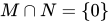
Given two normal subgroups, and of their intersection and their product are also normal subgroups of
The normal subgroups of form a lattice under subset inclusion with least element, and greatest element, The meet of two normal subgroups, and in this lattice is their intersection and the join is their product.
The lattice is complete and modular.[20]
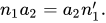
If is a normal subgroup, we can define a multiplication on cosets as follows: This relation defines a mapping To show that this mapping is well-defined, one needs to prove that the choice of representative elements does not affect the result. To this end, consider some other representative elements Then there are such that It follows that where we also used the fact that is a normal subgroup, and therefore there is such that This proves that this product is a well-defined mapping between cosets.
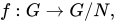
With this operation, the set of cosets is itself a group, called the quotient group and denoted with There is a natural homomorphism, given by This homomorphism maps into the identity element of which is the coset [23] that is,
In general, a group homomorphism, sends subgroups of to subgroups of Also, the preimage of any subgroup of is a subgroup of We call the preimage of the trivial group in the kernel of the homomorphism and denote it by As it turns out, the kernel is always normal and the image of is always isomorphic to (the first isomorphism theorem).[24] In fact, this correspondence is a bijection between the set of all quotient groups of and the set of all homomorphic images of (up to isomorphism).[25] It is also easy to see that the kernel of the quotient map, is itself, so the normal subgroups are precisely the kernels of homomorphisms with domain [26]
Source: Wikipedia. Article content is retrieved live through the MediaWiki API.

In group theory, a branch of mathematics, a subset of a group G is a subgroup of G if the members of that subset form a group with respect to the group operation in G. Formally, given a group G under a binary operation ∗, a subset H of G is called a subgroup of G if H also forms a group under the operation ∗. More precisely, H is a subgroup of G if the restriction of ∗ to H × H is a group operation on H. This is often denoted H ≤ G, read as "H is a subgroup of G". The trivial subgroup of any group is the subgroup {e} consisting of just the identity element. A proper subgroup of a group G is a subgroup H which is a proper subset of G (that is, H ≠ G). This is often represented notationally by H < G, read as "H is a proper subgroup of G". Some authors also exclude the trivial group from being proper (that is, H ≠ {e}). If H is a subgroup of G, then G is sometimes called an overgroup of H. The same definitions apply more generally when G is an arbitrary semigroup, but this article will only deal with subgroups of groups.
In abstract algebra, a normal subgroup (also known as an invariant subgroup or self-conjugate subgroup) is a subgroup that is invariant under conjugation by members of the group of which it is a part. In other words, a subgroup N {\displaystyle N} of the group G {\displaystyle G} is normal in G {\displaystyle G} if and only if g n g − 1 ∈ N {\displaystyle gng^{-1}\in N} for all g ∈ G {\displaystyle g\in G} and n ∈ N . {\displaystyle n\in N.} The usual notation for this relation is N ◃ G . {\displaystyle N\triangleleft G.} Normal subgroups are important because they (and only they) can be used to construct quotient groups of the given group. Furthermore, the normal subgroups of G {\displaystyle G} are precisely the kernels of group homomorphisms with domain G , {\displaystyle G,} which means that they can be used to internally classify those homomorphisms. Évariste Galois was the first to realize the importance of the existence of normal subgroups.
In mathematics, more specifically in abstract algebra, the commutator subgroup or derived subgroup of a group is the subgroup generated by all the commutators of the group. The commutator subgroup is important because it is the smallest normal subgroup such that the quotient group of the original group by this subgroup is abelian. In other words, G / N {\displaystyle G/N} is abelian if and only if N {\displaystyle N} contains the commutator subgroup of G {\displaystyle G} . So in some sense it provides a measure of how far the group is from being abelian; the larger the commutator subgroup is, the "less abelian" the group is.
In the theory of abelian groups, the torsion subgroup A T {\displaystyle A_{T}} of an abelian group A {\displaystyle A} is the subgroup of A {\displaystyle A} consisting of all elements that have finite order (the torsion elements of A {\displaystyle A} ). An abelian group A {\displaystyle A} is called a torsion group (or periodic group) if every element of A {\displaystyle A} has finite order and is called torsion-free if every element of A {\displaystyle A} except the identity is of infinite order. The proof that A T {\displaystyle A_{T}} is closed under the group operation relies on the commutativity of the operation (see examples section). If A {\displaystyle A} is abelian, then the torsion subgroup T {\displaystyle T} is a fully characteristic subgroup of A {\displaystyle A} and the factor group A / T {\displaystyle A/T} is torsion-free. There is a covariant functor from the category of abelian groups to the category of torsion groups that sends every group to its torsion subgroup and every homomorphism to its restriction to the torsion subgroup. There is another covariant functor from the category of abelian groups to the category of torsion-free groups that sends every group to its quotient by its torsion subgroup, and sends every homomorphism to the obvious induced homomorphism (which is easily seen to be well-defined). If A {\displaystyle A} is finitely generated and abelian, then it can be written as the direct sum of its torsion subgroup T {\displaystyle T} and a torsion-free subgroup (but this is not true for all infinitely generated abelian groups). In any decomposition of A {\displaystyle A} as a direct sum of a torsion subgroup S {\displaystyle S} and a torsion-free subgroup, S {\displaystyle S} must equal T {\displaystyle T} (but the torsion-free subgroup is not uniquely determined). This is a key step in the classification of finitely generated abelian groups.
Before the 1921 destruction of Tulsa’s Greenwood District, Black residents had created a remarkable center of business and community life. The district included stores, professional offices, entertainment venues and homes owned by Black citizens. Understanding Greenwood means learning what was built—not only what was burned.
MORE →The Greenwood District.





![{\displaystyle [n,g]=n^{-1}g^{-1}ng}](https://wikimedia.org/api/rest_v1/media/math/render/svg/790f6d6b3dc4cbd133dac4423c1ef93c96131068)


![{\displaystyle [G,G].}](https://wikimedia.org/api/rest_v1/media/math/render/svg/6733075f76db7d7910fae5342b94508ee54fca94)