Civil Rights
Movements, leaders, victories and the continuing fight for equality.

Explore the people, places, events, achievements, struggles and stories that shaped our journey.
Movements, leaders, victories and the continuing fight for equality.
Innovation, patents, science, technology and world-changing contributions.
Pioneers, champions, Negro Leagues, records, activism and excellence.
Meet the people whose lives, choices and achievements shaped the journey.
Black towns, communities, institutions and places where history happened.
Moments that changed communities, movements, institutions and the nation.
Katherine Johnson’s mathematical calculations helped guide some of America’s most important early space missions while she confronted the racial and gender barriers faced by Black women in twentieth-century America.
MORE →Reflects the personal views, recollections, and perspective of the author, Mike Davis.
This is a personal recollection on the Move fire on May 13, 1985
In mathematics, more specifically in abstract algebra, the commutator subgroup or derived subgroup of a group is the subgroup generated by all the commutators of the group.[1][2]
The commutator subgroup is important because it is the smallest normal subgroup such that the quotient group of the original group by this subgroup is abelian. In other words, is abelian if and only if contains the commutator subgroup of . So in some sense it provides a measure of how far the group is from being abelian; the larger the commutator subgroup is, the "less abelian" the group is.
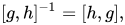
For elements and of a group G, the commutator of and is . The commutator is equal to the identity element e if and only if , that is, if and only if and commute. In general, .
However, the notation is somewhat arbitrary and there is a non-equivalent variant definition for the commutator that has the inverses on the right hand side of the equation: in which case but instead .
An element of G of the form for some g and h is called a commutator. The identity element e = [e,e] is always a commutator, and it is the only commutator if and only if G is abelian.
Here are some simple but useful commutator identities, true for any elements s, g, h of a group G:
The first and second identities imply that the set of commutators in G is closed under inversion and conjugation. If in the third identity we take H = G, we get that the set of commutators is stable under any endomorphism of G. This is in fact a generalization of the second identity, since we can take f to be the conjugation automorphism on G, , to get the second identity.
However, the product of two or more commutators need not be a commutator. A generic example is [a,b][c,d] in the free group on a,b,c,d. It is known that the least order of a finite group for which there exists two commutators whose product is not a commutator is 96; in fact there are two nonisomorphic groups of order 96 with this property.[3]
This motivates the definition of the commutator subgroup (also called the derived subgroup, and denoted or ) of G: it is the subgroup generated by all the commutators.
It follows from this definition that any element of is of the form
for some natural number , where the gi and hi are elements of G. Moreover, since , the commutator subgroup is normal in G. For any homomorphism f: G → H,
so that .
This shows that the commutator subgroup can be viewed as a functor on the category of groups, some implications of which are explored below. Moreover, taking G = H it shows that the commutator subgroup is stable under every endomorphism of G: that is, [G,G] is a fully characteristic subgroup of G, a property considerably stronger than normality.
The commutator subgroup can also be defined as the set of elements g of the group that have an expression as a product g = g1 g2 ... gk that can be rearranged to give the identity.
This construction can be iterated:
The groups are called the second derived subgroup, third derived subgroup, and so forth, and the descending normal series
is called the derived series. This should not be confused with the lower central series, whose terms are .
For a finite group, the derived series terminates in a perfect group, which may or may not be trivial. For an infinite group, the derived series need not terminate at a finite stage, and one can continue it to infinite ordinal numbers via transfinite recursion, thereby obtaining the transfinite derived series, which eventually terminates at the perfect core of the group.
Given a group , a quotient group is abelian if and only if .
The quotient is an abelian group called the abelianization of or made abelian.[4] It is usually denoted by or .
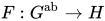
There is a useful categorical interpretation of the map . Namely is universal for homomorphisms from to an abelian group : for any abelian group and homomorphism of groups there exists a unique homomorphism such that . As usual for objects defined by universal mapping properties, this shows the uniqueness of the abelianization up to canonical isomorphism, whereas the explicit construction shows existence.
The abelianization functor is the left adjoint of the inclusion functor from the category of abelian groups to the category of groups. The existence of the abelianization functor Grp → Ab makes the category Ab a reflective subcategory of the category of groups, defined as a full subcategory whose inclusion functor has a left adjoint.
Another important interpretation of is as , the first homology group of with integral coefficients.
A group is an abelian group if and only if the derived group is trivial: [G,G] = {e}. Equivalently, if and only if the group equals its abelianization. See above for the definition of a group's abelianization.
A group is a perfect group if and only if the derived group equals the group itself: [G,G] = G. Equivalently, if and only if the abelianization of the group is trivial. This is, in a sense, the opposite of being abelian.
A group with for some n in N is called a solvable group; this is weaker than abelian, which is the case n = 1.
A group with for all n in N is called a non-solvable group.
A group with for some ordinal number, possibly infinite, is called a hypoabelian group; this is weaker than solvable, which is the case α is finite (a natural number).
Whenever a group has derived subgroup equal to itself, , it is called a perfect group. This includes non-abelian simple groups and the special linear groups for a fixed field .
Since the derived subgroup is characteristic, any automorphism of G induces an automorphism of the abelianization. Since the abelianization is abelian, inner automorphisms act trivially, hence this yields a map
Source: Wikipedia. Article content is retrieved live through the MediaWiki API.

In group theory, a branch of mathematics, a subset of a group G is a subgroup of G if the members of that subset form a group with respect to the group operation in G. Formally, given a group G under a binary operation ∗, a subset H of G is called a subgroup of G if H also forms a group under the operation ∗. More precisely, H is a subgroup of G if the restriction of ∗ to H × H is a group operation on H. This is often denoted H ≤ G, read as "H is a subgroup of G". The trivial subgroup of any group is the subgroup {e} consisting of just the identity element. A proper subgroup of a group G is a subgroup H which is a proper subset of G (that is, H ≠ G). This is often represented notationally by H < G, read as "H is a proper subgroup of G". Some authors also exclude the trivial group from being proper (that is, H ≠ {e}). If H is a subgroup of G, then G is sometimes called an overgroup of H. The same definitions apply more generally when G is an arbitrary semigroup, but this article will only deal with subgroups of groups.
In abstract algebra, a normal subgroup (also known as an invariant subgroup or self-conjugate subgroup) is a subgroup that is invariant under conjugation by members of the group of which it is a part. In other words, a subgroup N {\displaystyle N} of the group G {\displaystyle G} is normal in G {\displaystyle G} if and only if g n g − 1 ∈ N {\displaystyle gng^{-1}\in N} for all g ∈ G {\displaystyle g\in G} and n ∈ N . {\displaystyle n\in N.} The usual notation for this relation is N ◃ G . {\displaystyle N\triangleleft G.} Normal subgroups are important because they (and only they) can be used to construct quotient groups of the given group. Furthermore, the normal subgroups of G {\displaystyle G} are precisely the kernels of group homomorphisms with domain G , {\displaystyle G,} which means that they can be used to internally classify those homomorphisms. Évariste Galois was the first to realize the importance of the existence of normal subgroups.

Serpentine subgroup (part of the kaolinite-serpentine group in the category of phyllosilicates) are greenish, brownish, or spotted minerals commonly found in serpentinite. They are used as a source of magnesium and asbestos, and as decorative stone. The name comes from the greenish color and smooth or scaly appearance from the Latin serpentinus, meaning "snake-like". Serpentine subgroup is a set of common rock-forming hydrous magnesium iron phyllosilicate ((Mg,Fe)3Si2O5(OH)4) minerals, resulting from the metamorphism of the minerals that are contained in mafic to ultramafic rocks. They may contain minor amounts of other elements including chromium, manganese, cobalt or nickel. In mineralogy and gemology, serpentine may refer to any of the 20 varieties belonging to the serpentine subgroup. Owing to admixture, these varieties are not always easy to individualize, and distinctions are not usually made. There are three important mineral polymorphs of serpentine: antigorite, lizardite and chrysotile. Serpentine minerals are polymorphous, meaning that they have the same chemical formulae, but the atoms are arranged into different structures, or crystal lattices. Chrysotile, which has a fibrous habit, is one polymorph of serpentine and is one of the more important asbestos minerals. Other polymorphs in the serpentine subgroup may have a platy habit. Antigorite and lizardite are the polymorphs with platy habit. Many types of serpentine have been used for jewelry and hardstone carving, sometimes under the name "false jade" or "Teton jade".
In mathematics, more specifically in abstract algebra, the commutator subgroup or derived subgroup of a group is the subgroup generated by all the commutators of the group. The commutator subgroup is important because it is the smallest normal subgroup such that the quotient group of the original group by this subgroup is abelian. In other words, G / N {\displaystyle G/N} is abelian if and only if N {\displaystyle N} contains the commutator subgroup of G {\displaystyle G} . So in some sense it provides a measure of how far the group is from being abelian; the larger the commutator subgroup is, the "less abelian" the group is.
Before the 1921 destruction of Tulsa’s Greenwood District, Black residents had created a remarkable center of business and community life. The district included stores, professional offices, entertainment venues and homes owned by Black citizens. Understanding Greenwood means learning what was built—not only what was burned.
MORE →Madam C.J. Walker