Civil Rights
Movements, leaders, victories and the continuing fight for equality.

Explore the people, places, events, achievements, struggles and stories that shaped our journey.
Movements, leaders, victories and the continuing fight for equality.
Innovation, patents, science, technology and world-changing contributions.
Pioneers, champions, Negro Leagues, records, activism and excellence.
Meet the people whose lives, choices and achievements shaped the journey.
Black towns, communities, institutions and places where history happened.
Moments that changed communities, movements, institutions and the nation.
Wilmington, North Carolina once had a thriving Black middle class and an elected interracial government. In 1898 white supremacists used violence to overthrow that government, kill Black residents and drive many others from the city.
MORE →Reflects the personal views, recollections, and perspective of the author, Mike Davis.
This is a personal recollection on the Move fire on May 13, 1985
In mathematics and theoretical physics, a superalgebra is a -graded algebra.[1] That is, it is an algebra over a commutative ring or field with a decomposition into "even" and "odd" pieces and a multiplication operator that respects the grading.
The prefix super- comes from the theory of supersymmetry in theoretical physics. Superalgebras and their representations, supermodules, provide an algebraic framework for formulating supersymmetry. The study of such objects is sometimes called super linear algebra. Superalgebras also play an important role in related field of supergeometry where they enter into the definitions of graded manifolds, supermanifolds and superschemes.
Let be a commutative ring. In most applications, is a field of characteristic 0, such as or .
A superalgebra over is a -module with a direct sum decomposition
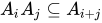
together with a bilinear multiplication such that
where the subscripts are read modulo 2, i.e. they are thought of as elements of .
A superring, or -graded ring, is a superalgebra over the ring of integers .
The elements of each of the are said to be homogeneous. The parity of a homogeneous element , denoted by , is 0 or 1 according to whether it is in or . Elements of parity 0 are said to be even and those of parity 1 to be odd. If and are both homogeneous, then so is the product and .
An associative superalgebra is one whose multiplication is associative and a unital superalgebra is one with a multiplicative identity element. The identity element in a unital superalgebra is necessarily even. Unless otherwise specified, all superalgebras in this article are assumed to be associative and unital.
A commutative superalgebra (or supercommutative algebra) is one which satisfies a graded version of commutativity. Specifically, is commutative if
for all homogeneous elements and of . There are superalgebras that are commutative in the ordinary sense, but not in the superalgebra sense. For this reason, commutative superalgebras are often called supercommutative in order to avoid confusion.[2]
When the grading arises as a "rollup" of a - or -graded algebra into even and odd components, then two distinct (but essentially equivalent) sign conventions can be found in the literature.[3] These can be called the "cohomological sign convention" and the "super sign convention". They differ in how the antipode (exchange of two elements) behaves. In the first case, one has an exchange map
where is the degree (- or -grading) of and the parity. Likewise, is the degree of and with parity This convention is commonly seen in conventional mathematical settings, such as differential geometry and differential topology. The other convention is to take
with the parities given as and the parity. This is more often seen in physics texts, and requires a parity functor to be judiciously employed to track isomorphisms. Detailed arguments are provided by Pierre Deligne.[3]
Let be a superalgebra over a commutative ring . The submodule , consisting of all even elements, is closed under multiplication and contains the identity of and therefore forms a subalgebra of , naturally called the even subalgebra. It forms an ordinary algebra over .
The set of all odd elements is an -bimodule whose scalar multiplication is just multiplication in . The product in equips with a bilinear form
such that
for all , , and in . This follows from the associativity of the product in .
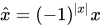
There is a canonical involutive automorphism on any superalgebra called the grade involution. It is given on homogeneous elements by
and on arbitrary elements by
where are the homogeneous parts of . If has no 2-torsion (in particular, if 2 is invertible) then the grade involution can be used to distinguish the even and odd parts of :
The supercommutator on is the binary operator given by
on homogeneous elements, extended to all of by linearity. Elements and of are said to supercommute if .
The supercenter of is the set of all elements of which supercommute with all elements of :
The supercenter of is, in general, different than the center of as an ungraded algebra. A commutative superalgebra is one whose supercenter is all of .
The graded tensor product of two superalgebras and may be regarded as a superalgebra with a multiplication rule determined by:
If either or is purely even, this is equivalent to the ordinary ungraded tensor product (except that the result is graded). However, in general, the super tensor product is distinct from the tensor product of and regarded as ordinary, ungraded algebras.
One can easily generalize the definition of superalgebras to include superalgebras over a commutative superring. The definition given above is then a specialization to the case where the base ring is purely even.
Let be a commutative superring. A superalgebra over is an -supermodule with an -bilinear multiplication that respects the grading. Bilinearity here means that
for all homogeneous elements and .
Equivalently, one may define a superalgebra over as a superring together with an superring homomorphism whose image lies in the supercenter of .
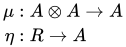
One may also define superalgebras categorically. The category of all -supermodules forms a monoidal category under the super tensor product with serving as the unit object. An associative, unital superalgebra over can then be defined as a monoid in the category of -supermodules. That is, a superalgebra is an -supermodule with two (even) morphisms
for which the usual diagrams commute.
Source: Wikipedia. Article content is retrieved live through the MediaWiki API.
In mathematics and theoretical physics, a superalgebra is a Z 2 {\displaystyle \mathbb {Z} _{2}} -graded algebra. That is, it is an algebra over a commutative ring or field with a decomposition into "even" and "odd" pieces and a multiplication operator that respects the grading. The prefix super- comes from the theory of supersymmetry in theoretical physics. Superalgebras and their representations, supermodules, provide an algebraic framework for formulating supersymmetry. The study of such objects is sometimes called super linear algebra. Superalgebras also play an important role in related field of supergeometry where they enter into the definitions of graded manifolds, supermanifolds and superschemes.
In mathematics, a Lie superalgebra is a generalisation of a Lie algebra to include a Z / 2 Z {\displaystyle \mathbb {Z} /2\mathbb {Z} } ‑grading. Lie superalgebras are important in theoretical physics where they are used to describe the mathematics of supersymmetry. The notion of Z / 2 Z {\displaystyle \mathbb {Z} /2\mathbb {Z} } grading used here is distinct from a second Z / 2 Z {\displaystyle \mathbb {Z} /2\mathbb {Z} } grading having cohomological origins. A graded Lie algebra (say, graded by Z {\displaystyle \mathbb {Z} } or N {\displaystyle \mathbb {N} } ) that is anticommutative and has a graded Jacobi identity also has a Z / 2 Z {\displaystyle \mathbb {Z} /2\mathbb {Z} } grading; this is the "rolling up" of the algebra into odd and even parts. This rolling-up is not normally referred to as "super". Thus, supergraded Lie superalgebras carry a pair of Z / 2 Z {\displaystyle \mathbb {Z} /2\mathbb {Z} } ‑gradations: one of which is supersymmetric, and the other is classical. Pierre Deligne calls the supersymmetric one the super gradation, and the classical one the cohomological gradation. These two gradations must be compatible, and there is often disagreement as to how they should be regarded.
In the mathematical field of representation theory, a representation of a Lie superalgebra L is an action of Lie superalgebra L on a Z2-graded vector space V, such that if A and B are any two pure elements of L and X and Y are any two pure elements of V, then (c1A + c2B) · X = c1A · X + c2B · X A · (c1X + c2Y) = c1A · X + c2A · Y (−1)A·X = (−1)A(−1)X [A,B] · X = A · (B · X) − (−1)ABB · (A · X). Equivalently, a representation of L is a Z2-graded representation of the universal enveloping algebra of L which respects the third equation above.
In mathematics, a Poisson superalgebra is a Z 2 {\displaystyle \mathbb {Z} _{2}} -graded associative unital algebra A = A 0 ⊕ A 1 {\displaystyle A=A_{0}\oplus A_{1}} that is equipped with a second bilinear map, [ ⋅ , ⋅ ] : A × A → A {\displaystyle [\cdot ,\cdot ]:A\times A\to A} . Let | x | {\displaystyle |x|} denote the parity of a homogeneous element x {\displaystyle x} , then ∀ x , y , z ∈ A {\displaystyle \forall x,y,z\in A} the bracket satisfies: Graded Antisymmetry: [ x , y ] = − ( − 1 ) | x | | y | [ y , x ] {\displaystyle [x,y]=-(-1)^{|x||y|}[y,x]} . Graded Jacobi Idenitity: [ x , [ y , z ] ] = [ [ x , y ] , z ] + ( − 1 ) | x | | y | [ y , [ x , z ] ] {\displaystyle [x,[y,z]]=[[x,y],z]+(-1)^{|x||y|}[y,[x,z]]} . Graded Leibniz Rule: [ x , y z ] = [ x , y ] z + ( − 1 ) | x | | y | y [ x , z ] {\displaystyle [x,yz]=[x,y]z+(-1)^{|x||y|}y[x,z]} . This is one of two possible ways of "super"izing the Poisson algebra. This gives the classical dynamics of fermion fields and classical spin-1/2 particles. The other way is to define an antibracket algebra or Gerstenhaber algebra, used in the BRST and Batalin-Vilkovisky formalism. The difference between these two is in the grading of the Lie bracket. In the Poisson superalgebra, the grading of the bracket is zero: | [ a , b ] | = | a | + | b | {\displaystyle |[a,b]|=|a|+|b|} whereas in the Gerstenhaber algebra, the bracket decreases the grading by one: | [ a , b ] | = | a | + | b | − 1 {\displaystyle |[a,b]|=|a|+|b|-1}
Before the 1921 destruction of Tulsa’s Greenwood District, Black residents had created a remarkable center of business and community life. The district included stores, professional offices, entertainment venues and homes owned by Black citizens. Understanding Greenwood means learning what was built—not only what was burned.
MORE →Brown v. Board of Education in 1954.






















![{\displaystyle [x,y]=xy-(-1)^{|x||y|}yx}](https://wikimedia.org/api/rest_v1/media/math/render/svg/fc0484e6a70a7eb05b7adebe88fbd8af1a7e0b08)
![{\displaystyle [x,y]=0}](https://wikimedia.org/api/rest_v1/media/math/render/svg/0bb3ac5611c95c794cec85401f417c5e0146185d)
![{\displaystyle \mathrm {Z} (A)=\{a\in A:[a,x]=0{\text{ for all }}x\in A\}.}](https://wikimedia.org/api/rest_v1/media/math/render/svg/0553f1ed94b374484e506caab491fac2f339e9d7)