Civil Rights
Movements, leaders, victories and the continuing fight for equality.

Explore the people, places, events, achievements, struggles and stories that shaped our journey.
Movements, leaders, victories and the continuing fight for equality.
Innovation, patents, science, technology and world-changing contributions.
Pioneers, champions, Negro Leagues, records, activism and excellence.
Meet the people whose lives, choices and achievements shaped the journey.
Black towns, communities, institutions and places where history happened.
Moments that changed communities, movements, institutions and the nation.
In August 1908, a white mob attacked Springfield, Illinois’s Black community, destroying homes and businesses and lynching two Black men. National outrage over the violence helped spur the movement that created the NAACP the following year.
MORE →Reflects the personal views, recollections, and perspective of the author, Mike Davis.
This is a personal recollection on the Move fire on May 13, 1985

In machine learning, supervised learning (SL) is a type of machine learning paradigm where an algorithm learns to map input data to a specific output based on example input-output pairs. This process involves training a statistical model using labeled data, meaning each piece of input data is provided with the correct output. The term "supervised" refers to the role of a teacher or supervisor who provides this training data, guiding the algorithm towards correct predictions.[1] For instance, if you want a model to identify cats in images, supervised learning would involve feeding it many images of cats (inputs) that are explicitly labeled "cat" (outputs).
The goal of supervised learning is for the trained model to accurately predict the output for new, unseen data.[2] This requires the algorithm to effectively generalize from the training examples, a quality measured by its generalization error. Supervised learning is commonly used for tasks such as classification (predicting a category, e.g., spam or not spam), regression (predicting a numerical value, e.g., a house price), and conditional density estimation (predicting the probability distribution of the output given an input, denoted by ).
To solve a given problem of supervised learning, the following steps must be performed:
A wide range of supervised learning algorithms are available, each with its strengths and weaknesses. There is no single learning algorithm that works best on all supervised learning problems (see the No free lunch theorem).
There are four major issues to consider in supervised learning:
A first issue is the tradeoff between bias and variance.[3] Imagine that we have available several different, but equally good, training data sets. A learning algorithm is biased for a particular input if, when trained on each of these data sets, it is systematically incorrect when predicting the correct output for . A learning algorithm has high variance for a particular input if it predicts different output values when trained on different training sets. The prediction error of a learned classifier is related to the sum of the bias and the variance of the learning algorithm.[4] Generally, there is a tradeoff between bias and variance. A learning algorithm with low bias must be "flexible" so that it can fit the data well. But if the learning algorithm is too flexible, it will fit each training data set differently, and hence have high variance. A key aspect of many supervised learning methods is that they are able to adjust this tradeoff between bias and variance (either automatically or by providing a bias/variance parameter that the user can adjust).
The second issue is of the amount of training data available relative to the complexity of the "true" function (classifier or regression function). If the true function is simple, then an "inflexible" learning algorithm with high bias and low variance will be able to learn it from a small amount of data. But if the true function is highly complex (e.g., because it involves complex interactions among many different input features and behaves differently in different parts of the input space), then the function will only be able to learn with a large amount of training data paired with a "flexible" learning algorithm with low bias and high variance.
A third issue is the dimensionality of the input space. If the input feature vectors have large dimensions, learning the function can be difficult even if the true function only depends on a small number of those features. This is because the many "extra" dimensions can confuse the learning algorithm and cause it to have high variance. Hence, input data of large dimensions typically requires tuning the classifier to have low variance and high bias. In practice, if the engineer can manually remove irrelevant features from the input data, it will likely improve the accuracy of the learned function. In addition, there are many algorithms for feature selection that seek to identify the relevant features and discard the irrelevant ones. This is an instance of the more general strategy of dimensionality reduction, which seeks to map the input data into a lower-dimensional space prior to running the supervised learning algorithm.
A fourth issue is the degree of noise in the desired output values (the supervisory target variables). If the desired output values are often incorrect (because of human error or sensor errors), then the learning algorithm should not attempt to find a function that exactly matches the training examples. Attempting to fit the data too carefully leads to overfitting. You can overfit even when there are no measurement errors (stochastic noise) if the function you are trying to learn is too complex for your learning model. In such a situation, the part of the target function that cannot be modeled "corrupts" your training data – this phenomenon has been called deterministic noise. When either type of noise is present, it is better to go with a higher bias, lower variance estimator.
In practice, there are several approaches to alleviate noise in the output values such as early stopping to prevent overfitting as well as detecting and removing the noisy training examples prior to training the supervised learning algorithm. There are several algorithms that identify noisy training examples and removing the suspected noisy training examples prior to training has decreased generalization error with statistical significance.[5][6]
Other factors to consider when choosing and applying a learning algorithm include the following:
When considering a new application, the engineer can compare multiple learning algorithms and experimentally determine which one works best on the problem at hand (see cross-validation). Tuning the performance of a learning algorithm can be very time-consuming. Given fixed resources, it is often better to spend more time collecting additional training data and more informative features than it is to spend extra time tuning the learning algorithms.
The most widely used learning algorithms are:
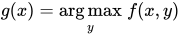
Given a set of training examples of the form such that is the feature vector of the -th example and is its label (i.e., class), a learning algorithm seeks a function , where is the input space and is the output space. The function is an element of some space of possible functions , usually called the hypothesis space. It is sometimes convenient to represent using a scoring function such that is defined as returning the value that gives the highest score: . Let denote the space of scoring functions.
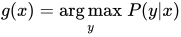
Although and can be any space of functions, many learning algorithms are probabilistic models where takes the form of a conditional probability model , or takes the form of a joint probability model . For example, naive Bayes and linear discriminant analysis are joint probability models, whereas logistic regression is a conditional probability model.
There are two basic approaches to choosing or : empirical risk minimization and structural risk minimization.[7] Empirical risk minimization seeks the function that best fits the training data. Structural risk minimization includes a penalty function that controls the bias/variance tradeoff.
In both cases, it is assumed that the training set consists of a sample of independent and identically distributed pairs, . In order to measure how well a function fits the training data, a loss function is defined. For training example , the loss of predicting the value is .
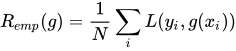
The risk of function is defined as the expected loss of . This can be estimated from the training data as
In empirical risk minimization, the supervised learning algorithm seeks the function that minimizes . Hence, a supervised learning algorithm can be constructed by applying an optimization algorithm to find .
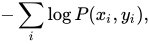
When is a conditional probability distribution and the loss function is the negative log likelihood: , then empirical risk minimization is equivalent to maximum likelihood estimation.
When contains many candidate functions or the training set is not sufficiently large, empirical risk minimization leads to high variance and poor generalization. The learning algorithm is able to memorize the training examples without generalizing well (overfitting).
Structural risk minimization seeks to prevent overfitting by incorporating a regularization penalty into the optimization. The regularization penalty can be viewed as implementing a form of Occam's razor that prefers simpler functions over more complex ones.
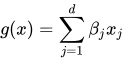
A wide variety of penalties have been employed that correspond to different definitions of complexity. For example, consider the case where the function is a linear function of the form
A popular regularization penalty is , which is the squared Euclidean norm of the weights, also known as the norm. Other norms include the norm, , and the "norm", which is the number of non-zero s. The penalty will be denoted by .
The supervised learning optimization problem is to find the function that minimizes
The parameter controls the bias-variance tradeoff. When , this gives empirical risk minimization with low bias and high variance. When is large, the learning algorithm will have high bias and low variance. The value of can be chosen empirically via cross-validation.
The complexity penalty has a Bayesian interpretation as the negative log prior probability of , , in which case is the posterior probability of .
The training methods described above are discriminative training methods, because they seek to find a function that discriminates well between the different output values (see discriminative model). For the special case where is a joint probability distribution and the loss function is the negative log likelihood a risk minimization algorithm is said to perform generative training, because can be regarded as a generative model that explains how the data were generated. Generative training algorithms are often simpler and more computationally efficient than discriminative training algorithms. In some cases, the solution can be computed in closed form as in naive Bayes and linear discriminant analysis.

There are several ways in which the standard supervised learning problem can be generalized:
Differentiable computing | |
|---|---|
| General | |
| Hardware | |
| Software libraries | |
| |
| National | |
|---|---|
| Other | |
Source: Wikipedia. Article content is retrieved live through the MediaWiki API.

In machine learning, supervised learning (SL) is a type of machine learning paradigm where an algorithm learns to map input data to a specific output based on example input-output pairs. This process involves training a statistical model using labeled data, meaning each piece of input data is provided with the correct output. The term "supervised" refers to the role of a teacher or supervisor who provides this training data, guiding the algorithm towards correct predictions. For instance, if you want a model to identify cats in images, supervised learning would involve feeding it many images of cats (inputs) that are explicitly labeled "cat" (outputs). The goal of supervised learning is for the trained model to accurately predict the output for new, unseen data. This requires the algorithm to effectively generalize from the training examples, a quality measured by its generalization error. Supervised learning is commonly used for tasks such as classification (predicting a category, e.g., spam or not spam), regression (predicting a numerical value, e.g., a house price), and conditional density estimation (predicting the probability distribution of the output given an input, denoted by p ( y ∣ x ) {\displaystyle p(y\mid x)} ).
Self-supervised learning (SSL) is a paradigm in machine learning where a model is trained on a task using the data itself to generate supervisory signals, rather than relying on externally-provided labels. In the context of neural networks, self-supervised learning aims to leverage inherent structures or relationships within the input data to create meaningful training signals. SSL tasks are designed so that solving them requires capturing essential features or relationships in the data. The input data is typically augmented or transformed in a way that creates pairs of related samples, where one sample serves as the input, and the other is used to formulate the supervisory signal. This augmentation can involve introducing noise, cropping, rotation, or other transformations. Self-supervised learning more closely imitates the way humans learn to classify objects. During SSL, the model learns in two steps. First, the task is solved based on an auxiliary or pretext classification task using pseudo-labels, which help to initialize the model parameters. Next, the actual task is performed with supervised or unsupervised learning. Self-supervised learning has produced promising results in recent years, and has found practical application in fields such as audio processing, and is being used by Facebook and others for speech recognition.
Unsupervised learning is a framework in machine learning where, in contrast to supervised learning, algorithms learn patterns exclusively from unlabeled data. Other frameworks in the spectrum of supervisions include weak- or semi-supervision, where a small portion of the data is tagged, and self-supervision. Some researchers consider self-supervised learning a form of unsupervised learning. Conceptually, unsupervised learning divides into the aspects of data, training, algorithm, and downstream applications. Typically, the dataset is harvested cheaply "in the wild", such as massive text corpus obtained by web crawling, with only minor filtering (such as Common Crawl). This compares favorably to supervised learning, where the dataset (such as the ImageNet1000) is typically constructed manually, which is much more expensive. There are algorithms designed specifically for unsupervised learning, such as clustering algorithms like k-means, dimensionality reduction techniques like principal component analysis (PCA), Boltzmann machine learning, and autoencoders. After the rise of deep learning, most large-scale unsupervised learning has been done by training general-purpose neural network architectures by gradient descent, adapted to performing unsupervised learning by designing an appropriate training procedure. Sometimes a trained model can be used as-is, but more often they are modified for downstream applications. For example, the generative pretraining method trains a model to generate a textual dataset, before finetuning it for other applications, such as text classification. As another example, autoencoders are trained to produce good features, which can then be used as a module for other models, such as in a latent diffusion model.

In machine learning and optimal control, reinforcement learning (RL) (also known as approximate dynamic programming) is concerned with how an intelligent agent should take actions in a dynamic environment in order to maximize a reward signal. Reinforcement learning is one of the three basic machine learning paradigms, alongside supervised learning and unsupervised learning. While supervised learning and unsupervised learning algorithms respectively attempt to discover patterns in labeled and unlabeled data, reinforcement learning involves training an agent through interactions with its environment. To learn to maximize rewards from these interactions, the agent makes decisions between trying new actions to learn more about the environment (exploration), or using current knowledge of the environment to take the best action (exploitation). The search for the optimal balance between these two strategies is known as the exploration–exploitation dilemma. The environment is typically stated in the form of a Markov decision process, as many reinforcement learning algorithms use dynamic programming techniques. The main difference between classical dynamic programming methods and reinforcement learning algorithms is that the latter do not assume knowledge of an exact mathematical model of the Markov decision process, and they target large Markov decision processes where exact methods become infeasible.
Before the 1921 destruction of Tulsa’s Greenwood District, Black residents had created a remarkable center of business and community life. The district included stores, professional offices, entertainment venues and homes owned by Black citizens. Understanding Greenwood means learning what was built—not only what was burned.
MORE →The Greenwood District.