Civil Rights
Movements, leaders, victories and the continuing fight for equality.

Explore the people, places, events, achievements, struggles and stories that shaped our journey.
Movements, leaders, victories and the continuing fight for equality.
Innovation, patents, science, technology and world-changing contributions.
Pioneers, champions, Negro Leagues, records, activism and excellence.
Meet the people whose lives, choices and achievements shaped the journey.
Black towns, communities, institutions and places where history happened.
Moments that changed communities, movements, institutions and the nation.
In 1968 Shirley Chisholm became the first Black woman elected to the United States Congress. In 1972 she launched a campaign for the Democratic presidential nomination, breaking another political barrier.
MORE →Reflects the personal views, recollections, and perspective of the author, Mike Davis.
This is a personal recollection on the Move fire on May 13, 1985

Thermionic emission is the liberation of charged particles from a hot electrode whose thermal energy gives some particles enough kinetic energy to escape the material's surface. The particles, sometimes called thermions in early literature, are now known to be ions or electrons. Thermal electron emission is specifically the emission of electrons and occurs when thermal energy overcomes the material's work function.
After emission, an opposite charge of magnitude equal to that of the emitted charge is initially left behind in the emitting region. But if the emitter is connected to a battery, that remaining charge is neutralized by charge supplied by the battery as particles are emitted, so the emitter will have the same charge it had before emission. This facilitates additional emission to sustain an electric current. Thomas Edison noticed this current in 1880 while inventing his light bulb, and subsequent scientists referred to the current as the Edison effect, though it wasn't until after the 1897 discovery of the electron that scientists understood that electrons were emitted and why.
Thermionic emission is crucial to the operation of a variety of electronic devices and can be used for electricity generation (such as thermionic converters and electrodynamic tethers) or cooling. Thermionic vacuum tubes emit electrons from a hot cathode into an enclosed vacuum and may steer those emitted electrons with applied voltage. The hot cathode can be a metal filament, a coated metal filament, or a separate structure of metal or carbides or borides of transition metals. Vacuum emission from metals tends to become significant only for temperatures over 1,000 K (730 °C; 1,340 °F). Charge flow increases dramatically with temperature.
The term thermionic emission is now also used to refer to any thermally-excited charge emission process, even when the charge is emitted from one solid-state region into another.
Because the electron was not identified as a separate physical particle until the work of J. J. Thomson in 1897, the word electron was not used when discussing experiments that took place before this date.
The phenomenon was initially reported in 1853 by Edmond Becquerel.[1][2][3] It was observed again in 1873 by Frederick Guthrie in Britain.[4][5] While doing work on charged objects, Guthrie discovered that a red-hot iron sphere with a negative charge would lose its charge (by somehow discharging it into air). He also found that this did not happen if the sphere had a positive charge.[6] Other early contributors included Johann Wilhelm Hittorf (1869–1883),[7][8][9][10][11][12] Eugen Goldstein (1885),[13] and Julius Elster and Hans Friedrich Geitel (1882–1889).[14][15][16][17][18]
Thermionic emission was observed again by Thomas Edison in 1880 while his team was trying to discover the reason for breakage of carbonized bamboo filaments[19] and undesired blackening of the interior surface of the bulbs in his incandescent lamps. This blackening was carbon deposited from the filament and was darkest near the positive end of the filament loop, which apparently cast a light shadow on the glass, as if negatively-charged carbon emanated from the negative end and was attracted towards and sometimes absorbed by the positive end of the filament loop. This projected carbon was deemed "electrical carrying" and initially ascribed to an effect in Crookes tubes where negatively-charged cathode rays from ionized gas move from a negative to a positive electrode. To try to redirect the charged carbon particles to a separate electrode instead of the glass, Edison did a series of experiments (a first inconclusive one is in his notebook on 13 February 1880) such as the following successful one:[20]
This effect had many applications. Edison found that the current emitted by the hot filament increased rapidly with voltage, and filed a patent for a voltage-regulating device using the effect on 15 November 1883,[21] notably the first US patent for an electronic device. He found that sufficient current would pass through the device to operate a telegraph sounder, which was exhibited at the International Electrical Exhibition of 1884 in Philadelphia. Visiting British scientist William Preece received several bulbs from Edison to investigate. Preece's 1885 paper on them referred to the one-way current through the partial vacuum as the Edison effect,[22][23] although that term is occasionally used to refer to thermionic emission itself. British physicist John Ambrose Fleming, working for the British Wireless Telegraphy Company, discovered that the Edison effect could be used to detect radio waves. Fleming went on to develop a two-element thermionic vacuum tube diode called the Fleming valve (patented 16 November 1904).[24][25][26] Thermionic diodes can also be configured to convert a heat difference to electric power directly without moving parts as a device called a thermionic converter, a type of heat engine.
Following J. J. Thomson's identification of the electron in 1897, the British physicist Owen Willans Richardson began work on the topic that he later called "thermionic emission". He received a Nobel Prize in Physics in 1928 "for his work on the thermionic phenomenon and especially for the discovery of the law named after him".
From band theory, there are one or two electrons per atom in a solid that are free to move from atom to atom. This is sometimes collectively referred to as a "sea of electrons". Their velocities follow a statistical distribution, rather than being uniform, and occasionally an electron will have enough velocity to exit the metal without being pulled back in. The minimum amount of energy needed for an electron to leave a surface is called the work function. The work function is characteristic of the material and for most metals is on the order of several electronvolts (eV). Thermionic currents can be increased by decreasing the work function. This often-desired goal can be achieved by applying various oxide coatings to the wire.
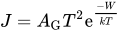
In 1901 Richardson published the results of his experiments: the current from a heated wire seemed to depend exponentially on the temperature of the wire with a mathematical form similar to the modified Arrhenius equation, .[27] Later, he proposed that the emission law should have the mathematical form[28]
where J is the emission current density, T is the temperature of the metal, W is the work function of the metal, k is the Boltzmann constant, and AG is a parameter discussed next.
In the period 1911 to 1930, as physical understanding of the behaviour of electrons in metals increased, various theoretical expressions (based on different physical assumptions) were put forward for AG, by Richardson, Saul Dushman, Ralph H. Fowler, Arnold Sommerfeld and Lothar Wolfgang Nordheim. Over 60 years later, there is still no consensus among interested theoreticians as to the exact expression of AG, but there is agreement that AG must be written in the form:
where λR is a material-specific correction factor that is typically of order 0.5, and A0 is a universal constant given by[29]
where and are the mass and charge of an electron, respectively, and is the Planck constant.
In fact, by about 1930 there was agreement that, due to the wave-like nature of electrons, some proportion rav of the outgoing electrons would be reflected as they reached the emitter surface, so the emission current density would be reduced, and λR would have the value 1 − rav. Thus, one sometimes sees the thermionic emission equation written in the form:
However, a modern theoretical treatment by Modinos assumes that the band-structure of the emitting material must also be taken into account. This would introduce a second correction factor λB into λR, giving . Experimental values for the "generalized" coefficient AG are generally of the order of magnitude of A0, but do differ significantly as between different emitting materials, and can differ as between different crystallographic faces of the same material. At least qualitatively, these experimental differences can be explained as due to differences in the value of λR.
Considerable confusion exists in the literature of this area because: (1) many sources do not distinguish between AG and A0, but just use the symbol A (and sometimes the name "Richardson constant") indiscriminately; (2) equations with and without the correction factor here denoted by λR are both given the same name; and (3) a variety of names exist for these equations, including "Richardson equation", "Dushman's equation", "Richardson–Dushman equation" and "Richardson–Laue–Dushman equation". In the literature, the elementary equation is sometimes given in circumstances where the generalized equation would be more appropriate, and this in itself can cause confusion. To avoid misunderstandings, the meaning of any "A-like" symbol should always be explicitly defined in terms of the more fundamental quantities involved.
Because of the exponential function, the current increases rapidly with temperature when kT is less than W.[further explanation needed] (For essentially every material, melting occurs well before kT = W.)
The thermionic emission law has been recently revised for 2D materials in various models.[30][31][32]

In electron emission devices, especially electron guns, the thermionic electron emitter will be biased negative relative to its surroundings. This creates an electric field of magnitude E at the emitter surface. Without the field, the surface barrier seen by an escaping Fermi-level electron has height W equal to the local work-function. The electric field lowers the surface barrier by an amount ΔW, and increases the emission current. This is known as the Schottky effect (named for Walter H. Schottky) or field enhanced thermionic emission. It can be modeled by a simple modification of the Richardson equation, by replacing W by (W − ΔW). This gives the equation[33][34]
where ε0 is the electric constant (also called the vacuum permittivity).
Electron emission that takes place in the field-and-temperature-regime where this modified equation applies is often called Schottky emission. This equation is relatively accurate for electric field strengths lower than about 108 V⋅m−1. For electric field strengths higher than 108 V⋅m−1, so-called Fowler–Nordheim (FN) tunneling begins to contribute significant emission current. In this regime, the combined effects of field-enhanced thermionic and field emission can be modeled by the Murphy-Good equation for thermo-field (T-F) emission.[35] At even higher fields, FN tunneling becomes the dominant electron emission mechanism, and the emitter operates in the so-called "cold field electron emission (CFE)" regime.
Thermionic emission can also be enhanced by interaction with other forms of excitation such as light.[36] For example, excited Cesium (Cs) vapors in thermionic converters form clusters of Cs-Rydberg matter which yield a decrease of collector emitting work function from 1.5 eV to 1.0–0.7 eV. Due to long-lived nature of Rydberg matter this low work function remains low which essentially increases the low-temperature converter's efficiency.[37]
Photon-enhanced thermionic emission (PETE) is a process developed by scientists at Stanford University that harnesses both the light and heat of the sun to generate electricity and increases the efficiency of solar power production by more than twice the current levels. The device developed for the process reaches peak efficiency above 200 °C, while most silicon solar cells become inert after reaching 100 °C. Such devices work best in parabolic dish collectors, which reach temperatures up to 800 °C. Although the team used a gallium nitride semiconductor in its proof-of-concept device, it claims that the use of gallium arsenide can increase the device's efficiency to 55–60 percent, nearly triple that of existing systems,[38][39] and 12–17 percent more than existing 43 percent multi-junction solar cells.[40][41]
{{cite book}}: CS1 maint: url-status (link)
{{cite book}}: ISBN / Date incompatibility (help)
{{cite journal}}: CS1 maint: multiple names: authors list (link)
| International | |
|---|---|
| National | |
| Other | |
Source: Wikipedia. Article content is retrieved live through the MediaWiki API.

Thermionic emission is the liberation of charged particles from a hot electrode whose thermal energy gives some particles enough kinetic energy to escape the material's surface. The particles, sometimes called thermions in early literature, are now known to be ions or electrons. Thermal electron emission is specifically the emission of electrons and occurs when thermal energy overcomes the material's work function. After emission, an opposite charge of magnitude equal to that of the emitted charge is initially left behind in the emitting region. But if the emitter is connected to a battery, that remaining charge is neutralized by charge supplied by the battery as particles are emitted, so the emitter will have the same charge it had before emission. This facilitates additional emission to sustain an electric current. Thomas Edison noticed this current in 1880 while inventing his light bulb, and subsequent scientists referred to the current as the Edison effect, though it wasn't until after the 1897 discovery of the electron that scientists understood that electrons were emitted and why. Thermionic emission is crucial to the operation of a variety of electronic devices and can be used for electricity generation (such as thermionic converters and electrodynamic tethers) or cooling. Thermionic vacuum tubes emit electrons from a hot cathode into an enclosed vacuum and may steer those emitted electrons with applied voltage. The hot cathode can be a metal filament, a coated metal filament, or a separate structure of metal or carbides or borides of transition metals. Vacuum emission from metals tends to become significant only for temperatures over 1,000 K (730 °C; 1,340 °F). Charge flow increases dramatically with temperature. The term thermionic emission is now also used to refer to any thermally-excited charge emission process, even when the charge is emitted from one solid-state region into another.

A field emission gun (FEG) is a type of electron gun in which a sharply pointed Müller-type emitter is held at several kilovolts negative potential relative to a nearby electrode, so that there is sufficient potential gradient at the emitter surface to cause field electron emission. Emitters are either of cold-cathode type, usually made of single crystal tungsten sharpened to a tip radius of about 100 nm, or of the Schottky type, in which thermionic emission is enhanced by barrier lowering in the presence of a high electric field. Schottky emitters are made by coating a tungsten tip with a layer of zirconium oxide (ZrO2) decreasing the work function of the tip by approximately 2.7 eV. In electron microscopes, a field emission gun is used to produce an electron beam that is smaller in diameter, more coherent and with up to three orders of magnitude greater current density or brightness than can be achieved with conventional thermionic emitters such as tungsten or lanthanum hexaboride (LaB6)-tipped filaments. The result in both scanning and transmission electron microscopy is significantly improved signal-to-noise ratio and spatial resolution, and greatly increased emitter life and reliability compared with thermionic devices.
Field electron emission, also known as field-induced electron emission, field emission (FE) and electron field emission, is the emission of electrons from a material placed in an electrostatic field. The most common context is field emission from a solid surface into a vacuum. However, field emission can take place from solid or liquid surfaces, into a vacuum, a fluid (e.g. air), or any non-conducting or weakly conducting dielectric. The field-induced promotion of electrons from the valence to conduction band of semiconductors (the Zener effect) can also be regarded as a form of field emission. Field emission in pure metals occurs in high electric fields: the gradients are typically higher than 1 gigavolt per metre and strongly dependent upon the work function. While electron sources based on field emission have a number of applications, field emission is most commonly an undesirable primary source of vacuum breakdown and electrical discharge phenomena, which engineers work to prevent. Examples of applications for surface field emission include the construction of bright electron sources for high-resolution electron microscopes or the discharge of induced charges from spacecraft. Devices that eliminate induced charges are termed charge-neutralizers. Historically, the phenomenon of field electron emission has been known by a variety of names, including "the aeona effect", "autoelectronic emission", "cold emission", "cold cathode emission", "field emission", "field electron emission" and "electron field emission". In some contexts (e.g. spacecraft engineering), the name "field emission" is applied to the field-induced emission of ions (field ion emission), rather than electrons, and because in some theoretical contexts "field emission" is used as a general name covering both field electron emission and field ion emission. Field emission was explained by quantum tunneling of electrons in the late 1920s. This was one of the triumphs of the nascent quantum mechanics. The theory of field emission from bulk metals was proposed by Ralph H. Fowler and Lothar Wolfgang Nordheim. A family of approximate equations, Fowler–Nordheim equations, is named after them. Strictly, Fowler–Nordheim equations apply only to field emission from bulk metals and (with suitable modification) to other bulk crystalline solids, but they are often used – as a rough approximation – to describe field emission from other materials. The related phenomena of surface photoeffect, thermionic emission (or Richardson–Dushman effect) and "cold electronic emission", i.e. the emission of electrons in strong static (or quasi-static) electric fields, were discovered and studied independently from the 1880s to 1930s. In the modern context, cold field electron emission (CFE) is the name given to a particular statistical emission regime, in which the electrons in the emitter are initially in internal thermodynamic equilibrium, and in which most emitted electrons escape by Fowler–Nordheim tunneling from electron states close to the emitter Fermi level. (By contrast, in the Schottky emission regime, most electrons escape over the top of a field-reduced barrier, from states well above the Fermi level.) Many solid and liquid materials can emit electrons in a CFE regime if an electric field of an appropriate size is applied. When the term field emission is used without qualifiers, it typically means "cold emission". For metals, the CFE regime extends to well above room temperature. There are other electron emission regimes (such as "thermal electron emission" and "Schottky emission") that require significant external heating of the emitter. There are also emission regimes where the internal electrons are not in thermodynamic equilibrium and the emission current is, partly or completely, determined by the supply of electrons to the emitting region. A non-equilibrium emission process of this kind may be called field (electron) emission if most of the electrons escape by tunneling, but strictly it is not CFE, and is not accurately described by a Fowler–Nordheim-type equation.
Thermal emission may refer to: Thermionic emission, the liberation of charged particles from an electrode due to thermal energy Thermal radiation, electromagnetic radiation generated by the thermal motion of particles in matter
Before the 1921 destruction of Tulsa’s Greenwood District, Black residents had created a remarkable center of business and community life. The district included stores, professional offices, entertainment venues and homes owned by Black citizens. Understanding Greenwood means learning what was built—not only what was burned.
MORE →Joe Louis.