Civil Rights
Movements, leaders, victories and the continuing fight for equality.

Explore the people, places, events, achievements, struggles and stories that shaped our journey.
Movements, leaders, victories and the continuing fight for equality.
Innovation, patents, science, technology and world-changing contributions.
Pioneers, champions, Negro Leagues, records, activism and excellence.
Meet the people whose lives, choices and achievements shaped the journey.
Black towns, communities, institutions and places where history happened.
Moments that changed communities, movements, institutions and the nation.
Mansa Musa was the ruler of the Mali Empire in West Africa. Details recorded here should be sourced; unknown information is left blank.
MORE →Reflects the personal views, recollections, and perspective of the author, Mike Davis.
This is a personal recollection on the Move fire on May 13, 1985
In theoretical physics orientifold is a generalization of the notion of orbifold, proposed by Augusto Sagnotti in 1987. The novelty is that in the case of string theory the non-trivial element(s) of the orbifold group includes the reversal of the orientation of the string. Orientifolding therefore produces unoriented strings—strings that carry no "arrow" and whose two opposite orientations are equivalent. Type I string theory is the simplest example of such a theory and can be obtained by orientifolding type IIB string theory.
In mathematical terms, given a smooth manifold , two discrete, freely acting, groups and and the worldsheet parity operator (such that ) an orientifold is expressed as the quotient space . If is empty, then the quotient space is an orbifold. If is not empty, then it is an orientifold.
In string theory is the compact space formed by rolling up the theory's extra dimensions, specifically a six-dimensional Calabi–Yau space. The simplest viable compact spaces are those formed by modifying a torus.
The six dimensions take the form of a Calabi–Yau for reasons of partially breaking the supersymmetry of the string theory to make it more phenomenologically viable. The Type II string theories have 32 real supercharges, and compactifying on a six-dimensional torus leaves them all unbroken. Compactifying on a more general Calabi–Yau sixfold, 3/4 of the supersymmetry is removed to yield a four-dimensional theory with 8 real supercharges (N=2). To break this further to the only non-trivial phenomenologically viable supersymmetry, N=1, half of the supersymmetry generators must be projected out and this is achieved by applying the orientifold projection.
A simpler alternative to using Calabi–Yaus to break to N=2 is to use an orbifold originally formed from a torus. In such cases it is simpler to examine the symmetry group associated to the space as the group is given in the definition of the space.
The orbifold group is restricted to those groups which work crystallographically on the torus lattice,[1] i.e. lattice preserving. is generated by an involution , not to be confused with the parameter signifying position along the length of a string. The involution acts on the holomorphic 3-form (again, not to be confused with the parity operator above) in different ways depending on the particular string formulation being used.[2]
The locus where the orientifold action reduces to the change of the string orientation is called the orientifold plane. The involution leaves the large dimensions of space-time unaffected and so orientifolds can have O-planes of at least dimension 3. In the case of it is possible that all spatial dimensions are left unchanged and O9 planes can exist. The orientifold plane in type I string theory is the spacetime-filling O9-plane.
More generally, one can consider orientifold Op-planes where the dimension p is counted in analogy with Dp-branes. O-planes and D-branes can be used within the same construction and generally carry opposite tension to one another.
However, unlike D-branes, O-planes are not dynamical. They are defined entirely by the action of the involution, not by string boundary conditions as D-branes are. Both O-planes and D-branes must be taken into account when computing tadpole constraints.
The involution also acts on the complex structure (1,1)-form J
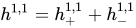
This has the result that the number of moduli parameterising the space is reduced. Since is an involution, it has eigenvalues . The (1,1)-form basis , with dimension (as defined by the Hodge diamond of the orientifold's cohomology) is written in such a way that each basis form has definite sign under . Since moduli are defined by and J must transform as listed above under , only those moduli paired with 2-form basis elements of the correct parity under survive. Therefore, creates a splitting of the cohomology as and the number of moduli used to describe the orientifold is, in general, less than the number of moduli used to describe the orbifold used to construct the orientifold.[3] Although the orientifold projects out half of the supersymmetry generators the number of moduli it projects out can vary from space to space. In some cases , in that all of the (1-1)-forms have the same parity under the orientifold projection. In such cases the way in which the different supersymmetry content enters into the moduli behaviour is through the flux dependent scalar potential the moduli experience, the N=1 case is different from the N=2 case.
Source: Wikipedia. Article content is retrieved live through the MediaWiki API.
In theoretical physics, type II string theory is a unified term that includes both type IIA strings and type IIB strings theories. Type II string theory accounts for two of the five consistent superstring theories in ten dimensions. Both theories have N = 2 {\displaystyle {\mathcal {N}}=2} extended supersymmetry which is maximal amount of supersymmetry — namely 32 supercharges — in ten dimensions. Both theories are based on oriented closed strings. On the worldsheet, they differ only in the choice of GSO projection. They were first discovered by Michael Green and John Henry Schwarz in 1982, with the terminology of type I and type II coined to classify the three string theories known at the time.
In supersymmetry, type IIB supergravity is the unique supergravity in ten dimensions with two supercharges of the same chirality. It was first constructed in 1983 by John Schwarz and independently by Paul Howe and Peter West at the level of its equations of motion. While it does not admit a fully covariant action due to the presence of a self-dual field, it can be described by an action if the self-duality condition is imposed by hand on the resulting equations of motion. The other types of supergravity in ten dimensions are type IIA supergravity, which has two supercharges of opposing chirality, and type I supergravity, which has a single supercharge. The theory plays an important role in modern physics since it is the low-energy limit of type IIB string theory.
In physics, matrix string theory is a set of equations that describe superstring theory in a non-perturbative framework. Type IIA string theory can be shown to be equivalent to a maximally supersymmetric two-dimensional gauge theory, the gauge group of which is U(N) for a large value of N. This matrix string theory was first proposed by Luboš Motl in 1997 and later independently in a more complete paper by Robbert Dijkgraaf, Erik Verlinde, and Herman Verlinde. Another matrix string theory equivalent to Type IIB string theory was constructed in 1996 by Ishibashi, Kawai, Kitazawa and Tsuchiya.
In theoretical physics orientifold is a generalization of the notion of orbifold, proposed by Augusto Sagnotti in 1987. The novelty is that in the case of string theory the non-trivial element(s) of the orbifold group includes the reversal of the orientation of the string. Orientifolding therefore produces unoriented strings—strings that carry no "arrow" and whose two opposite orientations are equivalent. Type I string theory is the simplest example of such a theory and can be obtained by orientifolding type IIB string theory. In mathematical terms, given a smooth manifold M {\displaystyle {\mathcal {M}}} , two discrete, freely acting, groups G 1 {\displaystyle G_{1}} and G 2 {\displaystyle G_{2}} and the worldsheet parity operator Ω p {\displaystyle \Omega _{p}} (such that Ω p : σ → 2 π − σ {\displaystyle \Omega _{p}:\sigma \to 2\pi -\sigma } ) an orientifold is expressed as the quotient space M / ( G 1 ∪ Ω G 2 ) {\displaystyle {\mathcal {M}}/(G_{1}\cup \Omega G_{2})} . If G 2 {\displaystyle G_{2}} is empty, then the quotient space is an orbifold. If G 2 {\displaystyle G_{2}} is not empty, then it is an orientifold.
Before the 1921 destruction of Tulsa’s Greenwood District, Black residents had created a remarkable center of business and community life. The district included stores, professional offices, entertainment venues and homes owned by Black citizens. Understanding Greenwood means learning what was built—not only what was burned.
MORE →Joe Louis.