Civil Rights
Movements, leaders, victories and the continuing fight for equality.

Explore the people, places, events, achievements, struggles and stories that shaped our journey.
Movements, leaders, victories and the continuing fight for equality.
Innovation, patents, science, technology and world-changing contributions.
Pioneers, champions, Negro Leagues, records, activism and excellence.
Meet the people whose lives, choices and achievements shaped the journey.
Black towns, communities, institutions and places where history happened.
Moments that changed communities, movements, institutions and the nation.
In 1968 Shirley Chisholm became the first Black woman elected to the United States Congress. In 1972 she launched a campaign for the Democratic presidential nomination, breaking another political barrier.
MORE →Reflects the personal views, recollections, and perspective of the author, Mike Davis.
This is a personal recollection on the Move fire on May 13, 1985

Uncomputation is a technique, used in reversible circuits, for cleaning up temporary effects on ancilla bits so that they can be re-used.[1]
Uncomputation is a fundamental step in quantum computing algorithms. Whether or not intermediate effects have been uncomputed affects how states interfere with each other when measuring results.[2]
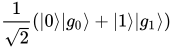
The process is primarily motivated by the principle of implicit measurement,[3][page needed] which states that discarding a register during computation is physically equivalent to measuring it. Failure to uncompute garbage registers can have unintentional consequences. For example, if we take the state where and are garbage registers. Then, if we do not apply any further operations to those registers, according to the principle of implicit measurement, the entangled state has been measured, resulting in a collapse to either or with probability . What makes this undesirable is that wave-function collapse occurs before the program terminates, and thus may not yield the expected result.
 | This quantum mechanics–related article is a stub. You can help Wikipedia by adding missing information. |
Source: Wikipedia. Article content is retrieved live through the MediaWiki API.

Uncomputation is a technique, used in reversible circuits, for cleaning up temporary effects on ancilla bits so that they can be re-used. Uncomputation is a fundamental step in quantum computing algorithms. Whether or not intermediate effects have been uncomputed affects how states interfere with each other when measuring results. The process is primarily motivated by the principle of implicit measurement, which states that discarding a register during computation is physically equivalent to measuring it. Failure to uncompute garbage registers can have unintentional consequences. For example, if we take the state {\displaystyle } 1 2 ( | 0 ⟩ | g 0 ⟩ + | 1 ⟩ | g 1 ⟩ ) {\displaystyle {\frac {1}{\sqrt {2}}}(|0\rangle |g_{0}\rangle +|1\rangle |g_{1}\rangle )} where g 0 {\displaystyle g_{0}} and g 1 {\displaystyle g_{1}} are garbage registers. Then, if we do not apply any further operations to those registers, according to the principle of implicit measurement, the entangled state has been measured, resulting in a collapse to either | 0 ⟩ | g 0 ⟩ {\displaystyle |0\rangle |g_{0}\rangle } or | 1 ⟩ | g 1 ⟩ {\displaystyle |1\rangle |g_{1}\rangle } with probability 1 2 {\displaystyle {\frac {1}{2}}} . What makes this undesirable is that wave-function collapse occurs before the program terminates, and thus may not yield the expected result.

Ancilla bits are extra bits (units of information) used in computing paradigms requiring reversible operations, such as classical reversible computing and quantum computing. Unlike classical computing, where bits can be freely set to 0 or 1, reversible computation requires all operations on computer memory to be invertible. Ancilla bits, whose initial state is known, provide the necessary "workspace" for performing operations that would otherwise erase information. They play a crucial role in implementing complex logic gates and enabling universal computation within these reversible models. In quantum computing, and unless explicitly established otherwise, the values of ancilla (qu)bits require uncomputation, as they may otherwise carry unwanted entanglement and will likely invalidate the result of the computation. Ancilla bits can simplify complex operations. For example, an ancilla bit can be used to control a Toffoli gate, effectively turning it into a simpler gate like a controlled NOT or a NOT gate.
In quantum computing, Grover's algorithm, also known as the quantum search algorithm, is a quantum algorithm for unstructured search that finds with high probability the unique input to a black box function that produces a particular output value, using just O ( N ) {\displaystyle O({\sqrt {N}})} evaluations of the function, where N {\displaystyle N} is the size of the function's domain. It was devised by an Indian-American computer scientist Lov Grover in 1996. The analogous problem in classical computation would have a query complexity O ( N ) {\displaystyle O(N)} (i.e., the function would have to be evaluated O ( N ) {\displaystyle O(N)} times: there is no better approach than trying out all input values one after the other, which, on average, takes N / 2 {\displaystyle N/2} steps). Charles H. Bennett, Ethan Bernstein, Gilles Brassard, and Umesh Vazirani proved that any quantum solution to the problem needs to evaluate the function Ω ( N ) {\displaystyle \Omega ({\sqrt {N}})} times, so Grover's algorithm is asymptotically optimal. Since classical algorithms for NP-complete problems require exponentially many steps, and Grover's algorithm provides at most a quadratic speedup over the classical solution for unstructured search, this suggests that Grover's algorithm by itself will not provide polynomial-time solutions for NP-complete problems (as the square root of an exponential function is still an exponential, not a polynomial function). Unlike other quantum algorithms, which may provide exponential speedup over their classical counterparts, Grover's algorithm provides only a quadratic speedup. However, even quadratic speedup is considerable when N {\displaystyle N} is large, and Grover's algorithm can be applied to speed up broad classes of algorithms. Grover's algorithm could brute-force a 128-bit symmetric cryptographic key in roughly 264 iterations, or a 256-bit key in roughly 2128 iterations. It may not be the case that Grover's algorithm poses a significantly increased risk to encryption over existing classical algorithms, however.

In quantum computing and specifically the quantum circuit model of computation, a quantum logic gate (or simply quantum gate) is a basic quantum circuit operating on a small number of qubits. Quantum logic gates are the building blocks of quantum circuits, like classical logic gates are for conventional digital circuits. According to quantum mechanics, a quantum system can only either evolve unitarily according to the Schrödinger equation, or be measured (sometimes called "Observed"). Quantum gates describe these unitary transformations, that occur when the system is not being measured. The expression "quantum gate" appears in relation to quantum processors, and in this context they are the logical operations that the quantum computer at the assembly language-level of abstraction (e.g. OpenQASM) can perform on the quantum data (qubits or quantum states) that they process. They can also be whole algorithms (e.g. the Quantum Fourier transform) if such algorithms contain no measurement operations. When the quantum data is measured, it is usually transformed into binary bits, which is then sent to a normal ("classical") computer. The quantum processor behaves like a coprocessor to such classical binary processors. Unlike many classical logic gates, quantum logic gates are reversible. It is possible to perform classical computing using only reversible gates. For example, the reversible Toffoli gate can implement all Boolean functions, often at the cost of having to use ancilla bits. The Toffoli gate has a direct quantum equivalent, showing that quantum circuits can perform all operations performed by classical circuits. Quantum gates are unitary operators, and are described as unitary matrices relative to some orthonormal basis. Usually the computational basis is used, which unless comparing it with something, just means that for a d-level quantum system (such as a qubit, a quantum register, or qutrits and qudits) the orthonormal basis vectors are labeled | 0 ⟩ , | 1 ⟩ , … , | d − 1 ⟩ {\displaystyle |0\rangle ,|1\rangle ,\dots ,|d-1\rangle } , or use binary notation.
Before the 1921 destruction of Tulsa’s Greenwood District, Black residents had created a remarkable center of business and community life. The district included stores, professional offices, entertainment venues and homes owned by Black citizens. Understanding Greenwood means learning what was built—not only what was burned.
MORE →Joe Louis.