Civil Rights
Movements, leaders, victories and the continuing fight for equality.

Explore the people, places, events, achievements, struggles and stories that shaped our journey.
Movements, leaders, victories and the continuing fight for equality.
Innovation, patents, science, technology and world-changing contributions.
Pioneers, champions, Negro Leagues, records, activism and excellence.
Meet the people whose lives, choices and achievements shaped the journey.
Black towns, communities, institutions and places where history happened.
Moments that changed communities, movements, institutions and the nation.
In August 1908, a white mob attacked Springfield, Illinois’s Black community, destroying homes and businesses and lynching two Black men. National outrage over the violence helped spur the movement that created the NAACP the following year.
MORE →Reflects the personal views, recollections, and perspective of the author, Mike Davis.
This is a personal recollection on the Move fire on May 13, 1985
 | This article needs more citations. (September 2020) |
| XNOR gate truth table | ||
|---|---|---|
| Input | Output | |
| A | B | A XNOR B |
| 0 | 0 | 1 |
| 0 | 1 | 0 |
| 1 | 0 | 0 |
| 1 | 1 | 1 |
| Logical connectives | ||||||||||||||||||||||||||
|---|---|---|---|---|---|---|---|---|---|---|---|---|---|---|---|---|---|---|---|---|---|---|---|---|---|---|
|
||||||||||||||||||||||||||
| Related concepts | ||||||||||||||||||||||||||
| Applications | ||||||||||||||||||||||||||
 Category Category | ||||||||||||||||||||||||||
The XNOR gate (sometimes ENOR, EXNOR, NXOR, XAND and pronounced as exclusive NOR) is a digital logic gate whose function is the logical complement of the exclusive OR (XOR) gate.[1] It is equivalent to the logical connective () from mathematical logic, also known as the material biconditional. The two-input version implements logical equality, behaving according to the truth table to the right, and hence the gate is sometimes called an "equivalence gate". A high output (1) results if both of the inputs to the gate are the same. If one but not both inputs are high (1), a low output (0) results.
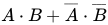
The algebraic notation used to represent the XNOR operation is . The algebraic expressions and both represent the XNOR gate with inputs A and B.
There are two symbols for XNOR gates: one with distinctive shape and one with rectangular shape and label. Both symbols for the XNOR gate are that of the XOR gate with an added inversion bubble.


XNOR gates are represented in most TTL and CMOS IC families. The standard 4000 series CMOS IC is the 4077, and the TTL IC is the 74266 (although an open-collector implementation). Both include four independent, two-input, XNOR gates. The (now obsolete) 74S135 implemented four two-input XOR/XNOR gates or two three-input XNOR gates.
Both the TTL 74LS implementation, the 74LS266, as well as the CMOS gates (CD4077, 74HC4077 and 74HC266 and so on) are available from most semiconductor manufacturers such as Texas Instruments or NXP, etc.[2] They are usually available in both through-hole DIP and SOIC formats (SOIC-14, SOC-14 or TSSOP-14).
Datasheets are readily available in most datasheet databases and suppliers.
An XNOR gate can be implemented using a NAND gate and an OR-AND-invert gate, as shown in the following picture.[3] This is based on the identity
An alternative, which is useful when inverted inputs are also available (for example from a flip-flop), uses a 2-2 AND-OR-invert gate, shown on below on the right.


CMOS implementations based on the OAI logic above can be realized with 10 transistors, as shown below. The implementation which uses both normal and inverted inputs uses 8 transistors, or 12 if inverters have to be used.


If a specific type of gate is not available, a circuit that implements the same function can be constructed from other available gates. A circuit implementing an XNOR function can be trivially constructed from an XOR gate followed by a NOT gate. If we consider the expression , we can construct an XNOR gate circuit directly using AND, OR and NOT gates. However, this approach requires five gates of three different kinds.
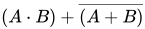
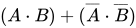
As alternative, if different gates are available we can apply Boolean algebra to transform as stated above, and apply de Morgan's Law to the last term to get which can be implemented using only three gates as shown on the right.
An XNOR gate circuit can be made from four NOR gates. In fact, both NAND and NOR gates are so-called "universal gates" and any logical function can be constructed from either NAND logic or NOR logic alone. If the four NOR gates are replaced by NAND gates, this results in an XOR gate, which can be converted to an XNOR gate by inverting the output or one of the inputs (e.g. with a fifth NAND gate).
| Desired gate | NAND construction | NOR construction |
|---|---|---|
 |
 |

|
An alternative arrangement is of five NAND gates in a topology that emphasizes the construction of the function from , noting from de Morgan's Law that a NAND gate is an inverted-input OR gate. Another alternative arrangement is of five NOR gates in a topology that emphasizes the construction of the function from , noting from de Morgan's Law that a NOR gate is an inverted-input AND gate.
| Desired gate | NAND construction | NOR construction |
|---|---|---|
|
 |

|
For the NAND constructions, the lower arrangement offers the advantage of a shorter propagation delay (the time delay between an input changing and the output changing). For the NOR constructions, the upper arrangement requires fewer gates.
From the opposite perspective, constructing other gates using only XNOR gates is possible though XNOR is not a fully universal logic gate. NOT and XOR gates can be constructed this way.
Although other gates (OR, NOR, AND, NAND) are available from manufacturers with three or more inputs per gate, this is not strictly true with XOR and XNOR gates. However, extending the concept of the binary logical operation to three inputs, the SN74S135 with two shared "C" and four independent "A" and "B" inputs for its four outputs, was a device that followed the truth table:
| Input | Output | ||
|---|---|---|---|
| A | B | C | Q |
| 0 | 0 | 0 | 1 |
| 0 | 0 | 1 | 0 |
| 0 | 1 | 0 | 0 |
| 0 | 1 | 1 | 1 |
| 1 | 0 | 0 | 0 |
| 1 | 0 | 1 | 1 |
| 1 | 1 | 0 | 1 |
| 1 | 1 | 1 | 0 |
This is effectively Q = NOT ((A XOR B) XOR C). Another way to interpret this is that the output is true if an even number of inputs are true. It does not implement a logical "equivalence" function, unlike two-input XNOR gates.

Common logical connectives | ||
|---|---|---|
 | ||
Source: Wikipedia. Article content is retrieved live through the MediaWiki API.
The XNOR gate (sometimes ENOR, EXNOR, NXOR, XAND and pronounced as exclusive NOR) is a digital logic gate whose function is the logical complement of the exclusive OR (XOR) gate. It is equivalent to the logical connective ( ↔ {\displaystyle \leftrightarrow } ) from mathematical logic, also known as the material biconditional. The two-input version implements logical equality, behaving according to the truth table to the right, and hence the gate is sometimes called an "equivalence gate". A high output (1) results if both of the inputs to the gate are the same. If one but not both inputs are high (1), a low output (0) results. The algebraic notation used to represent the XNOR operation is S = A ⊙ B {\displaystyle S=A\odot B} . The algebraic expressions ( A + B ¯ ) ⋅ ( A ¯ + B ) {\displaystyle (A+{\overline {B}})\cdot ({\overline {A}}+B)} and A ⋅ B + A ¯ ⋅ B ¯ {\displaystyle A\cdot B+{\overline {A}}\cdot {\overline {B}}} both represent the XNOR gate with inputs A and B.
Logical equivalent may refer to: Logical equivalence, in logic and mathematics Logical equality, the logical operator in propositional calculus XNOR gate, a logic gate implementing logical equality
A digital comparator or magnitude comparator is a hardware electronic device that takes two numbers as input in binary form and determines whether one number is greater than, less than or equal to the other number. Comparators are used in central processing units (CPUs) and microcontrollers (MCUs). Examples of digital comparator include the CMOS 4063 and 4585 and the TTL 7485 and 74682. An XNOR gate is a basic comparator, because its output is "1" only if its two input bits are equal. The analog equivalent of digital comparator is the voltage comparator. Many microcontrollers have analog comparators on some of their inputs that can be read or trigger an interrupt.

A logic gate is a device that performs a Boolean function, a logical operation performed on one or more binary inputs that produces a single binary output. Depending on the context, the term may refer to an ideal logic gate, one that has, for instance, zero rise time and unlimited fan-out, or it may refer to a non-ideal physical device (see ideal and real op-amps for comparison). The primary way of building logic gates uses diodes or transistors acting as electronic switches. Today, most logic gates are made from MOSFETs (metal–oxide–semiconductor field-effect transistors). They can also be constructed using vacuum tubes, electromagnetic relays with relay logic, fluidic logic, pneumatic logic, optics, molecules, acoustics, or even mechanical or thermal elements. Logic gates can be cascaded in the same way that Boolean functions can be composed, allowing the construction of a physical model of all of Boolean logic, and therefore, all of the algorithms and mathematics that can be described with Boolean logic. Logic circuits include such devices as multiplexers, registers, arithmetic logic units (ALUs), and computer memory, all the way up through complete microprocessors, which may contain more than 100 million logic gates. Compound logic gates AND-OR-invert (AOI) and OR-AND-invert (OAI) are often employed in circuit design because their construction using MOSFETs is simpler and more efficient than the sum of the individual gates. There are seven basic logic gates: NOT, OR, NOR (Negation of the OR statement), AND, NAND (Negation of the AND statement), XOR (Exclusive OR), XNOR (Negation of the Exclusive OR statement).
Before the 1921 destruction of Tulsa’s Greenwood District, Black residents had created a remarkable center of business and community life. The district included stores, professional offices, entertainment venues and homes owned by Black citizens. Understanding Greenwood means learning what was built—not only what was burned.
MORE →Mae Jemison, aboard Space Shuttle Endeavour in 1992.